 Bellingham Exterior
 Building a Deck That Actually Holds Up in Columbia
Columbia is one of Bellingham's older, established neighborhoods — a mix of home ages, mature trees, and lots that vary from flat backyards to noticeable slope as you move toward the ravines and creek corridors that cut through this part of the city. A deck built here has to do more than look good on a sunny afternoon in July. It has to survive eight or nine months of Pacific Northwest rain, the salt-laden air that rolls in off Bellingham Bay, and a shade-and-moisture combination under mature conifers and big-leaf maples that turns untreated wood green faster than most homeowners expect.
We build and repair custom decks for homes throughout Columbia and the surrounding Bellingham neighborhoods, and the same handful of climate problems show up on almost every job. This page walks through what those problems are, what a correctly built deck does about them, and how we approach the work from first visit to final walkthrough.
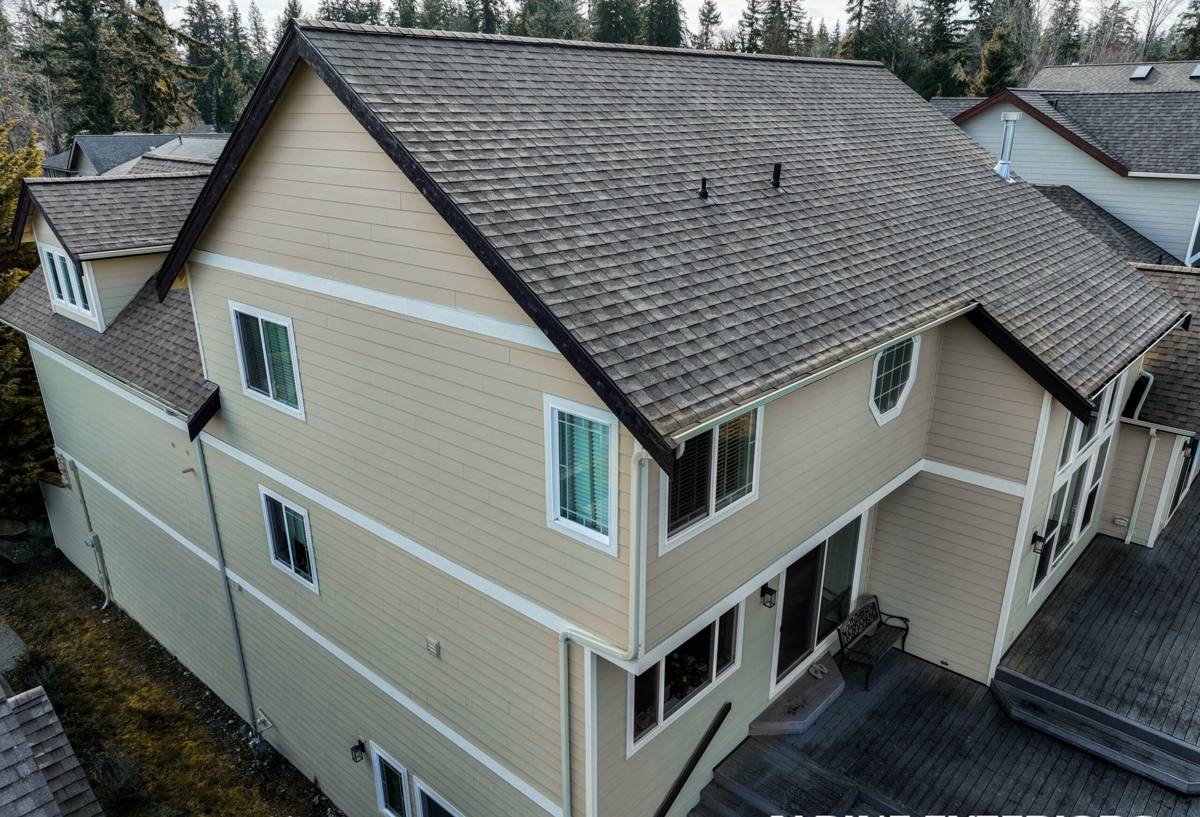
What Whatcom County Weather Does to a Deck
Whatcom County's climate is mild compared to most of the country, but "mild" is misleading. It's the combination of factors — not any single one — that wears decks out early.
Driving rain and standing moisture
Bellingham gets long stretches of steady, wind-driven rain rather than short heavy downpours. That means water gets pushed sideways into ledger boards, railing posts, and fastener heads, not just straight down onto the deck surface. Any gap in flashing or any fastener that isn't sealed properly becomes a slow, hidden entry point for moisture — the kind of problem that doesn't show up as a leak, it shows up as soft framing two or three years later.
Salt air near the bay
Homes closer to Bellingham Bay deal with a steady low-level exposure to salt in the air. Salt accelerates corrosion on anything metal — fasteners, brackets, railing hardware — and it does it quietly. A screw that looks fine on the surface can be corroding from the inside of the joist where you can't see it.
Moss, algae, and shade
Between the tree cover common in Columbia and the region's long wet season, decks here grow moss and algae faster than decks in drier climates. Moss holds moisture against the wood surface, which accelerates rot, and it makes stairs and walking surfaces genuinely slippery — that's a safety issue, not just a cosmetic one.
Choosing the Right Decking Material for This Site
There's no single "best" decking material — there's a best material for your budget, your sun/shade exposure, and how much upkeep you're willing to do. Here's how the common options actually compare once you factor in Whatcom County conditions.
| Material | Moss & moisture resistance | Maintenance | Typical lifespan | Upfront cost |
|---|---|---|---|---|
| Pressure-treated wood | Fair — needs sealing to perform well | Annual cleaning, periodic sealing/staining | 10–15 years with upkeep | $ |
| Cedar | Good natural rot resistance, still needs sealing in shade | Cleaning plus regular oil or sealer | 15–20 years with upkeep | $$ |
| Composite decking | Very good — doesn't absorb water like wood | Periodic cleaning, no staining/sealing | 25–30 years | $$$ |
| PVC decking | Excellent — fully synthetic, no organic material to feed moss | Occasional washing | 25–30+ years | $$$ |
In heavily shaded, tree-covered yards — which describes a fair number of Columbia lots — we often steer homeowners toward composite or PVC for the decking surface even if they keep real wood for framing or accent posts, simply because moss and algae get a much weaker foothold on synthetic material. That's a professional recommendation based on how these materials behave in wet shade, not a knock on wood as a product — cedar and treated lumber are fine choices when they're sealed and maintained on schedule.
Framing and Structure: What's Underneath Matters Most
The decking boards are what you see. The framing underneath is what determines whether the deck is still safe in fifteen years. Most deck failures we get called out to inspect start below the surface, not on top of it.
- Ledger board properly flashed where it meets the house, with a water-resistant barrier behind it — this is the single most common failure point on older decks
- Footings set below frost depth and sized for the actual load, not guessed at
- Joist tops protected with flashing tape so end-grain and fastener holes aren't absorbing rainwater directly
- Corrosion-resistant structural hardware rated for the fastener and lumber treatment being used together
- Positive slope away from the house so water doesn't pool against the ledger or foundation
- Adequate airflow underneath and around the framing so wood can dry out between rain events instead of staying damp
None of this is visible once the deck is finished, which is exactly why it matters that it's done right the first time. A deck that looks identical from the top can have a five-year lifespan or a thirty-year lifespan depending entirely on what the crew did with the framing, flashing, and fasteners.
Drainage, Grading, and Sloped Lots
Some Columbia properties are flat; others have real grade change, especially closer to the ravine and creek areas that run through this part of Bellingham. On sloped lots, deck design has to account for how water moves across the yard, not just how water sheds off the deck itself.
That usually means thinking through where runoff from the deck and the roofline above it is actually going, making sure footings on a slope are engineered for the soil conditions rather than treated like a flat-lot footing, and, where the deck sits low or close to grade, planning for airflow underneath so the space doesn't turn into a permanently damp pocket that grows moss and mildew even faster than the deck surface itself.
Railings, Fasteners, and Hardware for This Air
Railings and hardware take a disproportionate amount of weathering because they're the parts of the deck most exposed on all sides — rain, wind, and salt air hit them from every angle, not just from above. We spec stainless steel or coated, corrosion-rated fasteners and connectors as standard on decks in this area, particularly for anything within a few miles of the bay. It costs more than using standard galvanized hardware, but it's the difference between hardware that lasts the life of the deck and hardware that starts rust-staining the wood around it within a few seasons.
Cable, glass, and metal railing systems all hold up well here as long as the hardware and mounting brackets are rated for coastal-adjacent exposure. Wood railings need the same sealing schedule as wood decking, and they tend to show wear at the top rail first, since that's the surface catching the most direct rain.
Our Process, Start to Finish
We keep the process straightforward and try not to surprise anyone partway through.
- Site visit and assessment — we look at grade, sun/shade exposure, tree cover, existing structure if there is one, and how the deck will tie into the house
- Design and material discussion — honest talk about trade-offs between wood and composite/PVC based on your specific site, budget, and how much maintenance you actually want to do
- Permitting — most new decks and many rebuilds in Bellingham require a permit; we handle the application and inspections as part of the job
- Framing and flashing — the structural work described above, done to hold up through wet seasons, not just pass a quick glance
- Decking, railing, and finish work — installed to spec with proper fastener spacing and gapping for drainage and airflow
- Final walkthrough — we go over the finished deck with you, including basic care instructions specific to the material you chose
Living With Long Moss Season: Maintenance That Actually Works
Every deck in this climate needs some maintenance — the difference is how much, and how forgiving the material is if you fall behind.
- Sweep debris — needles, leaves, seed pods — out of board gaps regularly; trapped organic matter is what feeds moss growth
- Wash the deck surface at least once a year, more often in heavily shaded yards, with a cleaner appropriate to the material (avoid pressure-washing wood aggressively, which can damage the grain)
- Treat moss and algae early with a deck-safe cleaner rather than letting it establish — it's far easier to prevent than to remove once it's taken hold
- Reseal or restain wood decking on a regular cycle rather than waiting until it visibly needs it
- Check railing posts and stair connections annually for movement, which can signal a hardware or moisture issue underneath
- Keep gutters and downspouts above the deck clear so you're not adding extra concentrated water onto the structure
Why a Crew That Already Works Columbia Matters
A deck built to a generic national spec sheet isn't necessarily built for what Whatcom County actually throws at it. Knowing the difference between how a deck performs in a dry inland climate versus a shaded, rain-heavy, salt-air-adjacent Bellingham lot changes real decisions — material choice, fastener selection, flashing detail, and how much slope and airflow you build in underneath. A crew that already works in Columbia and the surrounding neighborhoods has seen how local decks age, which details hold up and which ones fail early, and what the City of Bellingham's permitting and inspection process actually expects.
That local track record is worth asking about directly when you're vetting any contractor for a deck project — not just here, but anywhere. It's the difference between a deck that's still solid in twenty years and one that needs major repair in five.
If you're planning a new deck or looking at replacing one that's showing its age, we're happy to come take a look and give you a straightforward, no-pressure estimate. There's a form below — reach out and we'll get a time on the calendar.