 Bellingham Exterior
 Why This Comparison Matters in Whatcom County
If you're re-siding a house in Bellingham, you've probably narrowed it down to two real contenders: vinyl and fiber cement. Both are widely available, both have decades of track record, and both get installed on homes all over the Pacific Northwest every year. The right choice isn't about which one is "better" in the abstract — it's about which one holds up to what our climate actually does to a house.
Whatcom County sits between salt water and mountains, which means our siding deals with a specific combination of stresses: near-constant moisture from October through May, salt-laden air off Bellingham Bay and the Strait of Georgia, and long stretches of shade on north-facing walls where moss and algae get a foothold and never fully dry out. Any siding product can look good on a sunny showroom day. What matters is how it performs through its fifteenth wet winter.
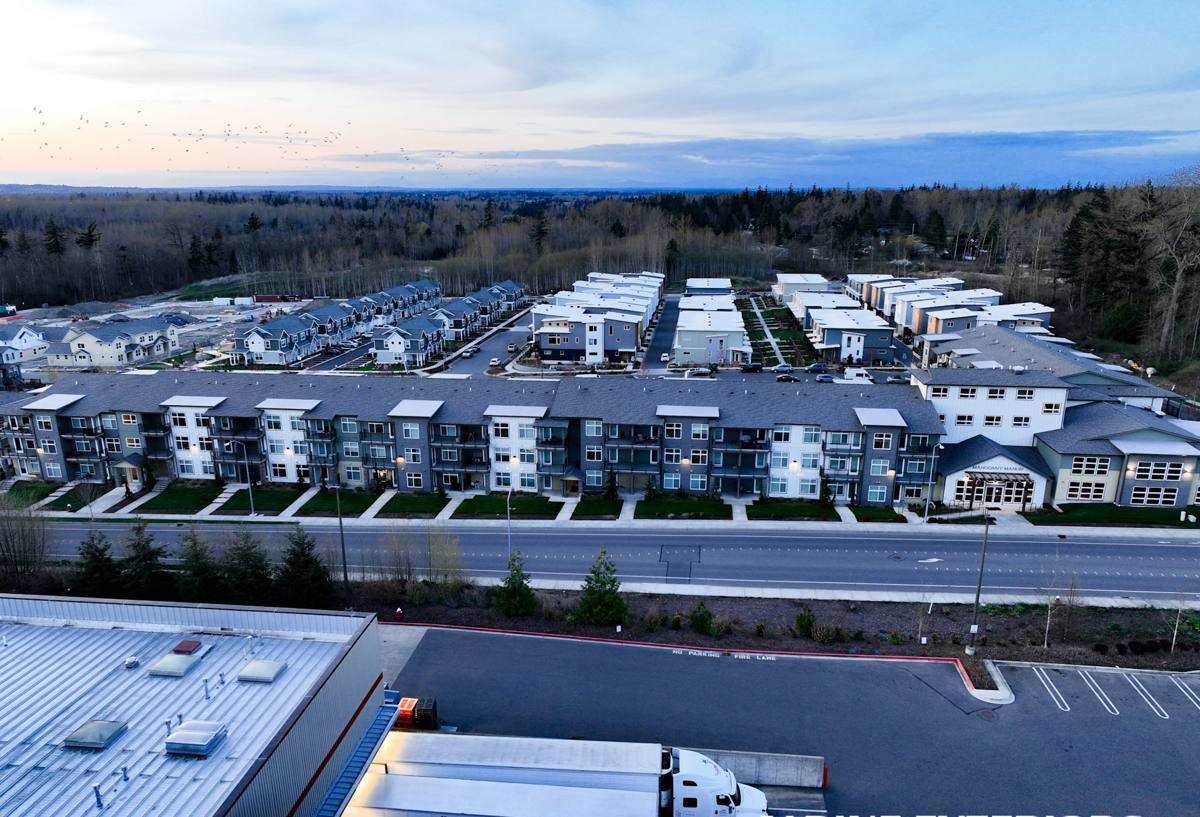
What Vinyl Siding Actually Is
Vinyl siding is an extruded PVC plastic panel, usually locked together in overlapping horizontal courses. It's been the default budget option in American residential siding since the 1980s for good reasons: it's light, it's inexpensive to manufacture and ship, it never needs painting, and a competent crew can install it quickly. For a lot of climates and a lot of budgets, it's a perfectly reasonable product.
Where Vinyl Genuinely Performs Well
- Low material cost, which keeps overall project price down
- Doesn't rot, and insects have no interest in it
- Factory color means no repainting for the life of the panel
- Fast installation lowers labor cost
- Reasonable impact resistance for its weight
Where Vinyl Struggles in Our Climate
Vinyl is a thin plastic shell hung loosely on a wall — it's designed to expand and contract with temperature, which means it's never fastened down tight. That loose-hang design is fine in dry climates. In a region with driving, wind-blown rain like ours, it creates gaps and laps where wind can push moisture behind the panel, especially on exposed west- and south-facing walls that catch storms coming off the water. Vinyl itself won't rot, but the wood sheathing and framing behind it can, quietly, for years before anyone notices a problem.
Vinyl also chalks and fades over time — UV breaks down the pigment, and darker colors fade faster and can't be repainted without specialized (and expensive) coatings, because standard paint doesn't bond well to PVC. And in the kind of prolonged, low-light dampness we get on shaded and north-facing elevations, vinyl's lapped seams and channels are excellent places for moss and green algae to establish themselves, since the panel never really sheds water fast and often traps a film of moisture against itself.
What Fiber Cement Actually Is
Fiber cement siding is a composite of Portland cement, sand, and cellulose fiber, cured into a dense, rigid board. It's heavier, it's nailed flat and tight to the wall rather than hung loose, and it behaves structurally more like a rigid board than a flexible shell. That construction is the whole reason it performs differently in wet, coastal climates — it doesn't rely on a loose fit to manage expansion, and it doesn't give wind-driven rain the same gaps to exploit.
Where Fiber Cement Genuinely Performs Well
- Dense, tight-fastened board resists wind-driven rain intrusion better than a loose-hung panel system
- Non-combustible — it will not contribute fuel to a fire
- Factory-applied finish is baked on and color-matched, not just tinted plastic
- Holds paint and factory finish far longer than raw wood, and can be recoated when it's eventually time
- Resists insects and won't rot the way solid wood siding does
- Much heavier and more impact-resistant than vinyl
The Honest Trade-Offs
Fiber cement isn't free of downsides, and we're not going to pretend otherwise. It costs more upfront than vinyl — both in material and in labor, since it's heavier to handle and requires specific fastening patterns, gapping, and caulking details to perform correctly. It has to be cut with the right tools and proper dust control, since cutting fiber cement generates silica dust. And critically: fiber cement is only as good as its installation. A panel that's face-nailed instead of properly blind-nailed, or butted tight with no expansion gap, or caulked wrong at trim, will develop problems — cracking, moisture staining — regardless of how good the underlying material is. This is a product where workmanship matters as much as the product itself.
Head-to-Head: The Practical Differences
| Factor | Vinyl Siding | Fiber Cement |
|---|---|---|
| Wind-driven rain resistance | Loose-hung, seams can allow moisture behind panel | Tight-fastened rigid board, fewer intrusion paths |
| Fire behavior | Combustible plastic, can melt/deform near heat | Non-combustible cement composite |
| Moss/algae resistance (shaded walls) | Traps moisture film in lapped seams | Sheds water more readily; still needs periodic washing |
| Impact resistance | Can crack or dent in cold weather impacts | Denser, more resistant to hail and impact |
| Color longevity | Chalks/fades; can't easily be repainted | Factory finish holds color much longer; can be recoated |
| Installation sensitivity | Relatively forgiving of installer error | Performance depends heavily on correct nailing/gapping |
| Upfront cost | Lower | Higher |
| Weight/handling | Light, easy to install quickly | Heavy, requires more labor time and specific tools |
The Salt Air and Moss Problem, Specifically
Two things about Bellingham's setting deserve their own discussion, because they're not generic "Pacific Northwest weather" talking points — they're specific to homes near Bellingham Bay, Lake Whatcom's shoreline, and the shaded, tree-covered lots common throughout Whatcom County.
Salt-laden air off the water accelerates corrosion of any exposed metal fasteners, flashing, and trim. Vinyl's fastening system relies on nails or staples through slotted holes, and those slots — plus the panel's own thermal movement — can work fasteners loose over years of expansion and contraction, exposing more metal to that salt air. Fiber cement's tight-fastened, rigid-board approach doesn't move the same way, so fastener exposure and loosening is less of a long-term concern, provided corrosion-resistant fasteners were used to begin with.
Moss and algae are a function of shade and moisture dwell time, and Bellingham has plenty of both — dense tree cover, north-facing elevations that barely see sun from October to April, and a marine layer that keeps humidity elevated even on days it isn't actively raining. Any siding will grow moss if it stays wet long enough in the shade. The difference is how much of a foothold the surface gives moss to start with and how easily it washes off. Vinyl's overlapping profile creates small ledges and channels that hold a film of moisture; a smooth, tight fiber cement lap sheds water faster and gives spores less to grab onto, though it still benefits from an occasional gentle wash on shaded walls just like any siding does.
Why We Standardized on James Hardie
We install James Hardie fiber cement exclusively — not a generic fiber cement product, and not vinyl. Hardie engineers specific product lines (their HZ5 formulation, for example) for regions like ours with heavy moisture exposure, and their ColorPlus factory finish is baked on under controlled conditions rather than field-painted, which is a meaningfully different (and more durable) process than site-applied paint on any material. Hardie also backs its products with a strong transferable warranty, which matters more than it sounds like it does — siding warranties are only as good as the company standing behind them, and a transferable warranty protects resale value too.
We made this a company standard, not a sales pitch we roll out project by project, because installation quality is the deciding factor in how any fiber cement product performs, and we didn't want to run two different skill sets and two different quality standards across our crews. Every house we side gets the same product line, the same fastening spec, and the same attention to flashing and gapping details — not a mix of "what the customer wants to pay for this week."
What to Ask Before You Decide
- Which direction do your most exposed walls face — prevailing wind and rain, or shaded and slow to dry?
- How long do you plan to own the home — resale value and warranty transferability matter more the sooner you might sell?
- What's your appetite for occasional maintenance (washing, caulk checks) versus true "install and forget"?
- Are you comparing installed quotes, not just material cost per square foot — labor and installation quality vary enormously between products?
- Is the contractor quoting you specific fastening and gapping details, or just "we'll put it up"?
Making the Right Call for Your House
Vinyl is not a bad product — it's a reasonable choice for a lot of homeowners and a lot of climates, and plenty of houses wear it fine for decades. But for a house in Bellingham facing driving rain off the water, salt air, and long shaded moss seasons, the trade-offs tend to tilt toward a heavier, tighter-fastened, non-combustible material that doesn't depend on a loose-hung fit to keep water out. That's the case for fiber cement in general, and it's why, when we do the work ourselves, we do it with Hardie specifically.
If you're weighing this decision for your own home, we're happy to walk your property, look at your specific exposures, and give you a straight answer — including telling you if vinyl would honestly serve you fine. Reach out for a free, no-pressure estimate and we'll go over what your house actually needs.