 Bellingham Exterior
 Ask five siding contractors in Whatcom County for a ballpark number and you'll likely get five different ranges. That's not because contractors are guessing — it's because siding pricing is built from a handful of variables that shift from house to house, and most homeowners never see the breakdown. This page walks through what actually moves the number up or down, so you can read a quote and understand what you're paying for instead of just comparing a bottom-line total.
Why Two "Similar" Houses Can Get Very Different Quotes
Two houses on the same block, roughly the same square footage, can land on very different siding quotes. The visible size of the house is only one input. What's underneath the old siding, how many corners and rooflines the house has, what material you choose, and how much of the sheathing needs repair before new siding goes on — those are the real cost drivers, and none of them are visible from the curb.
In Bellingham specifically, age of the house matters more than it does in drier climates. Decades of driving rain off the water, salt-laden air in the neighborhoods closer to the bay, and a moss season that runs long on north-facing walls all put steady pressure on whatever's behind the siding. A quote on an older Bellingham home often includes contingency language for sheathing repair that a quote in a drier inland market wouldn't need.
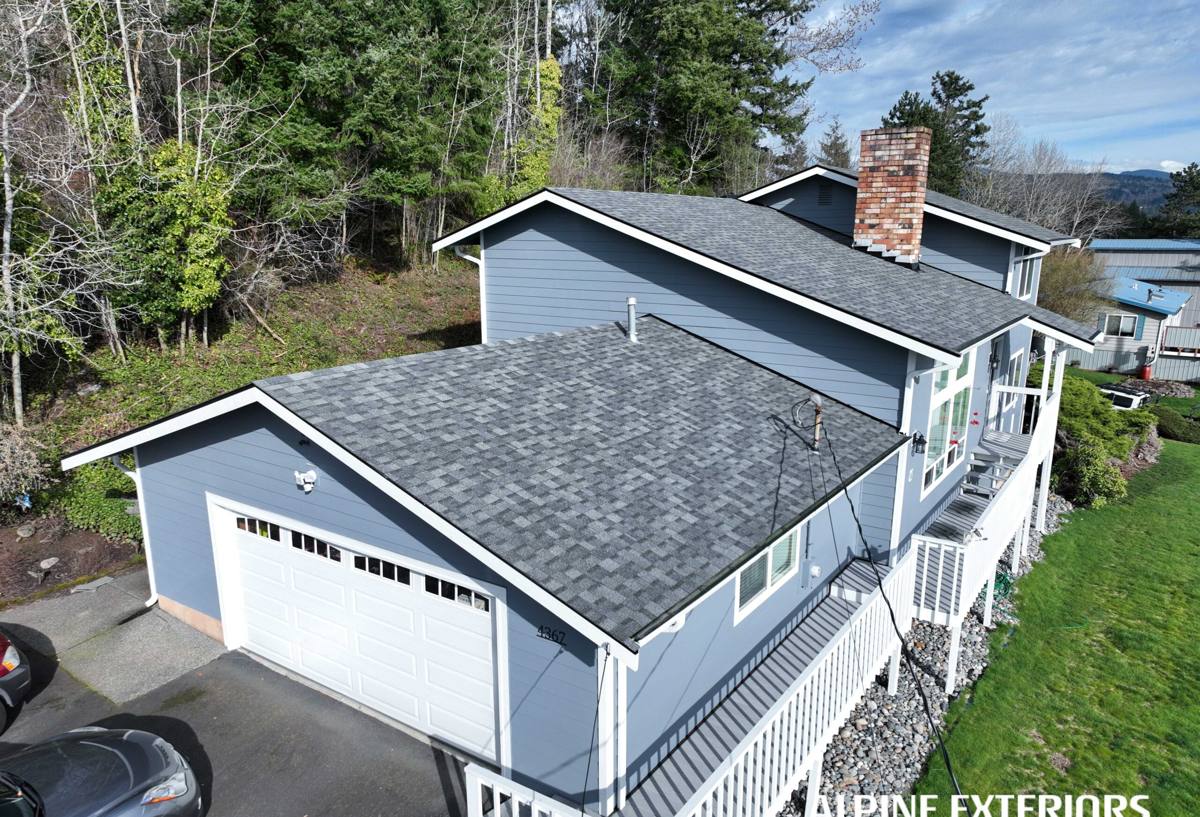
Material Choice Is the Single Biggest Lever
More than any other factor, the siding material you choose sets the range you're working within. Materials aren't interchangeable line items — they carry different labor requirements, different lifespans, and different maintenance obligations that affect the real cost over time, not just the install invoice.
| Material | Relative Install Cost | Maintenance Over Time | Fit for Bellingham's Climate |
|---|---|---|---|
| Vinyl | Lowest | Low, but prone to warping/fading; not repairable in kind after fading | Weak — can warp in temperature swings, doesn't hold up to salt air discoloration |
| Primed wood (spruce/cedar) | Moderate | High — repainting, caulking, moisture monitoring | Poor without constant upkeep — rot risk in a wet, moss-prone climate |
| LP SmartSide (engineered wood) | Moderate | Moderate — edge sealing and paint maintenance matter | Installation-sensitive — cut edges and seams need careful sealing in wet climates |
| Fiber cement (James Hardie) | Moderate to higher | Low — factory finish holds color, non-combustible, engineered for Pacific Northwest moisture | Strong — this is the material we install for a reason |
We only install James Hardie fiber cement, and we're upfront that it's not always the cheapest quote you'll get. What it buys you is a product engineered specifically for climates like ours — Hardie's HZ5 product line is formulated for the Pacific Northwest's moisture and temperature profile — plus a factory-applied ColorPlus finish that doesn't rely on field paint holding up to Bellingham's rain and salt air for the next fifteen years. We'll talk through other materials honestly if you ask, but we don't put our crews' work behind a product we don't trust in this climate.
Why We Don't Quote Every Material
Vinyl and engineered wood products can be well-made and reasonably priced, and plenty of homes wear them fine in milder climates. Our concern in Whatcom County specifically is long-term performance in sustained wet weather and salt exposure — vinyl's tendency to warp and fade, and engineered wood's dependence on perfect edge-sealing and paint maintenance to keep moisture out. Fiber cement removes both of those failure points, which is why it's the only material we stand behind.
Home Size, Shape, and Story Count
Square footage sets the baseline, but shape does more to move the number than most homeowners expect. A simple rectangular one-story ranch is the cheapest shape to side. Every additional corner, gable, dormer, and roofline intersection adds cutting, flashing, and trim work that a flat wall doesn't require. Two-story and three-story homes also cost more per square foot than single-story homes because of the scaffolding, staging, and safety equipment needed to work at height — a real factor on Bellingham's older two-and-a-half-story homes near the historic districts.
What's Under the Old Siding
This is the variable that causes the widest swing between an initial estimate and a final number, and it's almost never the contractor's fault — it's the house's history. Once old siding comes off, a few things determine whether the job proceeds as quoted or needs a change order:
- Sheathing condition — soft, delaminated, or rotted OSB/plywood has to be replaced before new siding goes up, and it's often only visible once the old siding is stripped.
- Water intrusion history — old flashing failures, missed kick-out flashing at roof-wall intersections, or poorly sealed window trim can mean hidden moisture damage that predates the current siding by years.
- House wrap and weather barrier — a failed or missing weather-resistant barrier needs to be corrected as part of the job, not just covered over.
- Insulation gaps — some re-siding jobs are a good opportunity to add continuous insulation, which changes labor and material scope.
Given how much driving rain and long wet seasons this region sees, a Bellingham home built before modern flashing standards has a meaningfully higher chance of hidden sheathing repair than the same-age home in a drier part of the state. A contractor who tells you "we won't know until it's off" isn't hedging — that's the honest answer.
Trim, Accessories, and Detail Work
Siding is rarely just flat panels. Corner boards, window and door trim, fascia, soffits, frieze boards, and any decorative detailing (board-and-batten accents, shake-style sections) all add labor and material cost beyond the field siding itself. Homes with a lot of architectural detail — multiple trim profiles, mixed siding textures, accent gables — will run higher than a home with clean, simple lines, independent of total square footage.
Labor and Installation Quality
Fiber cement in particular is installation-sensitive: proper fastening patterns, clearances from grade and roof lines, correctly lapped house wrap, and properly flashed penetrations all matter more in a wet climate than a dry one, because installation mistakes show up as moisture problems years later, not immediately. Skilled, factory-trained installation costs more than a rushed crew — and it's the difference between a Hardie installation that performs for decades and one that runs into avoidable callbacks.
Labor rates also reflect crew size, project timeline, and site access. A steep or narrow lot, limited driveway access for staging material, or tight setbacks between houses (common in some of Bellingham's older neighborhoods) can add time and cost that has nothing to do with the siding material itself.
Color and Finish Choices
With James Hardie, most homeowners choose a factory-applied ColorPlus finish rather than field-painted siding. ColorPlus costs a bit more upfront than primed material you'd paint after installation, but it comes baked with a stronger finish warranty and doesn't require repainting on the same schedule field paint does — a real consideration in a climate that's hard on exterior paint. Custom or less common colors, and mixed-material color schemes (siding plus a different trim color plus accent panels), also add modest cost over a single-color, single-texture install.
Permits, Disposal, and Site Factors
Whatcom County and the City of Bellingham require permits for full siding replacement in most cases, and permit cost is typically a small but real line item. Tear-off and disposal of old siding — especially old wood or asbestos-era siding on some vintage homes — adds cost and, in the case of hazardous materials, requires proper handling and disposal rather than a standard dumpster. If your home is older, it's worth asking your contractor directly whether they've assessed for this before work starts.
What to Ask For in a Quote
The most useful thing you can do as a homeowner isn't to chase the lowest number — it's to make sure every quote you're comparing is actually pricing the same scope of work. Use this list when reviewing bids:
- Is the material and specific product line named (not just "fiber cement" or "engineered wood" generically)?
- Does the quote include an allowance or process for sheathing repair if damage is found once old siding comes off?
- Is house wrap/weather barrier replacement included, or assumed to be reused?
- Are trim, fascia, and soffit work included, or priced separately?
- Is the finish factory-applied or field-painted, and what warranty applies to each?
- Does the quote include permit costs and disposal of old material?
- What's the manufacturer's warranty, and is it transferable if you sell the home?
The Honest Takeaway
Siding cost isn't one number — it's the sum of material, house shape, hidden condition, detail work, labor quality, and site access, and any estimate given without seeing the house is a rough starting point at best. What we can promise is a straight answer about what we find once we're actually looking at your walls, and a quote that names exactly what's included so you're not guessing at what a "final number" might grow into. If you want a clear, no-pressure look at what your specific home would need, request a free estimate below and we'll walk the property with you.