 Bellingham Exterior
 Exterior Contractor Serving Happy Valley
Happy Valley is one of Bellingham's older, well-established residential neighborhoods, sitting close to Western Washington University and the Fairhaven area on the city's south side. The housing stock here is a mix of early-to-mid-century homes and newer infill construction, many of them sitting on sloped lots with mature tree cover. That combination of age, terrain, and tree canopy shapes what these homes need from their exterior systems, and it's a big part of why we approach every Happy Valley project a little differently than a flat, newer subdivision on the edge of town.
We work on siding, roofing, windows, and decks throughout Bellingham and Whatcom County, and Happy Valley is part of our regular service area. That matters more than it sounds like it should. A crew that drives this neighborhood regularly knows what moss buildup looks like on a north-facing roof slope shaded by big conifers, knows how driving rain off the Puget Sound behaves against west-facing walls, and doesn't need a tutorial on how salt air and persistent damp change the math on which materials hold up and which ones quietly fail from the inside out.
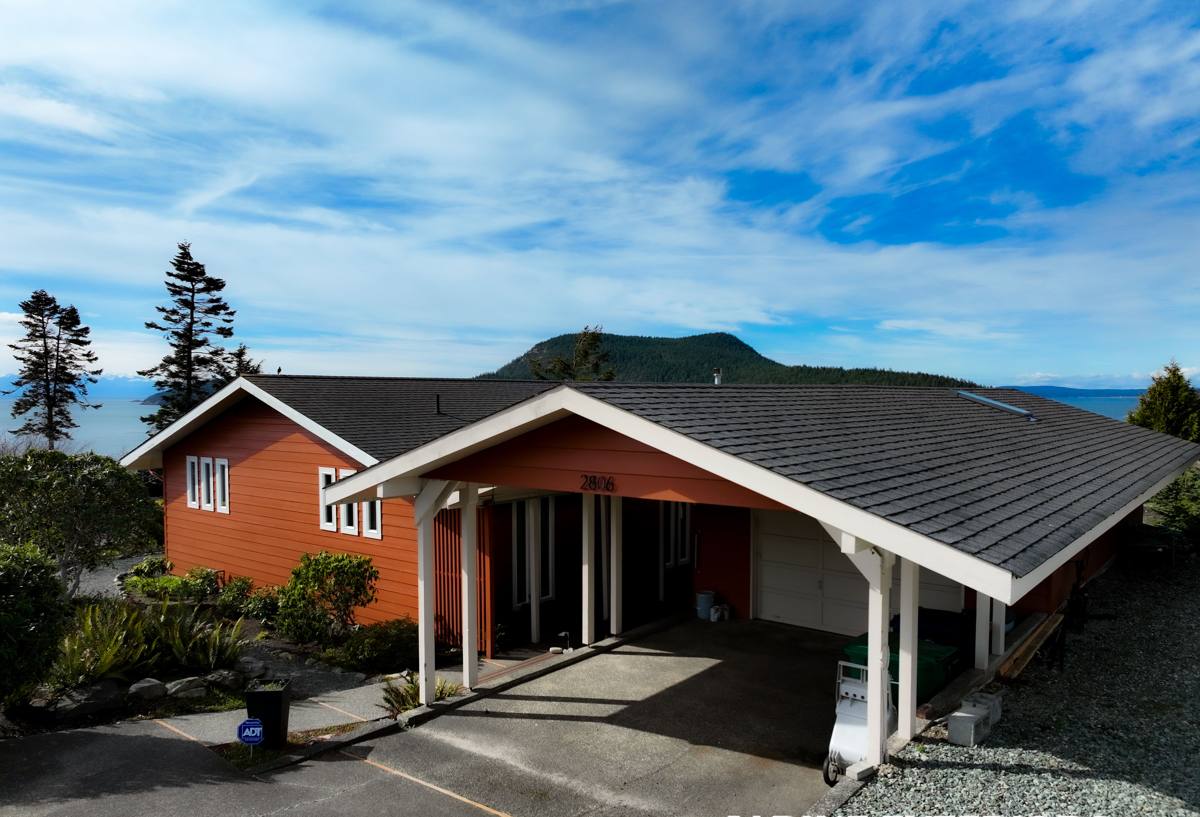
What Bellingham's Climate Does to a House
Whatcom County doesn't get the kind of dramatic weather that makes headlines, but it applies steady, unglamorous pressure to a home's exterior twelve months a year. Three things stand out:
- Salt air. Homes closer to Bellingham Bay deal with airborne moisture that carries salt and moisture together, which accelerates corrosion on fasteners, flashing, and any exterior material with a metal component.
- Driving rain. Storms off the water don't just fall straight down — wind-driven rain gets pushed sideways into wall assemblies, siding laps, and window flanges. Any gap or seam that isn't detailed correctly becomes a water path.
- A long moss and mildew season. Cool, damp, shaded conditions for much of the year mean moss, algae, and mildew get a long runway on roofs, siding, and decking, especially on the shaded, tree-covered lots common in Happy Valley.
None of this is unique to Happy Valley, but the neighborhood's mature landscaping and mixed lot orientations mean these effects show up unevenly from one house to the next, even on the same block. A home tucked under fir and cedar canopy holds moisture longer than one with more open southern exposure. That's part of why a walk-through by someone who actually knows the area is worth more than a generic estimate.
Why Older Homes Need a Closer Look
A good share of Happy Valley's housing predates modern moisture-management standards for exterior walls. That doesn't mean these homes are in trouble — many have held up fine for decades — but it does mean an exterior replacement is a good moment to check what's happening behind the old material, not just swap it out. Old siding can be hiding rotted sheathing, undersized flashing, or trapped moisture that's been slowly doing damage for years. We check for that before we quote, not after we've already started tearing things off.
Siding: Why We Only Install James Hardie
We install James Hardie fiber cement siding exclusively. We don't install vinyl, LP SmartSide, Cemplank, Allura, or primed wood species like spruce or cedar, and that's a deliberate decision, not an oversight. In a climate like Bellingham's, siding spends its life fighting moisture, temperature swings, and biological growth. The material choice determines how much of that fight the homeowner has to keep fighting themselves for the next 20-plus years.
Vinyl is inexpensive and low-maintenance in a general sense, but it's a petroleum-based product that expands and contracts with temperature, can crack in impact events, and has a ceiling on how it performs against sustained wind-driven rain at seams and laps. Wood-based products like LP SmartSide use engineered wood strand technology with a resin-saturated overlay — a real improvement over old-style hardboard, but it's still wood at its core, meaning any breach in the factory coating gives moisture a path to swell and eventually degrade the substrate, which is a bigger concern in a wet coastal climate than in drier regions. Primed cedar or spruce siding needs field-applied paint, which means a maintenance cycle homeowners have to stay on top of, and any lapse shows up as moisture damage faster here than in a dry climate. Cemplank and Allura are also fiber cement products, and structurally they compete in the same category as Hardie, but we standardized on one manufacturer so we can guarantee installation detailing, flashing practices, and warranty support without gaps between systems.
James Hardie fiber cement is cement, sand, and cellulose fiber — non-combustible, dimensionally stable across temperature and humidity swings, and finished with the ColorPlus factory-baked finish, which resists fading and chipping far better than field-applied paint. Hardie also engineers specific product lines (the HZ5 formulation) for wetter, more variable climates like ours, which is a meaningful difference from a one-size-fits-all product.
What Correct Hardie Installation Actually Involves
Fiber cement siding is only as good as the install behind it. Getting it right in this climate means:
- Proper rainscreen or drainage gap behind the siding so incidental moisture can drain and the wall can dry
- Correct flashing at every window, door, and penetration — the single most common source of hidden leaks
- Manufacturer-specified fastening and clearances so the material can move without cracking or trapping water
- Sealed and primed cut edges, since an exposed cut edge is the one place fiber cement can absorb moisture
A crew that skips any of these can install the exact same board and still produce a wall assembly that fails years early. That's the installation-sensitivity trade-off worth being honest about: Hardie is an excellent product, but it isn't foolproof against a rushed or careless install.
Roofing in a Moss-Heavy Neighborhood
Roofs in Happy Valley deal with the moss and moisture issue more directly than almost any other exterior component. Shade from mature trees keeps north- and east-facing slopes damp long after the rest of the roof has dried, and moss holds water against shingles, works into laps and fasteners, and shortens the life of the roofing system. A roof replacement or repair here isn't just about matching shingles — it's about making sure ventilation, underlayment, and flashing are set up to shed water fast and dry out between storms, and about realistic guidance on moss prevention and maintenance intervals rather than a one-time treatment that wears off in a season.
Windows and Decks: The Other Half of the Envelope
Siding and roofing get most of the attention, but windows and decks are just as exposed to the same conditions.
Older windows in Happy Valley homes often have failed seals, single-pane glass, or wood frames that have taken on decades of moisture cycling. Beyond comfort and energy costs, a failing window is a flashing and water-management problem waiting to surface at the wall around it. Replacement windows need to be integrated into the wall's water-resistive barrier correctly, not just dropped into an old opening.
Decks, meanwhile, sit outside year-round and take the full brunt of driving rain, standing moisture, and the same moss and mildew pressure as the roof. Ledger board attachment, proper flashing where the deck meets the house, and drainage away from the structure all matter more here than in a dry climate, where a sloppy detail might go unnoticed for years before it causes real damage.
Comparing Exterior Options
| Component | Common Failure Point in Bellingham's Climate | What We Prioritize |
|---|---|---|
| Siding | Moisture intrusion at laps/seams, coating failure, salt-air corrosion of fasteners | James Hardie fiber cement, correct flashing and drainage gap |
| Roofing | Moss retention on shaded slopes, degraded flashing, poor ventilation | Proper underlayment/flashing detail, realistic moss maintenance plan |
| Windows | Failed seals, old frames, poor integration with wall's water barrier | Correct flashing tie-in during install, not just unit replacement |
| Decks | Ledger rot, standing water, moss buildup on decking surface | Proper ledger flashing, drainage slope, durable decking material |
What to Check Before Hiring a Contractor Here
Happy Valley's mix of older construction and coastal climate means the stakes for a sloppy exterior job are higher than in a lot of places. Before hiring anyone for siding, roofing, window, or deck work, it's worth confirming:
- They're licensed and insured to work in Washington State, and can show proof without hesitation
- They can explain their flashing and moisture-management approach in plain language, not just brand names
- They've worked on comparable homes in Bellingham or Whatcom County, not just newer construction elsewhere
- Their warranty covers workmanship, not just the manufacturer's material warranty
- They give you a written scope of work, not just a verbal estimate
Why a Local Crew Matters for This Neighborhood
A contractor based outside the area can install siding or shingles competently in a general sense, but they haven't necessarily spent years watching how a specific neighborhood's homes age. We know what a Happy Valley roof under heavy tree cover looks like after five wet winters. We know which wall orientations in this part of Bellingham take the worst of the wind-driven rain. That local pattern recognition shapes real decisions — where we add extra flashing attention, which product line makes sense for a particular lot's exposure, and what maintenance schedule we actually recommend instead of a generic one.
If you're weighing a siding, roofing, window, or deck project on a Happy Valley home, we're happy to come take a look, tell you honestly what we see, and put together a straightforward, no-pressure estimate — no obligation either way.