 Bellingham Exterior
 Roofing Built for Happy Valley's Conditions
Happy Valley sits close enough to Bellingham Bay that salt-laden air is a constant factor in how roofing materials age here, and it's shaded and tree-lined enough in stretches that moss and moisture retention are a year-round concern rather than a seasonal one. A roof that performs well in a drier inland part of Whatcom County won't necessarily hold up the same way a few miles closer to the water. When we install a new roof in this neighborhood, we're accounting for both of those realities from the first estimate, not treating it as a standard replacement with a different address.
New roof installation is a bigger decision than most homeowners make more than once or twice in their lives. Getting the underlayment, ventilation, and flashing details right matters more than the shingle brand printed on the wrapper, and that's especially true in a marine climate where the roof is fighting driving rain and damp air for most of the year.
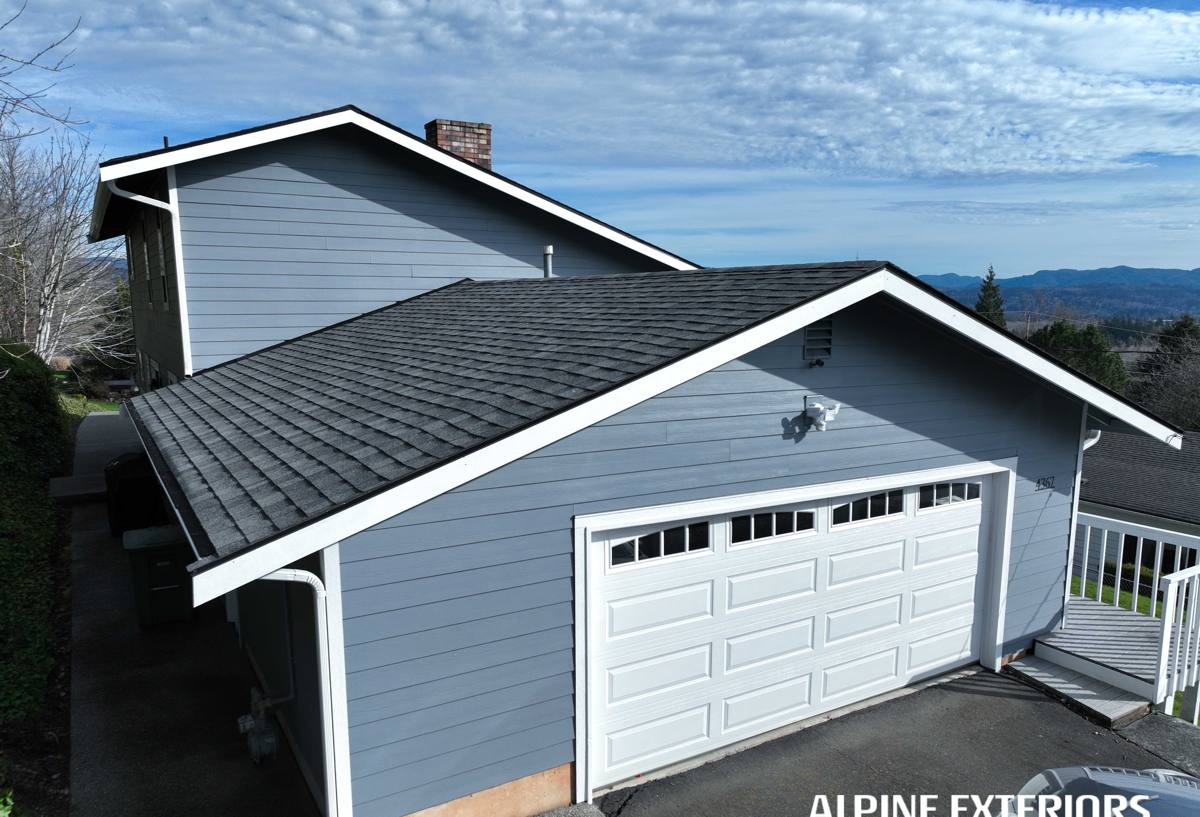
What Bellingham's Marine Climate Does to a Roof
Whatcom County weather is defined by long stretches of low-intensity rain, high ambient humidity, and wind-driven storms that come off the Strait of Georgia and Bellingham Bay. None of that is dramatic on any single day, but it adds up over the life of a roof in ways that matter for how we build one.
Salt Air and Metal Components
Proximity to the bay means airborne salt settles on roofing metal — flashing, vents, fasteners, gutters — and accelerates corrosion compared to homes further inland. This doesn't mean metal roofing or metal components are off the table; it means we're deliberate about which metals and fastener coatings go on a Happy Valley roof, since the wrong choice corrodes faster and shows it at the seams first.
Driving Rain and Wind-Driven Water
Rain in this area rarely falls straight down. Wind pushes it sideways and up under laps, edges, and penetrations that would stay dry in a calmer climate. That's why underlayment coverage, ice-and-water shield at vulnerable transitions, and properly lapped flashing matter more here than the shingle's wind rating on a spec sheet.
Moss and Shade
Many Happy Valley lots have mature tree cover, which is part of the neighborhood's character but also means roofs stay damp longer after rain and get less direct sun to dry out. Moss and algae take hold on surfaces that stay wet, and once established, moss holds moisture against the roofing material and works into laps and fastener lines. A new roof installed with this in mind — proper ventilation, the right underlayment, and moss-resistant material choices where appropriate — starts that fight from a much better position than a roof that ignores it.
Signs a Happy Valley Roof Needs Replacing, Not Patching
Not every roof problem calls for full replacement, and we'll tell you honestly when a repair is the right call. But there's a point where patching becomes false economy. Common signs we look for on local roofs include:
- Granule loss heavy enough that shingles look patchy or bald in sun-exposed areas
- Persistent moss or algae staining that comes back within a season of cleaning
- Soft or spongy decking felt underfoot during inspection, especially near valleys and eaves
- Daylight visible through the attic roof deck, or damp insulation below it
- Multiple past repairs concentrated in the same areas — a sign the underlying system, not just the surface, has failed
- A roof approaching or past the manufacturer's expected service life for its material and this climate
What a Correct Roof Installation Includes
A new roof is a system, not a single layer of material. Skipping or shortcutting any part of it shows up as a leak, premature wear, or a voided warranty within a few years — often right around when a homeowner has stopped expecting problems.
Tear-Off and Deck Inspection
We remove the existing roofing down to the deck rather than layering over it, because covering old material traps moisture and hides the deck's actual condition. Once exposed, we check the decking for soft spots, water staining, and rot, and replace any damaged sections before anything new goes down. This step is where a lot of hidden damage from past leaks gets found — and it's something you can't properly assess from the ground or from photos.
Underlayment and Water Protection
Given how much of Whatcom County's rain arrives at an angle, we pay particular attention to underlayment coverage and to reinforcing vulnerable areas — valleys, eaves, chimneys, skylights, and anywhere two roof planes meet — with additional water-resistant membrane. This layer is doing more work in this climate than in drier parts of the state, and it's the layer most likely to be shortchanged by a rushed job because it's invisible once the roof is finished.
Ventilation
Proper intake and exhaust ventilation keeps the attic space at a temperature and humidity level that doesn't cook shingles from underneath or trap moisture that feeds mold and rot. In a shaded, damp neighborhood like Happy Valley, ventilation also plays a direct role in how quickly a roof dries out after rain, which affects how much moss and algae growth you'll deal with down the road.
Flashing and Penetrations
Chimneys, plumbing vents, skylights, and wall-to-roof transitions are where the large majority of roof leaks actually start — not in the open field of shingles. Correct flashing work, properly lapped and sealed rather than just caulked over, is one of the clearest differences between a roof that lasts and one that leaks within a few winters.
Final Material Layer and Finish Details
The visible roofing material — asphalt shingle, metal, or another system — goes on last, following manufacturer specifications for nailing pattern, exposure, and starter courses. We also address ridge caps, drip edge, and gutter apron details that are easy to shortcut but affect how well water actually sheds off the finished roof.
Material Considerations for This Neighborhood
There's no single "best" roofing material for every home — the right choice depends on the home's structure, the homeowner's budget, and how the roof will be exposed to sun, shade, and salt air. Here's how the common options compare for a Happy Valley property specifically:
| Material | Performance in Salt Air / Rain | Moss Resistance | Maintenance Burden |
|---|---|---|---|
| Architectural asphalt shingle | Good with proper flashing and fasteners | Improved with algae-resistant (AR) granules | Low to moderate; periodic moss treatment in shaded areas |
| Standard 3-tab asphalt shingle | Adequate but shorter service life in this climate | Lower unless AR-rated | Moderate; more frequent moss cleaning |
| Metal roofing (coated steel) | Strong if fasteners and coatings are salt-rated | High — moss struggles to hold on smooth metal | Low, but coating and fastener quality matter |
| Synthetic/composite shingle | Good; resists moisture absorption well | Moderate to high depending on product | Low to moderate |
We'll walk through which of these fits your home's roof pitch, sun exposure, and budget honestly — including telling you when a lower-cost option is genuinely fine for your situation and not just an upsell opportunity.
Our Process for Happy Valley Roof Replacements
- On-site inspection and estimate — we look at the current roof, attic ventilation, and any signs of past leaks before quoting anything
- Written scope and material selection — you know exactly what's being installed, including underlayment and flashing details, not just the shingle color
- Scheduling around weather windows — roofing in this climate means working around Bellingham's rain patterns, and we plan tear-off timing to minimize the home's exposure
- Tear-off and deck repair — old material removed, deck inspected and repaired as needed
- Installation — underlayment, flashing, ventilation, and final roofing material installed to manufacturer and code specifications
- Cleanup and final walkthrough — site cleared of debris and nails, and we walk the finished roof with you
Why Local Experience with Happy Valley Homes Matters
A crew that regularly works in Whatcom County's marine climate already knows which flashing details fail first under driving rain, which fastener coatings hold up against salt air, and how much ventilation a shaded, tree-covered lot actually needs to keep moss from taking over again in two years. That's not something a crew coming from a dry-climate region picks up on the first job — it's built from repeatedly seeing how roofs in this specific area age and fail.
A Practical Pre-Installation Checklist
Before your roof replacement starts, a few things help the project go smoothly:
- Confirm attic access is clear so ventilation and deck condition can be properly assessed
- Move vehicles and outdoor items away from the perimeter of the home for material staging and debris drop
- Ask about permit requirements — most full roof replacements in Whatcom County require one, and a legitimate contractor handles this as part of the job
- Clarify warranty terms in writing, both for materials and for the labor/workmanship
- Discuss gutter condition at the same time — a new roof and worn-out gutters are often worth addressing together
Cost Factors Homeowners Should Understand
Roof replacement pricing varies by roof size, pitch, number of layers being removed, deck condition, and material choice, so we won't quote a number without seeing the roof. What we can say honestly is which factors tend to move the price most:
| Factor | Why It Affects Cost |
|---|---|
| Roof pitch and complexity | Steep or multi-plane roofs take longer and require more safety setup |
| Deck condition | Rotted or soft decking found during tear-off requires replacement before installation continues |
| Layers of existing roofing | Removing multiple old layers adds labor and disposal cost |
| Material selection | Asphalt, metal, and composite options carry different material and installation costs |
| Ventilation upgrades | Adding or correcting intake/exhaust ventilation is worth doing during a full replacement |
Get an Honest Estimate for Your Happy Valley Roof
If your roof is showing its age, holding onto moss it never used to have, or you're just trying to plan ahead before a leak forces the decision, we're glad to take a look and give you a straight answer — including telling you if repair is still a reasonable option. Use the form below to request a free, no-pressure estimate for your Happy Valley home.