 Bellingham Exterior
 A Company Policy, Not a Sales Pitch
Most exterior contractors will sell a homeowner whatever siding they ask for. We don't. Every siding job we take on in Bellingham and the rest of Whatcom County goes on with James Hardie fiber cement, full stop. No vinyl, no LP SmartSide, no Cemplank or Allura, no primed spruce, no cedar. That's not a marketing angle — it's a standard we settled on after years of watching which products actually held up against this specific coastline and climate, and which ones caused callbacks, warranty disputes, and homeowner headaches five to ten years down the road.
This page explains the reasoning in plain terms: what our marine climate does to a house, what the alternatives get right and where they fall short, and what James Hardie actually is as a product system — not just a brand name.
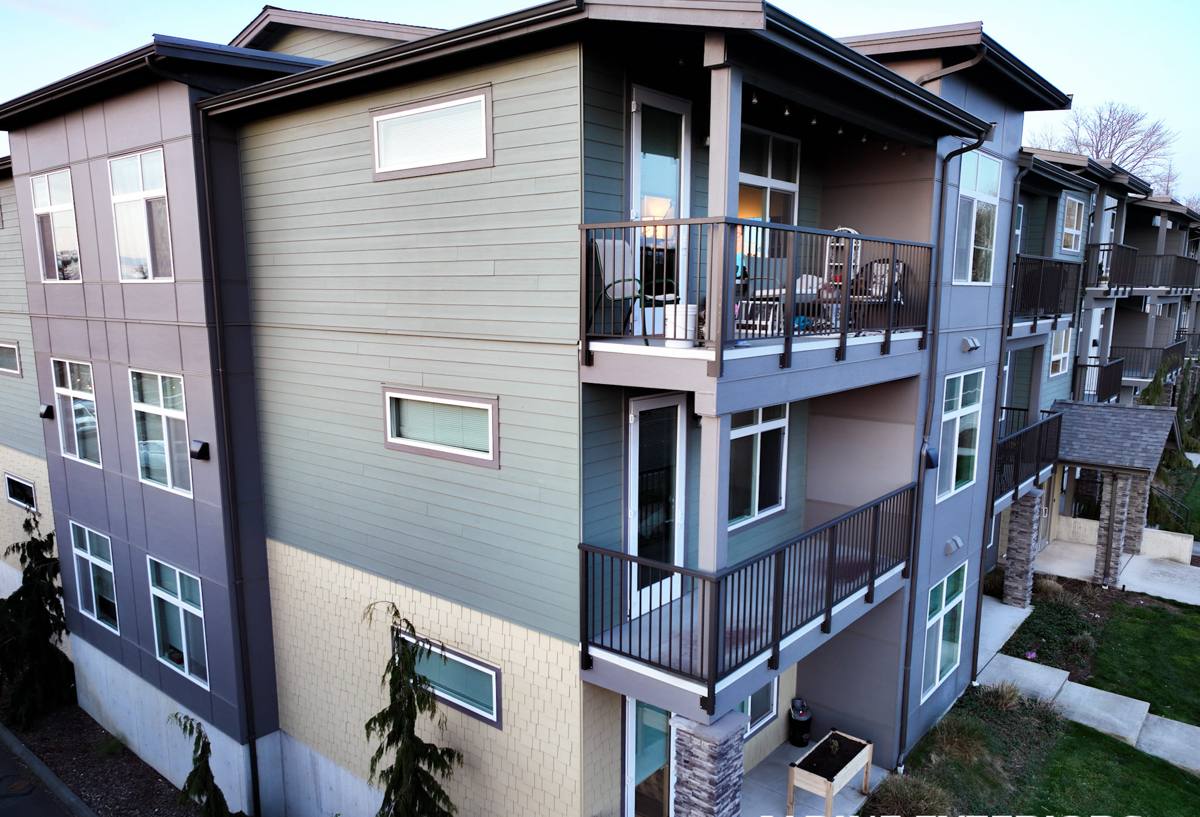
What Bellingham's Climate Actually Does to Siding
Whatcom County sits right on Bellingham Bay, which means salt air is a constant, low-level presence on every exterior surface in town, not just for homes on the waterfront. Add in driving rain off the Sound, a wet season that runs long even by Pacific Northwest standards, and a moss and algae season that can stretch eight or nine months out of the year on north-facing walls, and you've got a climate that's genuinely hard on building envelopes.
Three things matter most for siding here:
- Sustained moisture exposure — not just rain events, but weeks of damp air that never fully dries between storms
- Salt-laden air — corrosive to fasteners, hardware, and certain finishes over time
- Organic growth — moss, algae, and mildew that thrive on shaded, damp siding surfaces and can trap moisture against the substrate
Any siding product can look good on a sunny install day. The real test is how it performs after its fifth or sixth wet Bellingham winter.
Why We Stopped Offering Alternatives
Vinyl Siding
Vinyl is inexpensive and low-maintenance in mild, dry climates, and we're not going to pretend otherwise. But it's a thin plastic product that expands and contracts significantly with temperature swings, and its seams and J-channels rely on lap joints rather than a sealed surface. In a climate with this much sustained wind-driven rain, those joints are where water finds its way behind the cladding over time. Vinyl also has a service life that, realistically, doesn't match what we want to stand behind on a home in this region, and it can't be painted to refresh a faded color without specialty products.
Untreated or Primed Wood (Cedar, Primed Spruce)
Cedar and primed spruce are beautiful when new, and there's a reason they were the default here for decades. But wood siding needs disciplined maintenance — recoating, caulking, and moisture monitoring — to survive a climate this wet. Miss a maintenance cycle by even a year or two, and moss and moisture combine to start rot at butt joints and lower courses. We got tired of being the company called out to repair or replace wood siding that failed early because nobody kept up with it, which is nearly unavoidable for most busy homeowners.
LP SmartSide and Other Engineered Wood
Engineered wood products like LP SmartSide use treated strand board with a resin-saturated overlay, and the technology has improved a lot over the years. It's a legitimate product. Our issue is installation sensitivity: any breach in the factory coating — a saw cut, a fastener miss, an unsealed edge — creates a path for moisture into a wood-based core, and in a climate with our rainfall totals, those breaches happen on real job sites even with careful crews. Fiber cement doesn't have that failure mode, because there's no wood fiber for moisture to migrate into.
Cemplank and Allura (Other Fiber Cement Brands)
These are genuine fiber cement competitors to Hardie, not inferior imitations — the core material science is similar. Our reason for standardizing on Hardie specifically comes down to the factory-applied ColorPlus finish system, the depth of their HZ climate-zone engineering, and the strength and clarity of their transferable warranty, all covered below. Simplicity is also part of it: one product system means our crews install it to the same spec, every time, with no guesswork about batch-to-batch consistency.
What James Hardie Gets Right
Fiber Cement Composition
James Hardie siding is made from cement, sand, and cellulose fiber, cured under pressure. It's non-combustible, which matters more every year in a region with expanding wildfire seasons. It doesn't rot, it doesn't attract insects, and it doesn't swell or delaminate the way wood-based products can when exposed to sustained moisture. It holds paint and factory finish far more stably than wood because it doesn't move seasonally the way wood does.
ColorPlus Technology
Most Hardie siding we install uses their ColorPlus factory finish rather than field-applied paint. It's baked on in a controlled environment, which gives a more even, more durable finish than anything applied on-site with a brush or sprayer — and it comes with its own finish warranty separate from the product warranty. For a climate with this much UV-and-rain cycling, a factory finish that doesn't rely on weather conditions during installation is a real advantage.
HZ5 — Engineered for This Region
James Hardie makes climate-specific product formulations under what they call their HZ (HardieZone) system, engineered for different moisture and freeze-thaw conditions across the country. Western Washington, including Whatcom County, falls into their wetter climate zone designation, and we install the corresponding formulation rather than a generic version of the product. That's a detail a lot of homeowners never hear about, and it's part of why "we install Hardie" isn't the whole story — installing the correct Hardie product for this specific climate is what matters.
Comparing the Options Side by Side
| Material | Moisture Resistance Here | Fire Rating | Typical Maintenance | Repaint/Refinish |
|---|---|---|---|---|
| James Hardie Fiber Cement | Excellent — no wood core to absorb moisture | Non-combustible | Occasional wash; recaulk joints periodically | Optional; ColorPlus finish is long-lasting |
| Vinyl | Fair — water can migrate behind lap joints | Combustible, can warp near heat | Periodic washing; watch for cracking with age | Not paintable in most cases |
| Cedar / Primed Spruce | Poor without diligent upkeep | Combustible | Recoat every few years, ongoing caulk and inspection | Required on a set cycle |
| LP SmartSide (Engineered Wood) | Good if finish stays intact; vulnerable at breaches | Combustible | Inspect cut edges, fasteners, and seams regularly | Field touch-up possible, factory finish preferred |
The Warranty Difference
Warranty structure is one of the more overlooked parts of choosing a siding product, and it's a meaningful part of why we standardized on Hardie. James Hardie's warranty on their fiber cement products is transferable to a subsequent homeowner within the coverage period, which matters for resale — a home with documented, warrantied Hardie siding is an easier sell than one with an expired or non-transferable warranty on a different product. The ColorPlus finish carries its own separate warranty against fading and chipping, distinct from the substrate warranty. We only warranty our own labor and installation on products we fully control, which is another reason a single product system makes sense for us and for the homeowner.
What Correct Installation Actually Involves
Fiber cement is not a forgiving product to install incorrectly, and a lot of the horror stories about any siding product — Hardie included — trace back to installation shortcuts, not the material itself. Here's what we hold every job to:
- Correct fastener type, spacing, and penetration depth per Hardie's published installation guide
- Proper clearance from grade, decks, and roof lines to avoid wicking moisture at the bottom edge
- A weather-resistant barrier and rainscreen detailing appropriate for a high-rainfall climate
- Factory-cut edges used wherever possible, with field cuts sealed per spec
- Correct caulking at butt joints, trim, and penetrations — not over-caulking, which traps moisture
- Flashing details at windows, doors, and roof intersections that actually shed water rather than channel it inward
Skip any one of these and even the best siding material on the market will underperform. This is the part of the job that doesn't show up in a photo but determines whether a house is still dry behind its walls in fifteen years.
Cost Factors to Expect
| Factor | How It Affects Your Project |
|---|---|
| Home size and wall complexity | More corners, dormers, and trim details mean more labor and cutting |
| Existing siding removal | Tear-off of old wood, vinyl, or damaged material adds labor and disposal cost |
| Substrate repair | Rot or water damage found underneath old siding needs to be fixed before new siding goes on |
| Product line and finish | Plank profile, shingle-style panels, and trim board selections vary in material cost |
| Access and site conditions | Multi-story homes, tight lots, and steep grades affect scaffolding and staging time |
We don't quote a job over the phone with a per-square-foot number, because these variables genuinely change the total. What we can tell you honestly: fiber cement costs more up front than vinyl and comparable to or somewhat more than engineered wood, and it's an investment that tends to pay back in reduced maintenance and fewer callbacks over the life of the siding.
Is Hardie Right for Every Home?
We'll say this plainly: no single siding product is perfect for every budget or every homeowner's priorities, and if cost is the deciding factor above all else, we're probably not the right contractor for that job — and we'll tell you that directly rather than waste your time. What we won't do is install a product on your home that we don't believe will hold up to a Bellingham winter, because our name and our warranty are attached to that work for years afterward. Standardizing on one product we trust completely, and installing it correctly every time, is how we've chosen to run this business.
If you're weighing a siding replacement or new construction project and want a straight answer about what it would take and what it would cost, we're happy to walk your property and give you a free, no-pressure estimate — no obligation, and no sales script.