 Bellingham Exterior
 Lynden Decks Face a Different Kind of Wear
Lynden sits far enough inland to escape the worst of the direct coastal spray, but Whatcom County's weather doesn't care much about that distinction. Between the marine-influenced rain that settles in for months at a stretch, the humidity that never fully lets go, and the moss season that can run from early fall through late spring, a deck here ages differently than one in a drier climate. Wood that would last two decades in eastern Washington can show soft spots, checking, and fastener corrosion in half that time if it wasn't built with this specific weather in mind.
Most of the deck replacement calls we get in Lynden aren't from decks that were neglected. They're from decks that were built to a generic standard instead of a Whatcom County standard — undersized footings, decking laid tight with no drainage gap, or hardware that wasn't rated for the moisture load this region puts on outdoor structures year after year. Replacing a deck the right way here means designing around that reality from the first footing, not just swapping old boards for new ones.
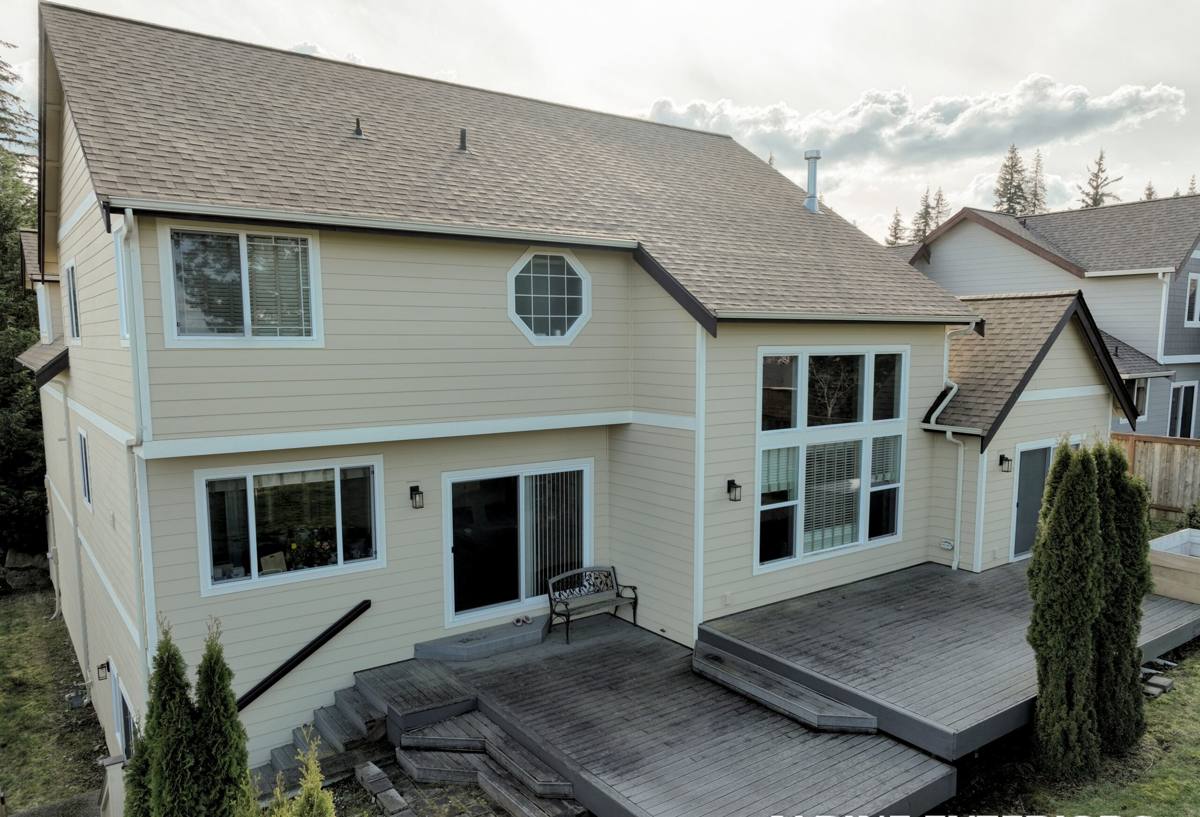
Signs Your Lynden Deck Needs Replacement, Not Repair
Not every tired-looking deck needs a full teardown. But there's a point where patching boards is throwing good money after bad, and it's worth knowing where that line sits.
- Soft, spongy decking in multiple areas rather than one isolated board — usually a sign moisture has been working underneath for a while.
- Ledger board separation or gaps where the deck meets the house, which can point to rot behind the flashing.
- Support posts or footings that have shifted, heaved, or show visible rot at the base where they sit closest to grade.
- Railings that flex more than they should — a safety issue as much as a wear issue.
- Persistent moss or algae staining that keeps returning within weeks of cleaning, which usually means the deck isn't drying out between rains.
- Fasteners that are rusted, bleeding stains into the wood, or backing out of their holes.
If you're only seeing one or two of these, a repair may genuinely be enough. If several show up together, especially anything involving the framing or footings, replacement is almost always the more honest recommendation — repairs on a structurally compromised deck tend to just delay the same conversation a year or two later.
What a Correct Deck Replacement Involves
Framing and Footings
Everything above ground depends on what's below it. In this climate, footings need to be sized and set below frost depth per local code, and posts should sit on bases that keep end grain off standing water. We check the existing footings on every replacement rather than assuming they're adequate — reusing a footing that was undersized or poorly poured just carries the original problem into the new deck.
Ledger Attachment and Flashing
The ledger board connection — where the deck ties into the house — is the single most common point of failure we find on decks in this region, and it's almost always a flashing problem, not a fastener problem. Proper flashing directs water away from the house rim joist instead of letting it pool and soak in behind the ledger. This is the detail that's easiest to shortcut and the most expensive to ignore.
Decking Material and Spacing
Board spacing that allows real drainage and airflow matters more here than in drier regions, since decking that stays damp for days at a time is what feeds moss and speeds rot. Material choice — covered below — also plays a bigger role in how much upkeep the deck will demand over its life.
Hardware and Fasteners
Coated or stainless structural screws and joist hardware rated for ground contact and moisture exposure aren't optional extras here; they're the difference between hardware that lasts the life of the deck and hardware that starts staining the wood within a few wet seasons.
Decking Material Options: How They Hold Up Locally
| Material | Moisture Behavior Here | Maintenance | Typical Lifespan |
|---|---|---|---|
| Pressure-treated lumber | Handles moisture well if properly sealed and maintained; end grain and cuts need re-treatment | Needs re-staining or sealing every 1-3 years in this climate | 15-20 years with upkeep |
| Cedar | Naturally moisture and insect resistant, but softer and can gray or check faster under constant damp | Regular cleaning and periodic oiling to prevent moss and graying | 15-20 years with upkeep |
| Composite decking | Doesn't rot or absorb water like wood, but can still grow surface moss/algae if not cleaned | Low — occasional washing, no staining or sealing | 25-30+ years, manufacturer-dependent |
| PVC decking | Fully moisture-resistant, holds up well to the region's persistent damp | Lowest — periodic washing only | 25-30+ years, manufacturer-dependent |
There's no universal right answer here — it depends on budget, how much upkeep you want to take on, and how the deck is used. What we won't do is put a high-maintenance material in a spot with poor sun exposure and heavy shade, which is common in this area, without being upfront that it'll need more frequent attention than the same material would in a drier or sunnier yard.
Our Process, Start to Finish
- On-site assessment. We look at the existing deck's framing, footings, and ledger connection, not just the surface boards, so the estimate reflects what's actually needed.
- Written estimate. A clear scope of work and price range before anything is torn out — no surprise change orders for problems we should have caught up front.
- Permitting. We handle the permit application and inspection scheduling required for the project so you're not navigating that process alone.
- Demolition and disposal. Old decking, framing, and any compromised footings are removed and hauled off.
- Rebuild. Footings, framing, ledger flashing, decking, and railings are installed in that order, with each stage checked before the next begins.
- Final walkthrough. We go over the finished deck with you, including basic care guidance specific to whatever material was installed.
Permits and Whatcom County Considerations
Deck replacement in this area typically requires a building permit when the deck exceeds a certain height or size, and railing height and guard requirements are enforced during inspection. Permit requirements can shift depending on whether the footprint or footings are changing versus a like-for-like rebuild, so this is worth confirming for your specific situation rather than assuming. We factor permit timing into the project schedule so it doesn't catch homeowners off guard midway through the job.
Moss, Mildew, and Long-Term Maintenance in This Climate
Even a well-built deck in Whatcom County needs some seasonal attention to stay ahead of moss and mildew. A few habits go a long way:
- Sweep leaves and debris off the deck regularly in fall — trapped organic matter holds moisture and feeds moss growth.
- Clean the deck surface at least once a year with a deck-safe cleaner, more often in shaded or low-airflow areas.
- Check and clear drainage gaps between boards so water isn't pooling underneath.
- Re-seal or re-stain wood decking on the schedule appropriate to the product — skipping a cycle in this climate shows up faster than it would somewhere drier.
- Inspect railings and stairs once a year for looseness or soft wood, especially where posts meet the ground.
None of this replaces a properly built deck, but it does extend the life of whatever material you choose, and it's a lot cheaper than another replacement in ten years.
Why a Local Crew That Already Works in Lynden Matters
A crew that regularly works Lynden and the surrounding Bellingham area already knows how this county's inspectors expect footings and flashing to look, what soil conditions tend to show up when digging footings in this area, and how the local weather patterns actually behave through the build schedule — not just in general terms, but season by season. That familiarity shows up in fewer surprises during the permit process and a build sequence that accounts for the rain windows this region gets, instead of a schedule written for a climate that doesn't match Whatcom County's.
It also means accountability. A contractor based in the area and working here regularly has a reputation in the community to maintain, which is a different incentive structure than a crew passing through from out of the region for one job.
Getting Started
If your Lynden deck is showing any of the signs above, or you just want an honest read on whether repair or replacement makes more sense for your situation, we're happy to take a look. Estimates are free and there's no pressure to commit on the spot — fill out the form below and we'll get in touch to schedule a time to come out.