 Bellingham Exterior
 Deck Repair Built for Lynden's Climate
Lynden sits far enough inland from Bellingham Bay that homeowners sometimes assume salt air isn't much of a factor here, but westerly weather off the Salish Sea still reaches Whatcom County's farmland and neighborhoods, carrying moisture that settles into wood, fasteners, and connections. Combine that with a wet season that can stretch from October through May, and a deck in Lynden spends a large part of the year damp, shaded, and slow to dry. That combination is exactly what breaks decks down — not all at once, but board by board, fastener by fastener, over several seasons.
We repair decks all over the Lynden area and see the same failure patterns again and again: soft spots near the house where flashing was never installed correctly, rusted or popped fasteners, ledger board connections that were never properly flashed to begin with, and thick moss buildup that holds water against the decking far longer than rain alone ever would. Repair work here isn't just about swapping a bad board — it's about understanding why that board failed and making sure the fix doesn't fail the same way in three years.
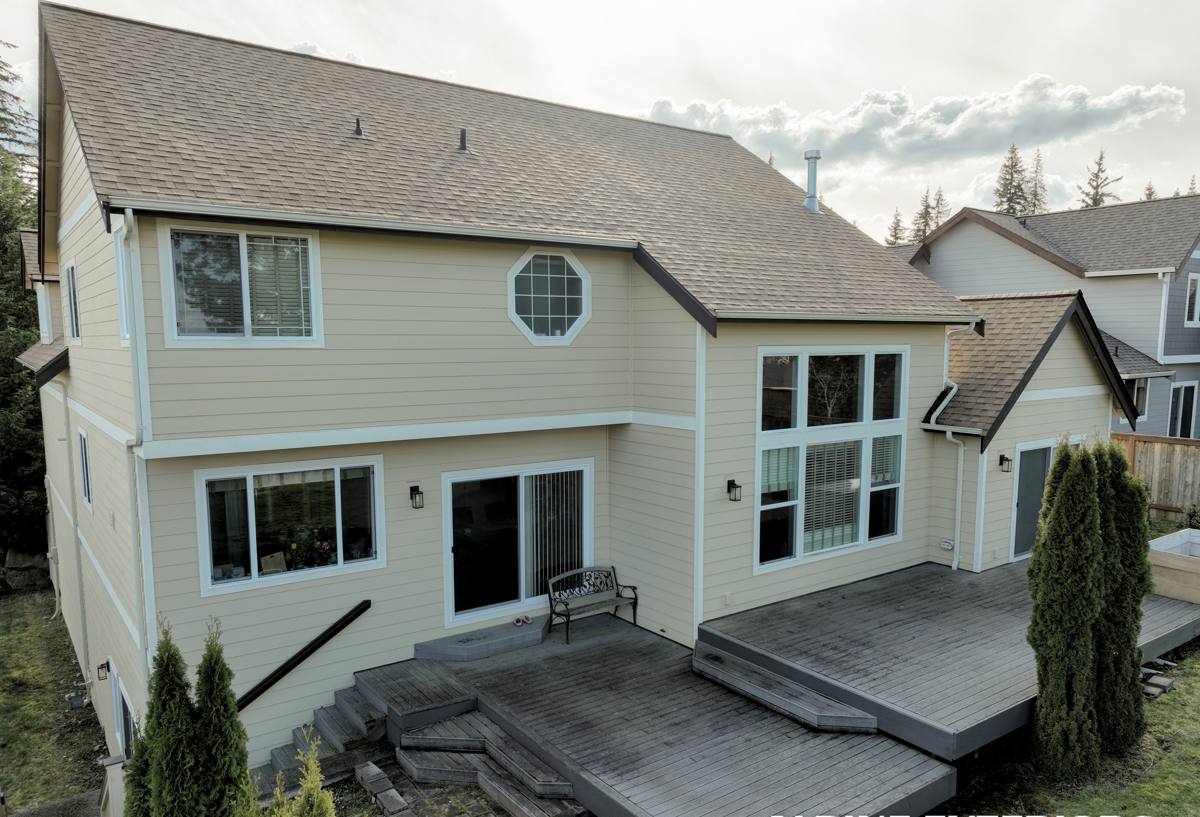
Why Decks in This Area Wear Down Faster Than People Expect
A deck in a dry climate can go years with minimal attention. That's not the case in Lynden. A few regional factors work against your deck every year:
- Extended damp season: Long stretches of overcast, drizzly weather mean wood surfaces stay wet for days at a time instead of drying out between rain events.
- Moss and algae growth: Shaded decks, north-facing decks, and decks under trees develop moss that traps moisture directly against the wood or composite surface.
- Airborne salt and moisture: Even inland, coastal air movement carries moisture that accelerates corrosion on fasteners, brackets, and metal hardware.
- Freeze-thaw cycling: Whatcom County winters aren't brutally cold, but repeated freezing and thawing works water deeper into cracks and joints over time.
- Original construction shortcuts: Many decks built 15-25 years ago in this region were built to code at the time, but flashing, fastener choice, and ledger attachment standards have improved significantly since then.
None of these factors are dramatic on their own. Together, and repeated year after year, they're why we get called out to decks that "seemed fine last summer" and now have a soft spot near the stairs or a railing post that wiggles more than it should.
Common Deck Repair Issues We Find in Lynden
Ledger Board and House Connection Problems
The ledger board — where the deck attaches to the house — is the single most important structural connection on most decks, and it's also the one most likely to have moisture problems. If flashing wasn't installed correctly (or wasn't installed at all) when the deck was built, water works its way behind the ledger and into the rim joist of the house itself. This is a repair we take seriously, because it isn't just a deck issue at that point — it can affect the structure of the home.
Rot in Framing and Decking
Rot typically starts where water sits: under planters, around post bases, near stair stringers, and anywhere debris collects instead of shedding water. By the time rot is visible on the surface, it has often traveled further into the framing than it looks. A proper repair means probing beyond the visible damage, not just capping over a soft spot.
Fastener and Hardware Corrosion
Older decks often used fasteners and joist hangers that weren't rated for the moisture exposure this region delivers. Rusted nails back out over time, and corroded hangers lose their holding strength well before they look obviously bad. We check hardware condition as a standard part of any repair, not as an upsell.
Moss, Algae, and Surface Deterioration
Moss isn't just cosmetic. On wood decking it holds moisture against the boards and accelerates cupping, splitting, and rot. On composite decking it can stain and, in some cases, contribute to slip hazards on stairs and ramps. Surface cleaning is sometimes part of a repair visit, and sometimes it reveals that what looked like a cleaning job is actually a structural one.
Railing and Guard Post Movement
Loose or wobbly railings are one of the most common repair calls we get, and one of the most important to take seriously — a railing that fails under load is a real safety issue, not just an inconvenience. Post movement is often a sign of rot at the base connection, not just a loose bolt.
What a Correct Deck Repair Actually Involves
A repair that only addresses what's visible on the surface tends to come back. Our process is built to catch what's underneath before we start replacing material:
- Full walk of the deck surface, substructure, ledger connection, stairs, and railings.
- Probing any suspect boards, posts, or framing members with a screwdriver or awl to find soft wood, not just discolored wood.
- Checking flashing at the house connection and confirming water isn't tracking behind the siding.
- Inspecting fasteners and hardware for corrosion, not just visible looseness.
- Identifying the moisture source causing the damage — this is the step that's easy to skip and the one that prevents a repeat repair.
- Repairing or replacing only what's actually compromised, matched to the existing material where possible.
- Correcting the underlying moisture issue — better flashing, improved drainage, gap spacing, or hardware upgrades — so the same failure doesn't recur in the same spot.
That last step is the difference between a patch and an actual repair. Replacing a rotted board without fixing why it rotted just buys a few more years before the next board goes.
Repair vs. Replacement: How We Help You Decide
Not every deck problem needs a full rebuild, and not every deck is worth saving board by board. We give homeowners a straight answer based on what we actually find, not a default recommendation toward the bigger job.
| Factor | Leans Toward Repair | Leans Toward Replacement |
|---|---|---|
| Extent of rot | Isolated to a few boards or one area | Widespread across framing and decking |
| Structural framing condition | Solid, joists and beams sound | Multiple joists or the ledger compromised |
| Age of the deck | Newer construction, good bones | 20+ years old with cumulative wear |
| Original build quality | Adequately flashed and fastened | Missing flashing, undersized hardware |
| Homeowner goals | Extend life a few more years | Wanting a different layout, size, or material |
We'll tell you honestly when a repair is the smarter money — and we'll also tell you when we think you're better off putting that repair budget toward a rebuild instead of chasing the same problem in different spots.
Wood, Composite, and Cedar: Repair Considerations
Different decking materials fail differently, and the repair approach changes with them.
Pressure-treated wood decks are the most common repair calls in this region — they're durable but need consistent maintenance (cleaning, sealing) to hold up against our wet season, and repairs are usually straightforward since material is widely available and easy to match.
Cedar decks age beautifully when maintained but are softer than treated lumber, so rot can progress faster once moisture gets in. Matching weathered cedar color-wise takes some judgment, and we talk through expectations before starting.
Composite decking is generally lower-maintenance and resists rot in the boards themselves, but the substructure underneath is still typically wood framing — and that framing can rot even while the composite surface looks fine. We always check the structure under composite decking, not just the boards on top. We also stay selective about certain composite products where we've seen moisture-related warranty and maintenance issues over time in wet climates; when that's relevant to your deck, we'll explain the trade-off plainly rather than just installing whatever's cheapest.
Why Hire a Crew That Already Works in Lynden
Deck repair done right depends on understanding how a specific region's weather behaves against a specific structure, not on a generic checklist. Working throughout Whatcom County means we've seen how ledger flashing fails differently on a Lynden farmhouse deck than on a newer build closer to Bellingham, and how moss patterns on a shaded rural lot differ from a more exposed in-town yard. That local pattern recognition shortens the guesswork and speeds up an accurate diagnosis.
It also means we're realistic about timing. Deck repair work in this region goes faster and holds up better when it's scheduled around drier stretches, and a crew that works here year-round knows how to plan around that instead of promising a start date that weather won't cooperate with.
Signs You Should Have Your Deck Inspected
- Boards that feel spongy, springy, or soft underfoot
- Visible gaps, cracks, or splitting concentrated in one area
- Railings or posts that move when pushed
- Rust streaks running down from fasteners or hardware
- Persistent moss or dark staining that keeps coming back after cleaning
- Water pooling on the surface instead of draining off
- Gaps or separation where the deck meets the house
- Stairs that feel less solid than they used to
Any one of these on its own might be minor. Two or three together usually means it's worth having someone take a closer look before the next wet season adds to the damage.
Get a Straight Answer on Your Deck
If your deck in Lynden has soft spots, a wobbly railing, or just doesn't feel as solid as it used to, we're happy to take a look and give you an honest read on what's actually going on — repair, partial rebuild, or otherwise. Reach out for a free, no-pressure estimate using the form below.