 Bellingham Exterior
 Birch Bay sits right where the Salish Sea meets Whatcom County's weather patterns, and that combination is tough on a roof. Homes here take on salt-laden air off the water, wind-driven rain that finds its way under poorly lapped shingles, and a moss season that can run most of the year in shaded, north-facing sections. An asphalt shingle roof installed the way it's meant to be installed handles all of that for decades. One installed with shortcuts shows problems within a few winters. This page covers what a correct asphalt shingle roofing job looks like specifically for Birch Bay conditions, how we approach it, and what to expect if you're planning a repair or full replacement.
Why Birch Bay's Climate Is Harder on a Roof Than It Looks
Asphalt shingles are a proven, affordable roofing product across the country, but "proven" assumes average conditions. Birch Bay isn't quite average. Its waterfront exposure means fasteners, flashing, and any exposed metal age faster than they would a few miles inland, because salt air accelerates corrosion. Add in driving rain that comes sideways during winter storms, and any weak point in the underlayment, flashing, or shingle overlap becomes a leak path instead of a minor annoyance.
Then there's shade. Many Birch Bay properties sit under mature evergreens or close to neighboring trees, which keeps roof sections damp long after a storm passes. That moisture, combined with mild temperatures for most of the year, is exactly what moss and algae need to take hold. None of this means asphalt shingles are the wrong choice for the area — they're not — but it does mean the installation details matter more here than they would in a drier, more open part of Whatcom County.
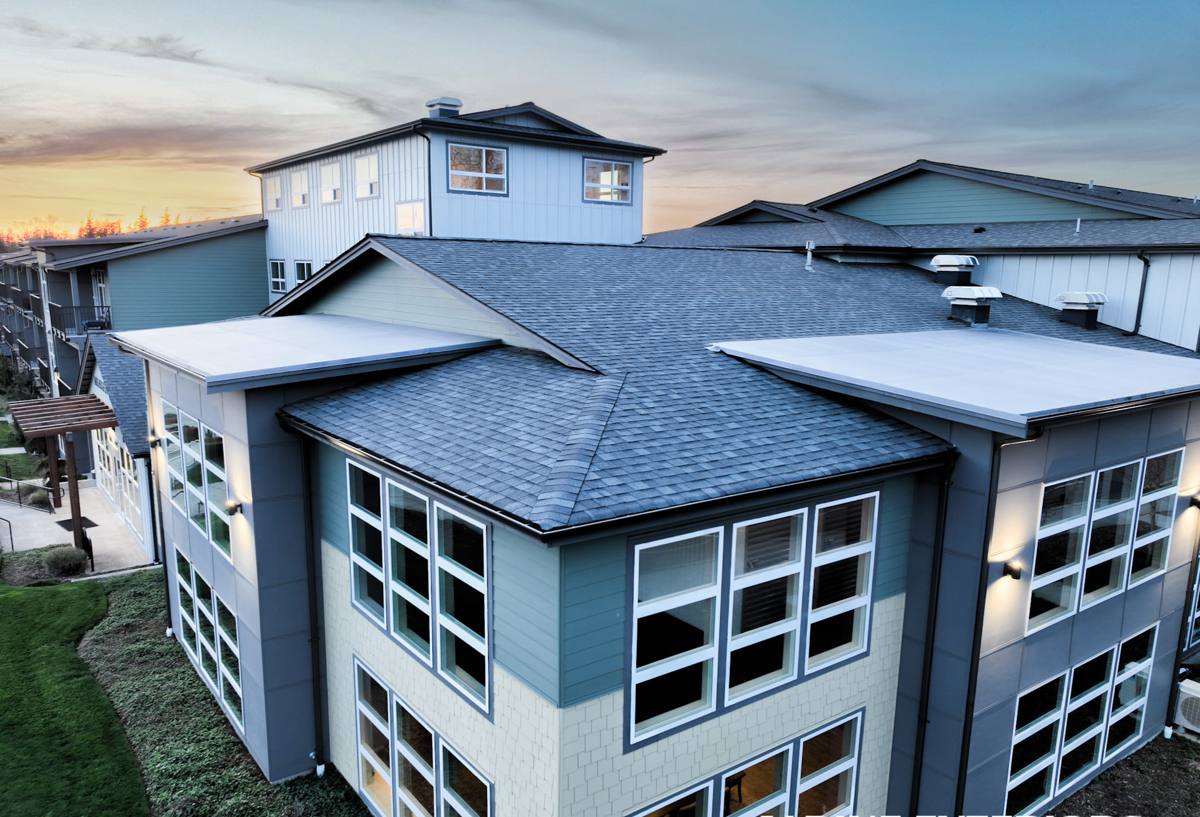
What a Correctly Installed Roof Needs in This Environment
A Real Water Barrier, Not Just Underlayment
Standard felt or synthetic underlayment is a baseline, not a complete plan. In wind-driven rain, water can travel uphill under shingles at eaves, valleys, and around penetrations. We install self-adhered ice-and-water membrane at the vulnerable spots — eaves, valleys, chimneys, skylights, and low-slope transitions — so that if wind-blown rain does get past the shingle surface, it still can't reach the roof deck.
Ventilation That Matches the Local Humidity
A roof that can't breathe traps moisture in the attic, which shortens shingle life from underneath and makes moss and mildew worse. Balanced intake and exhaust ventilation matters everywhere, but in a damp coastal microclimate like Birch Bay's, it's one of the details we won't skip just to save a step.
Corrosion-Resistant Flashing and Fasteners
Cheap galvanized nails and thin flashing hold up fine inland. Near the water, salt air eats through them faster than most homeowners expect. We use corrosion-resistant fasteners and properly formed flashing at every roof-to-wall transition, chimney, and vent, because a rusted-through nail or a flashing seam that's failed doesn't announce itself — it just leaks quietly until there's damage.
Shingles Rated for Wind and Algae Resistance
Not every asphalt shingle line is built the same. For Birch Bay we favor products with a higher wind rating and algae-resistant granules, since both wind exposure and algae staining are realistic, ongoing conditions here rather than occasional risks.
Moss and Algae: Managing the Long Wet Season
Moss doesn't just look bad — it holds moisture against the shingle surface, lifts shingle edges as it grows, and shortens the life of the roof underneath it. In Birch Bay's shaded, moisture-heavy pockets, moss can establish itself within a couple of seasons on a roof that isn't maintained. The goal isn't to eliminate moss risk entirely (that's not realistic on a shaded coastal lot), it's to manage it so it never gets ahead of you.
- Have moss and debris cleared from valleys, roof-to-wall joints, and behind chimneys at least once a year
- Ask about zinc or copper control strips near the ridge, which allow rainwater to carry natural moss-inhibiting minerals down the roof slope
- Keep gutters clear so water doesn't back up and sit against the lower courses of shingles
- Trim back overhanging branches where it's practical, to cut down on shade and falling debris
- Never pressure-wash a shingle roof — it strips protective granules and can void manufacturer warranties
- Have a professional check flashing and fastener condition every few years, not just when a leak shows up
Signs a Birch Bay Roof Needs Repair or Replacement
Some warning signs are obvious — missing shingles after a windstorm, a visible leak stain on a ceiling, daylight showing through the attic decking. Others are easy to miss from the ground: granule buildup in gutters (a sign shingles are wearing down), soft spots on the roof surface, curling or cupped shingle edges, or moss thick enough that you can't see the shingle surface underneath it in places. Any of these are worth a professional look before the next winter storm season, since a small repair now is almost always cheaper than water damage repair later.
Our Asphalt Shingle Roofing Process
1. On-Site Inspection and Honest Assessment
We walk the roof, check the attic where accessible, and tell you plainly whether you're looking at a repair, a partial re-roof, or a full replacement. We don't upsell a full tear-off when a targeted repair will genuinely hold up.
2. Tear-Off and Deck Inspection
For full replacements, we remove old shingles down to the deck and check for soft, rotted, or delaminated sheathing — common where old flashing has been leaking slowly. Any damaged decking gets replaced before anything new goes down; covering over a compromised deck just hides the problem.
3. Underlayment and Flashing
Ice-and-water membrane at vulnerable areas, synthetic underlayment across the field, and new corrosion-resistant flashing at every penetration and transition, as described above.
4. Shingle Installation
Installed to manufacturer specifications for nailing pattern and exposure, with attention to proper alignment at valleys and hips — the areas most exposed to wind-driven rain.
5. Ventilation Check
We confirm intake and exhaust ventilation is balanced for the size and shape of the roof, adjusting as needed rather than assuming the existing setup was correct.
6. Cleanup and Walkthrough
Magnetic sweep for stray nails, full site cleanup, and a walkthrough so you understand what was done and what to expect going forward.
What Affects the Cost of Asphalt Shingle Roofing in Birch Bay
Every roof is different, so we don't quote sight-unseen prices — but these are the factors that typically move a project up or down in scope:
| Factor | Why It Matters |
|---|---|
| Roof size and pitch | More surface area and steeper slopes mean more material and labor time, plus additional safety measures on steep sections |
| Number of layers to remove | Roofs with an existing layer (or two) over the original take longer to tear off and dispose of than a single-layer roof |
| Deck condition | Rotted or soft sheathing found during tear-off needs replacement before shingles go on — this is common on older coastal homes with a history of slow leaks |
| Shingle tier | Standard three-tab, architectural, and premium algae-resistant lines vary in material cost and expected lifespan |
| Flashing and penetrations | Chimneys, skylights, multiple roof valleys, and vent pipes all add flashing work and labor time |
| Ventilation upgrades | Adding or correcting intake/exhaust ventilation is a smaller add-on cost that protects the rest of the investment |
We walk through these with you during the estimate so there are no surprises once work starts.
Why It Matters to Hire a Crew That Already Works in Birch Bay
A roofing crew that mostly works drier, inland jobs can still do competent work, but they're often applying a general Pacific Northwest approach rather than one shaped by waterfront exposure. Crews who regularly work Birch Bay and the surrounding Whatcom County coastline know which details actually matter here: where salt air does the most damage, which roof orientations hold moss the longest, and how to detail flashing so wind-driven rain off the bay doesn't find a way in. That local pattern recognition is the difference between a roof that's technically installed to code and one that's actually built for where it sits.
After Installation: Keeping It Performing
A new asphalt shingle roof still needs occasional attention in this climate. Annual gutter cleaning, a look at flashing and valleys every couple of years, and prompt moss removal go a long way toward getting the full service life out of the materials. If you ever notice granule loss, a soft spot, or a stain on an interior ceiling, it's worth a call before the next heavy rain rather than after.
If you're weighing a repair against a full replacement, or just want an honest read on where your current roof stands, we're happy to take a look. We offer free, no-pressure estimates for Birch Bay homeowners — use the form below to get started.