 Bellingham Exterior
 Birch Bay's Coastal Climate Asks More of Your Siding
Birch Bay sits right on the water, and that location shapes everything about how siding ages here. Homes a few miles inland in Bellingham deal with plenty of rain, but Birch Bay adds salt air, near-constant onshore wind, and a longer stretch of shaded, damp conditions during the moss season that runs from fall through spring. Siding that would hold up fine in a drier, more sheltered part of Whatcom County can fail years early out here if it wasn't built or installed with this specific exposure in mind.
That's the lens we use for every siding replacement we quote in Birch Bay. It's not a generic siding job — it's a coastal siding job, and the material, the flashing details, and the install sequence all need to account for what this stretch of coastline actually does to a house over time.
Salt Air and Corrosion
Salt-laden air doesn't just affect metal fasteners and flashing — it accelerates the breakdown of paint films and can work into seams and butt joints faster than plain rainwater does. Siding materials that rely on a surface coating for protection are more exposed to this than materials engineered with the coating baked into the product itself.
Driving Rain and Wind Exposure
Wind off the water pushes rain sideways into a house rather than letting it run straight down, which puts more stress on laps, joints, and trim transitions than a calmer inland location would. This is exactly where installation quality — not just product choice — determines whether a siding job lasts.
Moss, Mildew, and Shade
Many Birch Bay lots carry mature trees and sit close enough to the water that siding stays damp longer after a storm. Combined with our long Pacific Northwest moss season, that moisture creates ideal conditions for moss and mildew growth on siding surfaces that don't dry out quickly or that trap water at poorly sealed joints.
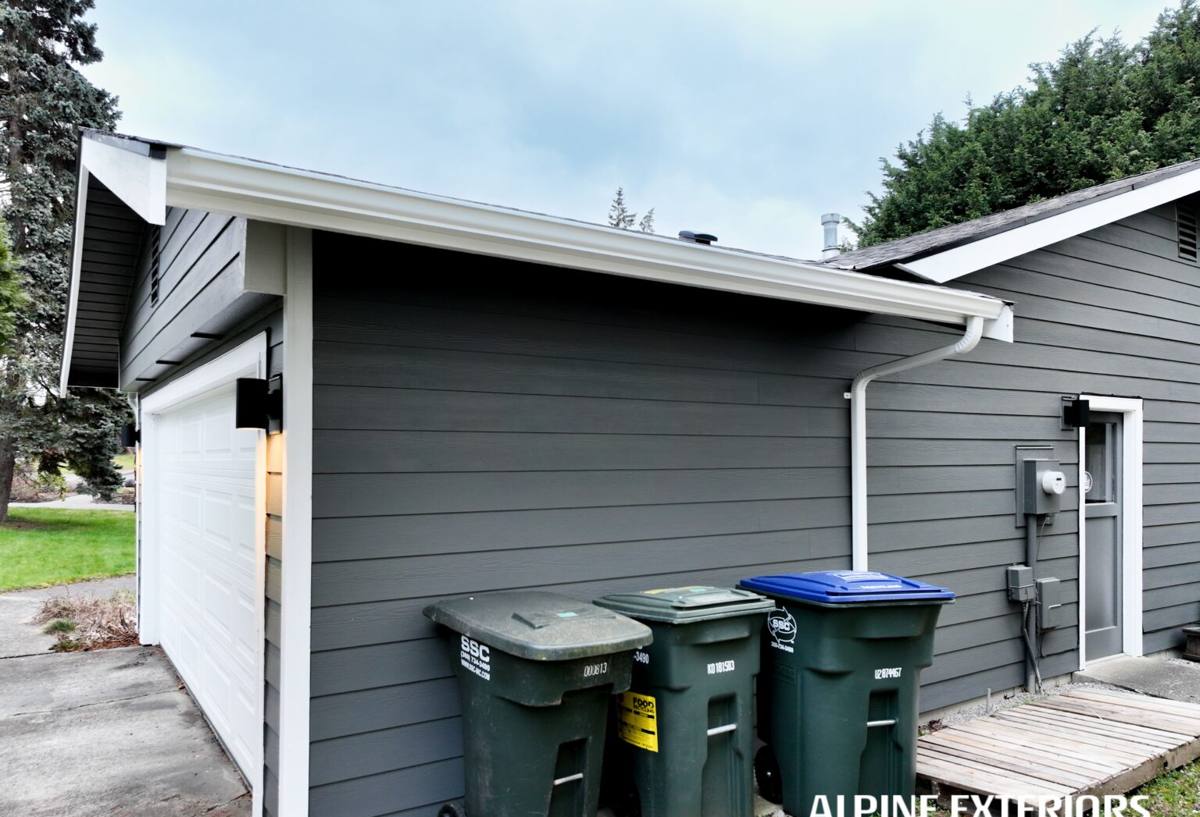
Signs a Birch Bay Home Needs Siding Replacement
Not every issue means a full tear-off, but in a coastal climate small problems compound faster than they would elsewhere. If you're seeing more than one or two of these, it's worth a closer look before another wet season passes.
- Soft or spongy spots when you press on the siding, especially near the bottom courses or under windows
- Persistent moss or dark streaking that comes back within weeks of cleaning
- Visible warping, cupping, or separation at panel joints
- Paint that's peeling, chalking, or bubbling rather than just fading
- Gaps opening up around trim, corner boards, or window and door casings
- A musty smell or visible staining on interior walls that back up to exterior siding
- Siding that's more than 20-25 years old and has never been fully replaced
Why We Install Only James Hardie Fiber Cement
We standardized on James Hardie fiber cement siding for every replacement job we do, including in Birch Bay, and we don't install vinyl, LP SmartSide, Cemplank, Allura, primed spruce, or cedar. That's not a marketing position — it's a decision built around what actually holds up in this climate with the least amount of homeowner maintenance over the years.
Vinyl siding is affordable and low-maintenance in a general sense, but it's a thin plastic product that can warp in heat, crack in cold, and it isn't rigid enough to resist the wind-driven rain and impact exposure that coastal Whatcom County properties see. Wood-based products like cedar or primed spruce look good initially but require ongoing paint, caulk, and moisture management that's a much harder ask in a salt-air, high-moss environment — the maintenance burden shows up fast. Other fiber cement brands compete reasonably well on paper, but we've standardized on one manufacturer, one installation system, and one warranty structure so our crews build deep expertise with it rather than splitting attention across several products.
The HZ5 Product Line, Engineered for This Climate
James Hardie engineers its siding in regional formulations, and the HZ5 line is built for climates with significant moisture exposure, like the Pacific Northwest coast. It's manufactured to resist moisture-related damage better than standard fiber cement formulations meant for drier regions, which matters directly for a location like Birch Bay where siding stays wet longer after storms.
ColorPlus Factory Finish vs. Field-Applied Paint
Most of the failures we see on older siding — chalking, peeling, color fade — trace back to the paint, not the substrate underneath it. James Hardie's ColorPlus finish is baked on in a controlled factory environment with multiple coats, which gives it better adhesion and UV/fade resistance than paint applied on-site after installation. In a salt-air environment that's harder on coatings generally, starting with a factory-cured finish is a meaningful advantage, and it comes backed by its own finish warranty separate from the product warranty.
What a Correct Siding Replacement Actually Involves
The siding itself is only part of the job. Most siding failures we're called out to inspect — regardless of brand — trace back to what's underneath the panels, not the panels themselves. A correct replacement addresses the whole wall assembly.
Tear-Off and Sheathing Inspection
Once the old siding comes off, we inspect the sheathing underneath for rot, soft spots, or prior water intrusion before anything new goes up. Covering up damaged sheathing with new siding just hides a problem that will resurface, often faster in a wet coastal environment than it would elsewhere.
Weather-Resistive Barrier and Flashing
A weather-resistive barrier goes on correctly lapped, and flashing gets installed at every window, door, and horizontal trim transition — the places where wind-driven rain actually finds its way in. This is the step that separates a siding job that lasts decades from one that leaks behind the walls within a few years, and it's where corner-cutting does the most long-term damage.
Installation to Manufacturer Specification
James Hardie siding has specific fastening, clearance, and gapping requirements — proper ground clearance, correct nail placement, and gaps at joints sized for the product's expansion and contraction. Installing it outside those specs doesn't just risk cosmetic issues; it can void the manufacturer's warranty entirely, which defeats the purpose of choosing a well-engineered product in the first place.
Our Process for Birch Bay Homeowners
| Step | What Happens | Why It Matters Here |
|---|---|---|
| On-site assessment | We walk the exterior, check for moisture damage, and look at sun/shade and wind exposure specific to the lot | Birch Bay lots vary a lot in wind exposure and tree cover, which changes the risk areas |
| Detailed scope and estimate | Written estimate covering tear-off, sheathing repair allowances, product line, and finish color | No pressure, no vague pricing — you know what's included before work starts |
| Tear-off and inspection | Old siding removed, sheathing inspected and repaired as needed | Catches hidden moisture damage before it's sealed behind new siding |
| Weather barrier and flashing | New barrier and flashing installed at all penetrations and transitions | This is the layer that actually stops coastal wind-driven rain |
| Hardie installation | Panels, trim, and accessories installed to manufacturer spec | Keeps the product warranty intact and performing as engineered |
| Final walkthrough | We review the finished job with you before calling it complete | You should understand what was done and how to maintain it |
Cost Factors for Siding Replacement in Birch Bay
Every home is different, so we won't quote a number without seeing the property, but these are the factors that most often move the price up or down on a coastal Whatcom County home.
| Factor | How It Affects Scope |
|---|---|
| Sheathing condition | Rot or water damage found during tear-off adds repair work before new siding can go on |
| Home size and wall complexity | More corners, dormers, and trim transitions mean more flashing detail and labor time |
| Current siding type | Removing old cedar or heavier materials generally takes longer than stripping vinyl |
| Access and site conditions | Waterfront lots with limited access or steep grades can affect staging and equipment needs |
| Trim and accessory choices | Corner boards, fascia, and soffit work done alongside siding add scope but improve the whole system |
Why a Crew That Already Works in Birch Bay Matters
Coastal siding work rewards familiarity with the specific conditions of a place. A crew that regularly works Birch Bay and the surrounding Whatcom County coastline already knows to pay extra attention to flashing at wind-exposed corners, to expect longer dry times between weather windows, and to plan installation sequencing around the salt-air and moisture realities of the area rather than treating it like a standard inland job. That local pattern recognition shows up in the details — the ones you won't notice until years later when the siding either holds up or doesn't.
It also matters for warranty follow-through. A contractor who's still working in the area next year, and the year after, is the one who'll actually be reachable if a question comes up down the road.
Maintenance After Replacement
James Hardie fiber cement is genuinely low-maintenance compared to wood, but "low-maintenance" doesn't mean "no maintenance," especially this close to the water. A simple annual rinse to clear salt residue and moss spores, prompt attention to any caulking that shrinks at trim joints, and keeping vegetation trimmed back from the siding will go a long way toward getting the full lifespan out of the material and finish.
If your Birch Bay home's siding is showing its age or you're just planning ahead of the next wet season, we're glad to take a look and walk you through what we're seeing — no pressure, no obligation. Fill out the form below for a free estimate.