 Bellingham Exterior
 Board & Batten Siding for Sudden Valley Homes
Board and batten has a long history in Pacific Northwest building — it shows up on farmhouses, lake cabins, and the craftsman-style homes scattered through the hills around Lake Whatcom. The vertical lines suit the wooded, sloped lots that define Sudden Valley, and the style holds up well against the kind of weather this part of Whatcom County actually gets: long wet winters, deep shade under tall conifers, and moisture that lingers longer here than it does on more open, sun-exposed lots closer to town.
We install board and batten siding for homeowners throughout Sudden Valley, and we install it in one material: James Hardie fiber cement. This page covers what the style requires to hold up in this specific setting, what a correct installation actually involves, and why the details matter more here than they do on a drier, more exposed lot.
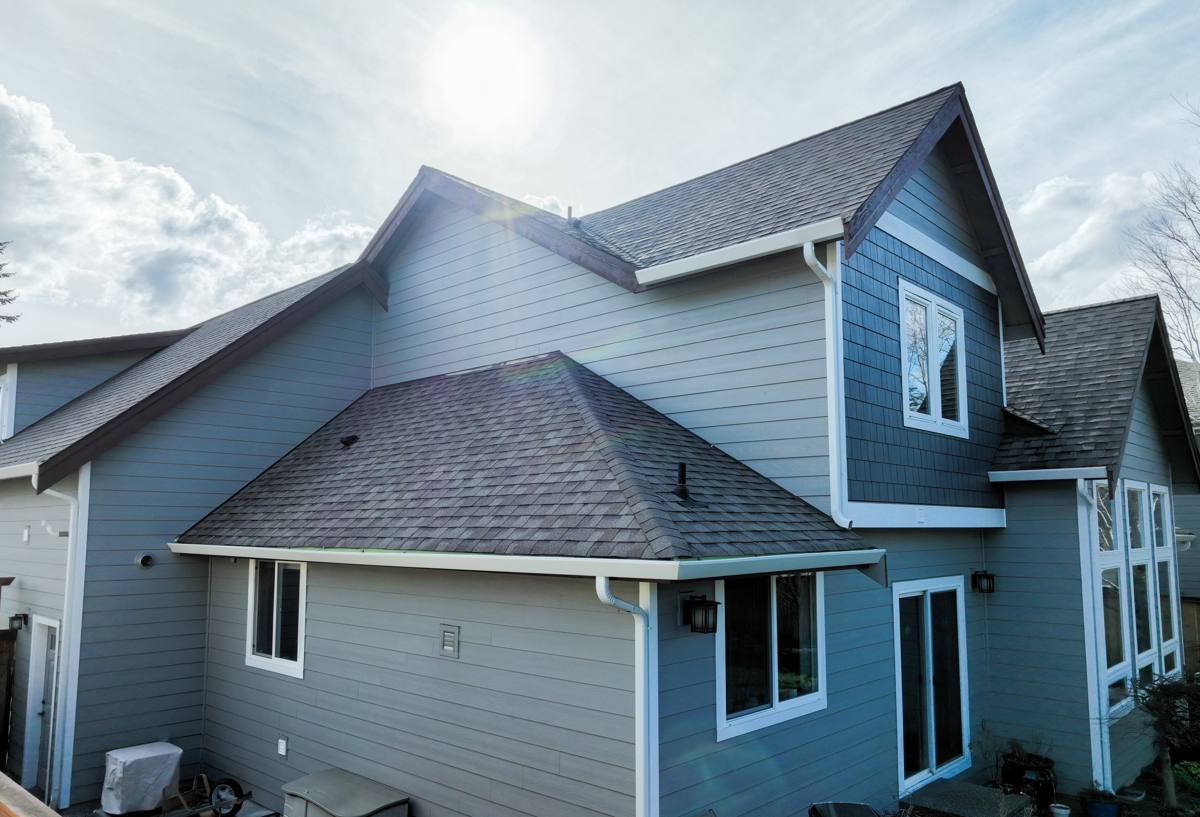
What Sudden Valley's Climate Actually Does to Siding
Sudden Valley sits back from Bellingham Bay, tucked into the timber around Lake Whatcom, so it doesn't take the direct salt-laden wind that hits waterfront homes closer to the water. But that distance doesn't buy much of a break. The tree canopy and lake humidity create their own problem: siding here dries slower than siding on an open lot, and slow-drying siding is exactly what moss, algae, and mildew need to take hold.
Combine that with Whatcom County's driving winter rain — often wind-driven, often sideways — and you get two failure modes that show up again and again on homes in this area:
- Surface growth (moss and green algae staining) on shaded, north-facing, and tree-covered walls that never get enough sun to dry out between storms
- Moisture intrusion behind the cladding where water finds a way past face-sealed joints, poor flashing, or siding installed tight to the sheathing with no way to drain or vent
The first problem is cosmetic and manageable. The second one rots sheathing and framing behind walls that look fine from the driveway. A correct siding job in this microclimate has to account for both, and board and batten — because of its vertical seams and batten strips — needs more attention to detail than a standard lap profile to get it right.
Why the Lake and Tree Cover Matter More Than the Coastline Here
A lot of general siding advice for Whatcom County talks about salt air and coastal exposure, and that's real for homes closer to Bellingham Bay. Sudden Valley's bigger issue is shade and standing humidity — walls that stay damp for days after a storm because sun and wind never reach them. That changes which parts of the job matter most: drainage behind the panel matters more than corrosion resistance on fasteners, and batten placement matters more than it would on a wide-open, south-facing lot.
Why Board & Batten, Specifically, in James Hardie
Board and batten is unforgiving of material choice. The style relies on flat, wide panels and narrow battens holding a crisp, straight line for decades — any warping, swelling, or color fade shows up immediately because there's so little surface detail to distract the eye.
We don't install board and batten in cedar, primed spruce, LP SmartSide, or vinyl. Each of those has a specific reason it doesn't hold up to this look, in this climate, over the long run:
- Cedar board and batten needs regular refinishing and is vulnerable to exactly the moisture and moss exposure Sudden Valley's shaded lots create — the maintenance burden compounds every year the canopy keeps it damp.
- Primed spruce or wood composite panels depend on paint film integrity to stay dry; once a batten seam opens or the finish checks, moisture gets behind the board with nowhere to go.
- Vinyl board and batten profiles are thin and can show waviness in direct light, and the material doesn't hold a crisp panel line the way fiber cement does.
James Hardie's fiber cement panels are dimensionally stable, non-combustible, and finished at the factory with ColorPlus technology rather than a field-applied paint job that has to survive years of PNW rain. That factory finish is the reason board and batten in Hardie holds its line and color on a shaded lot far longer than the alternatives.
What a Correct Installation Actually Involves
Board and batten looks simple — wide panel, narrow batten, repeat — but the installation details are what determine whether it lasts fifteen years or fifty. Most of the failures we get called out to inspect on existing board and batten jobs trace back to shortcuts in three areas.
Drainage Gap Behind the Panel
Board and batten is a face-sealed system by design — the seams are covered by battens rather than lapped like traditional horizontal siding. That makes the drainage plane behind the panel non-negotiable. We install vertical furring strips (or a code-rated drainage wrap system) behind the panel so any moisture that does get past the batten seams has somewhere to go besides straight into the sheathing. On a shaded, slow-drying lot like most of Sudden Valley, skipping this gap is the single biggest reason board and batten jobs fail early.
Batten Spacing and Fastening
Battens need to land over solid backing and be fastened on a layout that matches the framing, not just wherever it looks even. We follow James Hardie's fastening schedule for panel and batten spacing, with battens sized and spaced to actually cover and protect the panel seam underneath rather than just sitting on top of it decoratively.
Flashing, Trim, and Ground Clearance
Every horizontal transition — window heads, roof-to-wall intersections, deck ledgers — needs proper flashing, not just caulk. Caulk is a maintenance item; flashing is permanent. We also hold the panel bottom edge to the manufacturer's minimum clearance above grade, decks, and roof lines, which matters more on wooded, uneven Sudden Valley lots where grading and splashback vary from one side of the house to the other.
Our Process for a Sudden Valley Job
- On-site inspection. We look at existing siding condition, sheathing access points, tree cover and sun exposure on each elevation, and any past moisture damage before quoting anything.
- Tear-off and sheathing check. Old siding comes off and we inspect the sheathing underneath — this is where hidden rot from a previous face-sealed installation usually shows up.
- Weather-resistant barrier and drainage plane. A new barrier and vertical furring or drainage matrix goes on before any panel is hung.
- Panel and batten installation. HardiePanel vertical siding and matching Hardie trim battens go up per the fastening schedule, with attention to elevation-specific exposure — shaded, north-facing walls get the same rigor as sunny ones, since they're the walls most likely to hold moisture.
- Flashing and detail work. Window heads, roof intersections, and any penetrations get flashed correctly, not just caulked over.
- Final walkthrough and warranty registration. We register the installation with James Hardie so the manufacturer warranty is active from day one.
Cost Factors on a Sudden Valley Board & Batten Job
Every home is different, but the line items that move the price on this specific job, in this specific area, tend to be the same ones:
| Cost Factor | Why It Matters in Sudden Valley |
|---|---|
| Tear-off and sheathing repair | Shaded, slow-drying walls are more likely to have hidden moisture damage behind old siding, which adds repair scope before new panel goes up |
| Drainage gap / furring system | Non-negotiable for a face-sealed profile in a high-rain, low-sun-exposure setting — skipping it isn't a real option here |
| Batten layout complexity | Homes with more elevations, gables, and window trim take more batten labor than a simple rectangular wall |
| Site access | Wooded lots, long driveways, and sloped grading around Lake Whatcom can add setup and material-handling time |
| Color selection | Factory ColorPlus finishes come at a range of price points; darker colors and specialty finishes cost more than standard tones |
Why a Crew That Already Works Sudden Valley Matters
Siding work in this neighborhood has a few local wrinkles that a crew unfamiliar with the area tends to miss. Many homes here fall under a community association with architectural or exterior-change guidelines, so it's worth checking before materials are ordered rather than after. Lots are often sloped and wooded, which changes scaffolding, staging, and material access compared to a flat in-town lot. And because Whatcom County's permit and inspection process differs somewhat from projects inside Bellingham's city limits, knowing which jurisdiction applies before work starts saves real time.
None of that is complicated, but it's the kind of thing that either gets handled correctly up front or turns into a delay halfway through the job. A crew that regularly works this specific area has already worked out the routine.
Living With Board & Batten in a Moss-Prone Setting
Fiber cement doesn't rot, and it won't feed moss the way wood siding can, but any exterior surface under heavy tree cover will collect surface growth over time. A properly installed job keeps that growth cosmetic instead of structural. Here's what to check periodically:
- Look at shaded and north-facing walls each fall for early moss or algae staining — a soft wash (never a high-pressure wash aimed at the finish) handles it before it spreads
- Keep tree branches and shrubs trimmed back a few inches from the siding so airflow and sun can reach the wall
- Check that gutters and downspouts are directing water away from the wall base, especially on the downhill side of the house
- Inspect caulking at windows, trim, and penetrations annually — caulk is a maintenance item even on a well-flashed house
- Watch ground-contact areas near decks, planters, or sloped grading for splashback staining at the bottom courses
None of this is heavy maintenance — it's closer to the same seasonal walk-around most homeowners already do for gutters and roofs.
Get a Local Estimate
If you're weighing board and batten for a home in Sudden Valley, we're happy to come take a look, talk through what your specific lot and sun exposure mean for the installation, and put together a straightforward, no-pressure estimate. Use the form below to get started.