 Bellingham Exterior
 Building Decks for Ferndale's Coastal Climate
Ferndale sits close enough to the water that salt air is a real factor in how outdoor structures age, and far enough into Whatcom County's wet-season weather pattern that a deck here spends a good portion of the year damp, shaded, and slow to dry. Add in the driving rain that comes off the coast through fall and winter, and a moss season that can stretch from October well into spring, and you have a climate that is genuinely harder on a deck than what most decking products are designed and marketed for. A deck built the same way you'd build one in a dry inland climate will show problems in Ferndale years before it should — soft spots, corroded fasteners, slick moss-covered boards, and framing that stays wet long after the rain stops.
None of that means a deck can't hold up here. It means the material choices, the framing details, and the drainage plan all have to be built around this specific climate rather than a generic one. That's the difference between a deck that needs real repair work in five or six years and one that's still solid at twenty.
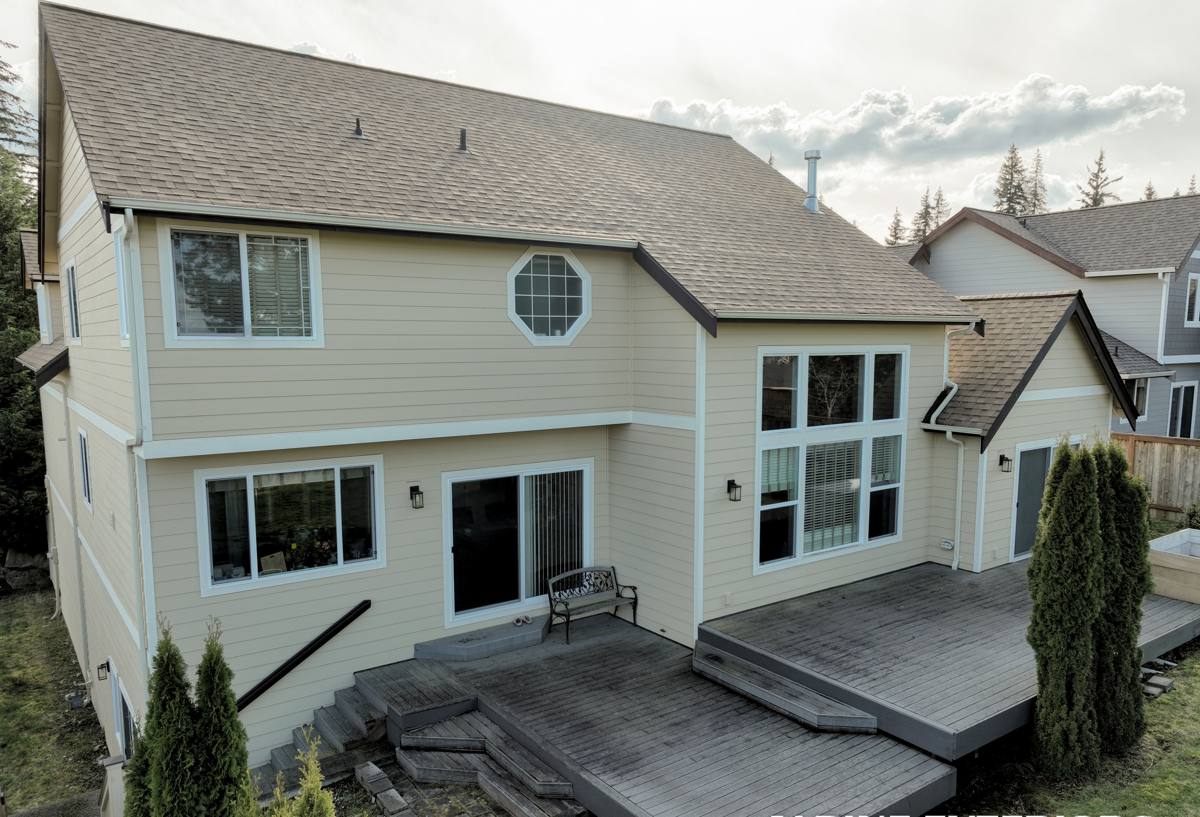
What Ferndale Homes Need From a Deck
Wind and Salt Exposure
Homes closer to the water or on more open, exposed lots take a steadier dose of salt-laden air than homes further inland. Salt air accelerates corrosion in metal fasteners, brackets, and hardware, and it can degrade some finishes and coatings faster than the manufacturer's published timelines assume. It's not a reason to avoid wood or metal in a deck build — it's a reason to be deliberate about which grades of fastener and hardware go into the structure.
Rain Volume and Ground Moisture
Whatcom County gets a lot of rain, and a lot of it comes down hard and sideways rather than as a light, steady drizzle. Ground around a deck's footings can stay saturated for long stretches, which matters for how footings are sized, how deep they're set, and how well the soil around them drains. A deck built on undersized or shallow footings might seem fine through a dry summer and then start showing movement the following winter once the ground around it has been saturated for months.
Choosing the Right Decking Material for This Climate
There's no single "correct" decking material — there's a correct material for a given budget, look, and maintenance tolerance, once you account for how each one actually behaves in a wet, shaded, salt-influenced climate. Here's how the common options compare for a Ferndale-area build:
| Material | Moisture Behavior | Maintenance | Typical Lifespan Here |
|---|---|---|---|
| Pressure-treated wood | Absorbs and releases moisture; prone to cupping and checking if not sealed regularly | Annual cleaning, re-sealing every 1-2 years | 10-15 years with upkeep |
| Cedar | Naturally rot-resistant but still needs sealing in a wet climate to hold color and resist moss | Regular cleaning and periodic finish renewal | 15-20 years with upkeep |
| Capped composite | Doesn't absorb water like wood; less prone to warping, but can stay slick longer in shaded, damp spots | Periodic washing to keep moss and mildew from building up in the cap texture | 25-30+ years |
| PVC decking | Fully synthetic, sheds water well, no internal wood core to rot | Lowest maintenance; occasional washing | 25-30+ years |
Composite and PVC cost more upfront than pressure-treated wood, but in a climate where moisture exposure is constant for months at a time, the reduced maintenance burden and resistance to rot are often worth that difference — especially on a deck that doesn't get much direct sun to dry out between rain events.
Where Wood Still Makes Sense
Wood decking isn't wrong for Ferndale. It's a good choice for homeowners who want the traditional look, are comfortable with a real maintenance schedule, and understand that skipping a sealing cycle in this climate will show up faster than it would somewhere drier. The mistake isn't choosing wood — it's choosing wood and then treating it like a low-maintenance material.
Framing and Structure: Where Lesser Decks Fail First
The decking surface is what you see, but the framing underneath is what determines whether the deck is safe and how long it actually lasts. In a climate this wet, a few framing details matter more than they would elsewhere:
- Ledger flashing — where the deck attaches to the house needs proper flashing so water is directed away from the house structure, not trapped against it.
- Joist protection — joist tape or an equivalent moisture barrier on top of the framing keeps standing water from sitting against the wood where deck screws penetrate.
- Footing depth and bearing — footings need to go below frost depth and land on stable, well-draining soil, not just deep enough to "pass."
- Hardware-rated connectors — structural connectors and hangers rated for exterior, wet-use conditions, not standard interior-grade hardware.
These details don't show up in photos and they don't affect how the deck looks the day it's finished. They show up five to ten years later, in the difference between a deck that's still tight and level and one that's starting to sag, bounce, or separate from the house.
Railings, Fasteners, and Hardware for Salt Air
Fasteners and metal hardware are usually the first thing to show wear on a coastal-influenced deck, well before the decking or framing itself. Standard galvanized fasteners can start showing surface corrosion within a few years in a salt-air environment, especially in fastener heads that stay wet after rain. Stainless steel fasteners and hardware cost more, but they hold up substantially longer under the same exposure, and on visible connections — railing posts, stair stringers, structural brackets — that difference in longevity is worth the added material cost.
Railing systems deserve the same scrutiny. Cable rail and some powder-coated metal railing systems look clean but vary a lot in how well their coatings hold up to salt air over time; wood and composite railing systems avoid that specific failure mode but bring their own maintenance considerations. The right choice depends on the home's exposure and the owner's tolerance for upkeep, not on which railing style is currently popular.
Managing Moss, Mildew, and Drainage Through the Wet Season
A long moss season is one of the more predictable challenges of building a deck in this part of Whatcom County. Moss and mildew need moisture and shade to establish, and a deck that stays damp for weeks at a time in fall and winter gives both exactly that. Good drainage design — proper board spacing, a slight slope away from the house, and clear space underneath the deck for airflow — reduces how much moisture sits on and under the surface in the first place, which reduces how aggressively moss and mildew take hold.
No design choice eliminates the need for some seasonal upkeep, though. A few habits keep a Ferndale-area deck from getting ahead of you:
- Sweep leaves and debris off the deck surface regularly through fall — trapped organic matter holds moisture and feeds moss growth.
- Keep gutters and downspouts near the deck clear so runoff isn't dumping extra water directly onto or under the deck.
- Wash the deck surface at least once a year, more often in heavily shaded areas, to keep moss and mildew from establishing a foothold.
- Check under-deck ventilation isn't blocked by stored items, plants, or added skirting that traps moisture.
- Inspect fasteners and connectors annually for early corrosion, especially near ground level and on stair stringers.
Permits and Code Considerations
Most new decks and significant deck rebuilds in Whatcom County require a building permit, and the requirements cover things like guardrail height, stair geometry, footing depth, and ledger attachment method. These aren't bureaucratic hurdles for their own sake — they exist because deck failures are almost always structural failures that were invisible until they weren't. A contractor who pulls the permit, schedules the required inspections, and builds to the approved plan is giving you a paper trail that protects you at resale and, more importantly, a structure that's been checked by someone other than the person who built it.
Setback requirements from property lines and, depending on the lot, any shoreline or critical-area regulations that apply near water or wetlands can also affect where and how a deck can be built. These vary by specific property, which is another reason a generic national guide isn't a substitute for someone who pulls permits in this county regularly.
Our Deck Building Process
The process for a new deck or a full deck rebuild in Ferndale generally follows the same sequence:
- Site visit and assessment — we look at the ground conditions, sun and shade exposure, drainage patterns, and how the deck will connect to the house.
- Design and material selection — we walk through decking and railing options against your budget and maintenance preferences, being direct about the trade-offs of each.
- Permit handling — we prepare and submit the permit application and plans and schedule the required inspections.
- Demolition and framing — if it's a rebuild, we remove the old structure and check the ledger and existing framing before building new; new builds start with footings and structural framing.
- Decking, railing, and finish work — installation of the decking surface, railing system, and any stairs, followed by a final walkthrough with you before we consider the job done.
Every step is built around the same principle: what's underneath the finished surface matters as much as what you see, especially in a climate that will find any shortcut within a few wet seasons.
Why Hire a Crew That Already Works in Ferndale
A deck built by a crew that only occasionally works in this specific part of Whatcom County can look identical to one built by a crew that works here regularly — until the first few wet seasons pass. Knowing how saturated the ground gets in a typical Ferndale winter, how much salt air a given exposure actually sees, which fastener grades hold up and which don't, and how the local permitting process actually works isn't something you get from a product spec sheet. It comes from building and maintaining decks in this exact climate, seeing what fails and what doesn't, and adjusting accordingly.
That local experience is also what lets a contractor give you an honest answer about material trade-offs instead of just selling you whatever's easiest to install. The right deck for a shaded, low-lying lot near Ferndale isn't always the same as the right deck for an open, sunny lot a few miles away, even though both are technically in the same county.
If you're planning a new deck or need to replace one that's showing its age, we're happy to take a look and walk through your options. The estimate is free, there's no pressure, and you'll get a straight answer about what your property actually needs.