 Bellingham Exterior
 Sudden Valley's Setting Is Harder on Windows Than People Expect
Sudden Valley sits in the trees along Lake Whatcom, and that setting is beautiful right up until you look closely at the windows. Heavy tree canopy keeps most lots shaded for a good part of the day, which sounds pleasant until you realize it also means siding, trim, and window frames dry out far more slowly after rain than they would on an open lot. Combine that with the moisture that comes off the lake itself, and you've got a microclimate that's noticeably damper than a typical Bellingham street just a few miles away.
Add in the broader Whatcom County weather pattern — long stretches of driving rain in fall and winter, wind-driven storms that push water sideways into window openings, and a moss and algae season that can run eight months or more in shaded spots — and you have a recipe for windows that fail years before their rated lifespan. This isn't a scare story; it's just what happens when wood-frame construction sits under a canopy next to a lake in the Pacific Northwest. Windows here work harder than windows almost anywhere else in the county, and they need to be selected and installed with that in mind.
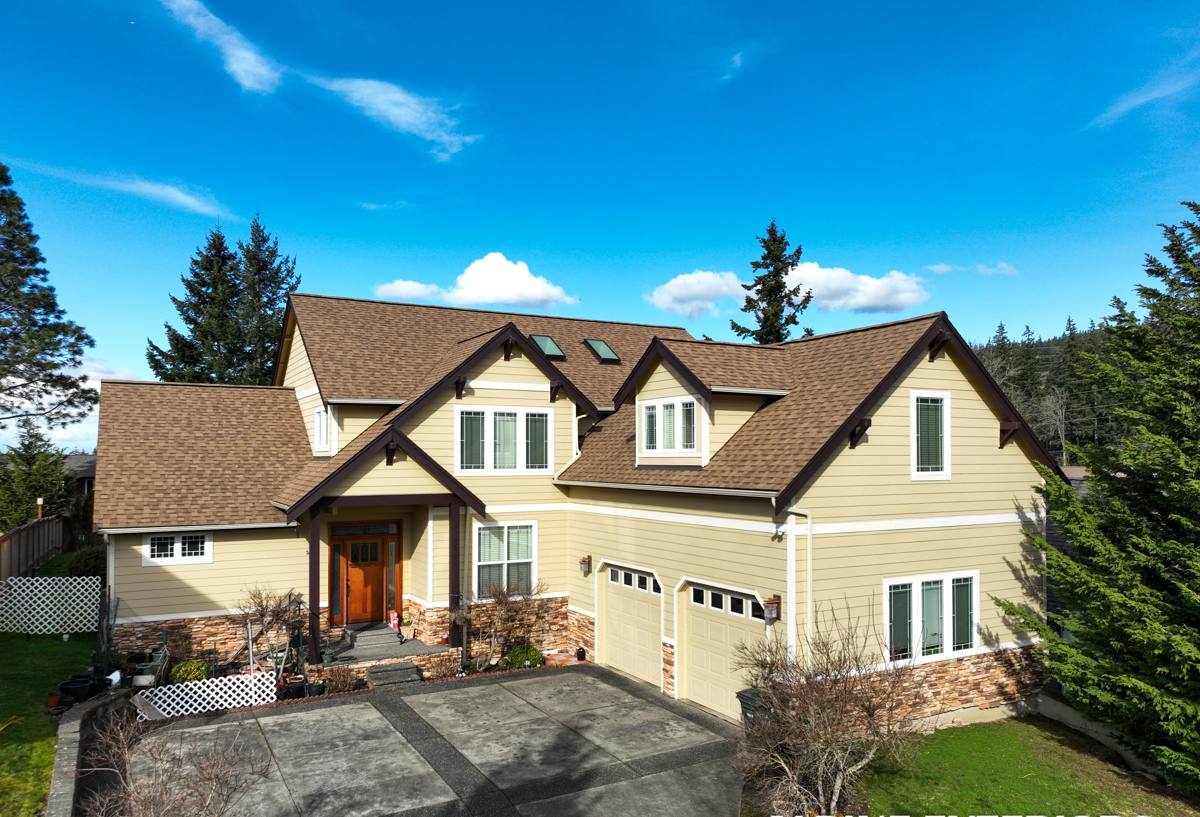
Signs Your Windows Are Losing the Battle
Most window failure in Sudden Valley doesn't show up as a shattered pane — it shows up gradually, and homeowners often live with it for a year or two before deciding to act. Here's what we look for, and what you should be watching for too.
- Fogging or a milky haze between the panes of a double-pane window — this means the seal has failed and the gas fill (or plain air) has been replaced by outside moisture. It cannot be fixed; the sealed unit needs replacing.
- Soft, spongy, or discolored wood at the sill or bottom corners of the frame — a sign moisture has been sitting there long enough to start breaking the wood down.
- Windows that are hard to open, stick in the track, or won't latch flush — frames can swell and warp after repeated wet/dry cycles.
- Visible moss, algae, or dark streaking on or just below the sill — a strong sign the area stays damp longer than it should.
- Noticeable drafts near the frame, or a cold radiating feeling when you stand close to the glass on a windy night.
- A heating bill that keeps climbing even though nothing else about your usage has changed.
Any one of these on its own might not mean much. Two or three together, especially on the shaded or lake-facing side of the house, usually means it's time for a real evaluation rather than another round of caulk and weatherstripping.
What "Energy-Efficient" Actually Means Here
Energy-efficient windows aren't a marketing category — they're rated. Manufacturers publish National Fenestration Rating Council (NFRC) numbers for every unit, and three of those numbers matter more than the rest for a home like yours:
U-Factor
This measures how much heat the window lets escape. Lower is better. In a shaded, damp, wind-exposed spot like Sudden Valley, a low U-factor keeps interior wall and window surfaces warmer, which does double duty — it cuts heating costs and it reduces the surface condensation that feeds mold and mildew growth on interior sills.
Low-E Coatings
A low-emissivity coating is a microscopically thin layer that reflects heat back into the room in winter and blocks excess solar heat in summer. For this climate, a low-E package tuned for heat retention (rather than heat rejection, which matters more in hot, sunny regions) is usually the right call, since Sudden Valley's biggest challenge is keeping warmth in through a long, wet, shaded winter.
Gas Fill and Spacer Systems
Argon-filled double-pane units are standard now and perform noticeably better than plain air-filled glass. The spacer — the material separating the two panes at the edge — also matters more here than in a drier climate; a warm-edge spacer resists condensation forming at the glass edge, which is exactly where we see the most moisture problems on shaded, lake-adjacent homes.
Frame Material Matters as Much as the Glass
We get asked constantly whether the glass package or the frame material makes the bigger difference. Honestly, in a climate like this one, they're close to equally important. The frame is what sits in direct, repeated contact with rain, humidity, and shade — and it's usually the frame, not the glass, that fails first in Sudden Valley homes.
| Frame Material | Moisture & Rot Resistance | Maintenance in Shade/Damp Settings | Typical Lifespan Here |
|---|---|---|---|
| Vinyl | Good — won't rot, but can warp under prolonged trapped moisture if installed poorly | Low; occasional cleaning of tracks and weep holes | 20–30 years |
| Fiberglass | Excellent — dimensionally stable, doesn't absorb water | Low; the most forgiving option for heavy shade | 30+ years |
| Wood (unclad) | Poor in this setting without diligent upkeep — prone to rot where finish wears thin | High; needs regular refinishing, especially on shaded elevations | Highly variable, often shortened by moisture exposure |
| Aluminum/vinyl-clad wood | Good if the cladding stays intact; failure points are usually seams and corners | Moderate; watch cladding joints for water intrusion | 20–30 years, dependent on cladding integrity |
We're not against wood windows on principle — they have real appeal and plenty of homes carry them well. But we're honest with Sudden Valley homeowners about the trade-off: an unclad wood frame on a shaded, lake-facing wall is signing up for more maintenance than most people want, and skipped maintenance is exactly what leads to the rot we get called out to fix. For most homes in this specific setting, we steer clients toward fiberglass or a well-built vinyl unit, and reserve wood or clad-wood for elevations that get real sun and airflow.
What a Correct Installation Actually Involves
A window is only as good as its installation, and this is where a huge share of the moisture problems we see actually started — not with the product, but with how it was put in. Given how much water this neighborhood deals with, a few details are non-negotiable:
- Sill pan flashing. A proper sloped pan under the window directs any water that gets past the exterior seal back outside instead of into the wall cavity.
- Correct tie-in to the water-resistive barrier. Flashing tape and house wrap need to be layered shingle-style — upper layers over lower ones — so water sheds outward at every point, not just at the window itself.
- Backer rod and sealant, not just caulk on top. A quality exterior sealant over proper backing accommodates movement without cracking loose the way a thin bead of caulk does after a season or two.
- Insulating the gap without overfilling. Low-expansion foam or backer rod fills the space between frame and rough opening; packing it too tight can bow the frame and cause it to bind.
- An honest call on full-frame versus insert replacement. If we find rot in the rough opening, replacing just the sash into the old frame locks that damage in place. Full-frame replacement costs more but is the only correct fix once rot is present.
None of this is visible once the trim goes back on, which is exactly why it matters who does the work. A window that looks fine from the curb can still be routing water into the wall if these steps were rushed.
Our Process, Start to Finish
Assessment and Measurement
We start by looking at more than the window itself — we check the sill, the surrounding siding, and the interior trim for any signs of moisture already working its way in. Every opening gets measured individually; older homes settle unevenly, and assuming all windows on a wall are identical is how you end up with gaps.
Product Selection
We walk through frame material, glass package, and grille or hardware options based on the specific elevation — a shaded, lake-facing window gets a different recommendation than one on a sunny south wall, even on the same house.
Community and Permit Requirements
If your property is part of the Sudden Valley community association or another HOA, exterior changes — including window style, color, and grid pattern — may need approval before ordering. We're happy to provide the product specs and drawings needed for that process; just loop us in early so it doesn't hold up your timeline.
Installation Day
We protect interior floors and landscaping, remove the old unit, inspect the opening for hidden damage before anything new goes in, flash and install to the standards above, and seal both inside and out. Job-site cleanup is part of the work, not an afterthought.
Final Check
Every window gets operated, latched, and checked for square before we consider the job done. We'll walk you through basic care — clearing weep holes, what to watch for after the first heavy storm — so small issues don't turn into big ones.
Why Hiring a Crew That Already Works in Sudden Valley Matters
Sudden Valley isn't like working a standard Bellingham city lot. The access roads are narrower and windier, many driveways and lots are heavily wooded, staging materials takes more planning, and gate or community-access logistics need to be worked out ahead of time. A crew that's already done projects in the neighborhood isn't guessing at any of that — we show up knowing how to get equipment and materials to your door efficiently instead of burning half a day figuring it out.
More importantly, we've seen firsthand which products and installation details hold up under this specific combination of shade, lake humidity, and driving rain, and which ones don't. That's not something you get from a showroom catalog — it's something you learn by going back to homes in this exact setting and seeing what's still performing years later and what needed to be redone.
Get a Straight Answer for Your Home
If your windows are fogging, sticking, drafty, or just old enough that you're wondering, the honest next step is having someone look at them in person rather than guessing from a list of symptoms. We offer a free, no-pressure estimate for Sudden Valley homeowners — we'll tell you plainly what we find, what your real options are, and what we'd recommend for your specific lot and exposure. Fill out the form below to get started.