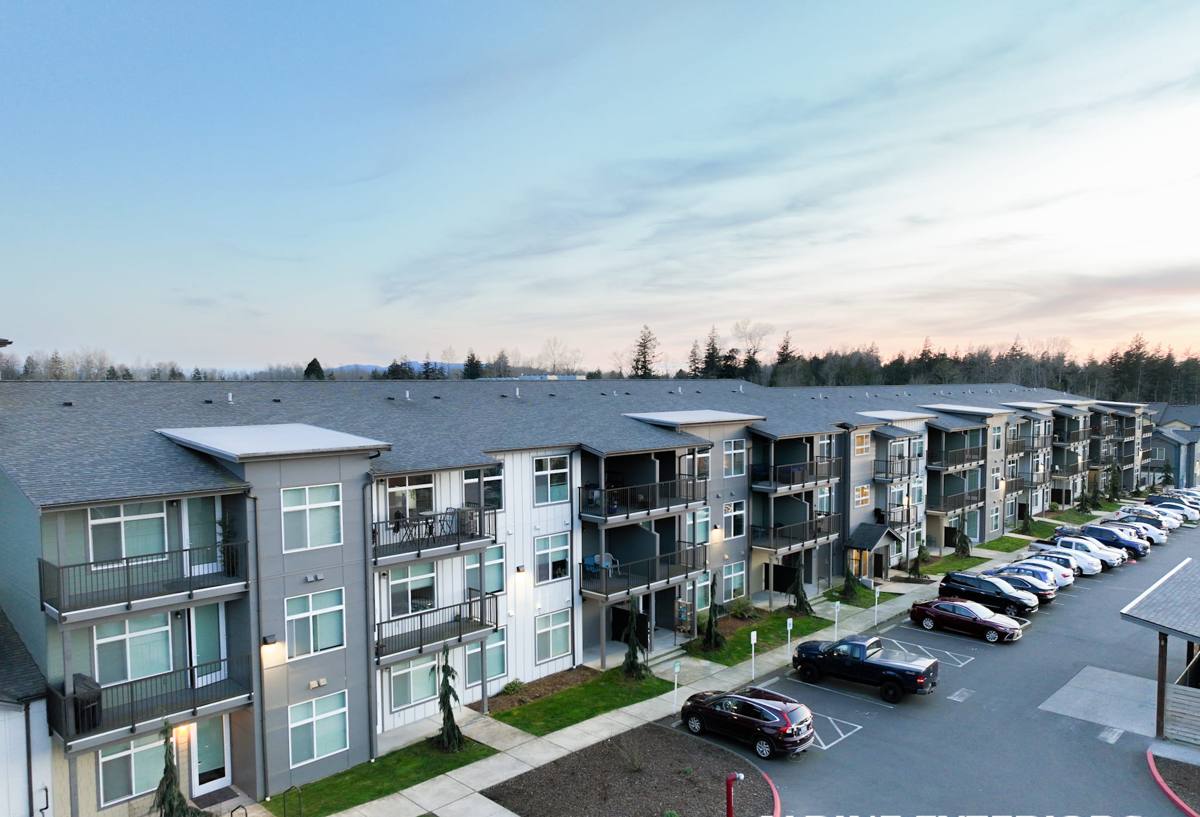
 Bellingham Exterior
 Why Ferndale Homes Need Windows Built for This Climate
Ferndale sits close enough to the water and the marine air off Bellingham Bay and the Strait that homes here take on a different kind of weather stress than houses twenty miles inland. Salt-laden air corrodes hardware and fasteners faster than dry-climate manufacturers account for. Driving rain, pushed sideways by wind off the water, tests every seal and flashing detail a window has. And the long gray stretch from fall through spring keeps north- and west-facing walls damp for months at a time, which is exactly the environment moss and mildew need to take hold on sills, trim, and glazing beads.
None of this means Ferndale is a hard place to keep windows in good shape. It means the windows and the installation have to be matched to the conditions, not just picked off a showroom floor because they looked good in a drier climate's marketing photos. That's the difference between a window that's still tight and clear in ten years and one that's fogging, staining, or letting in drafts by year four.
What "Custom" Actually Means for a Ferndale Job
A lot of window companies use "custom" loosely. For us it has a specific meaning: the window is built to the exact rough opening on your house, not squeezed into the nearest stock size with extra trim to hide the gap.
Why Stock Sizing Falls Short Here
Whatcom County has a wide mix of housing stock — older farmhouses and post-war homes around Ferndale with settled, slightly out-of-square openings, newer construction with modern standard framing, and additions built at different times with different lumber. Stock-size windows assume a perfectly square, standard opening. When that's not what's actually in the wall, installers either force the window in (which stresses the frame and breaks seals early) or pack the gap with extra caulk and trim, which is exactly where water finds its way in during a hard, wind-driven rain.
Where Custom Sizing Pays Off
- Older homes with settling or slightly irregular framing
- Additions or bump-outs where the opening doesn't match modern standard sizes
- Bay, bow, or picture window replacements where the original was a one-off shape
- Matching sightlines when you're replacing some but not all windows on a wall
- Basement or utility openings that were framed by hand decades ago
Material and Glass Choices That Make Sense on the Coast
There's no single "best" window material — there's what fits your house, your budget, and how much upkeep you want to sign up for. Here's how the common options actually perform in a marine climate like this one.
| Material | Coastal Performance | Maintenance | Best Fit |
|---|---|---|---|
| Vinyl | Good — won't rust or corrode, handles moisture well | Low — occasional cleaning | Most homes, value-focused replacements |
| Fiberglass | Very good — dimensionally stable, resists warping in wet-dry cycles | Low | Larger openings, higher wind exposure |
| Wood (unclad) | Poor without diligent upkeep — absorbs moisture, prone to rot near salt air | High — regular painting/sealing | Historic homes where authenticity matters and upkeep is planned for |
| Wood-clad (exterior aluminum or vinyl) | Good — protected exterior face, wood interior | Moderate | Homeowners wanting a wood look inside without full wood maintenance outside |
| Aluminum | Fair — can corrode over time in salt air unless properly finished | Moderate | Specific architectural or commercial applications |
For most Ferndale homes we steer clients toward vinyl or fiberglass frames precisely because they don't give salt air and moisture a foothold. If you love the look of real wood, wood-clad options get you close without the exterior maintenance burden — we'll walk through the trade-offs honestly rather than push whatever has the best margin.
Glass Packages Worth the Upgrade Here
Double-pane with a Low-E coating and argon gas fill is the baseline we recommend for this area — it's a meaningful step up from older single-pane or basic double-pane glass in both insulation and condensation resistance. Triple-pane is worth discussing for north-facing rooms, homes right along the water, or anyone dealing with road or highway noise, but it's not always necessary — we'll tell you when it is and when it isn't for your specific walls.
The Installation Details That Actually Keep Water Out
In a climate where rain regularly comes in sideways, the window unit itself is only part of the equation. Most leaks and rot we get called to fix trace back to installation shortcuts, not a bad window.
Flashing and Water Management
Every opening gets properly flashed so that any water that does get past the exterior cladding is directed back out and down, not into the wall cavity. This means correct layering of flashing tape and building paper — sill pan first, jamb flashing next, head flashing last — so water always sheds downward and outward like shingles, never trapped behind a seam.
Sealing Without Trapping Moisture
It's tempting to just caulk everything solid and call it weatherproof, but a wall needs to be able to dry out if any moisture does get in. We seal the exterior tight while making sure the assembly still has a path to release trapped moisture, which matters more here than in a dry climate where a wall that gets damp once in a while can just dry out on its own between rains.
Fasteners and Hardware
Salt air accelerates corrosion on lower-grade screws, hinges, and cranks. We use fasteners and hardware rated for coastal exposure so you're not dealing with rust streaks or seized hardware a few winters in.
Problems We Commonly See on Ferndale Homes
Moss and Mildew Buildup
Long stretches of damp, shaded weather let moss and mildew establish on sills, exterior trim, and glazing beads — especially on north- and west-facing walls that don't get much direct sun to dry them out. Beyond looking bad, sustained moss growth holds moisture against wood trim and accelerates rot underneath.
Seal Failure and Fogging
Older insulated glass units weren't always sealed to handle constant humidity swings. Once the seal between panes fails, moisture gets trapped and the glass fogs permanently — no amount of cleaning fixes it, and it's a sign the whole unit needs replacing.
Drafts Around Aging Frames
Wood and vinyl frames both shrink and expand with seasonal moisture changes. On older installations, especially ones without proper flashing to begin with, that movement opens gaps that let drafts and wind-driven rain in around the frame edges rather than through the glass itself.
How Our Process Works
- On-site assessment — we look at the actual openings, existing flashing condition, and any signs of past water intrusion before recommending anything.
- Precise measurement — every opening is measured individually; we don't assume uniform sizing across a wall or a house.
- Material and glass selection — we walk through the honest trade-offs for your specific exposure and budget.
- Custom fabrication — windows are built to the measured openings, not adjusted-to-fit stock units.
- Installation with proper flashing and sealing — following the water-management sequence outlined above.
- Final walkthrough — we check operation, seals, and finish work with you before we consider the job done.
Keeping New Windows Performing Long-Term
A well-installed window in this climate still needs a little seasonal attention. This is the routine we recommend to Ferndale homeowners:
- Rinse salt residue and grime off exterior glass and frames a few times a year, more often if you're close to the water
- Clear moss and organic buildup off sills and tracks before it holds moisture against the frame
- Check that weep holes (the small drainage openings on vinyl and fiberglass frames) are clear of debris so water can drain out properly
- Inspect exterior caulking annually and touch up any cracked or separated sections
- Lubricate hardware — locks, cranks, hinges — once a year to keep salt air from seizing moving parts
Why It Matters to Hire a Crew That Already Works in Ferndale
Window installation done right in this part of Whatcom County isn't the same job as installation in a dry inland climate, even though the products on the truck might look identical. A crew that already works Ferndale and the surrounding Bellingham area knows which walls take the worst of the driving rain, which older home styles tend to have irregular framing, and how much margin to build into flashing details for a season that's wet more months than it's dry. That local pattern recognition is what keeps a job from becoming a callback two winters later.
It also means we're not learning on your house. We've seen what salt air does to cheap hardware and what a rushed flashing job looks like five years later, and we build around those lessons from the start.
If you're weighing whether it's time to replace aging windows or you're planning a custom fit for an addition or renovation, we're happy to take a look and give you an honest read on what your home actually needs — no pressure, no sales script. Reach out using the form below to schedule a free estimate.