 Bellingham Exterior
 Sunnyland's Siding Problem: It's Not One Thing, It's Three
Sunnyland is one of Bellingham's older, well-established residential neighborhoods, and homes here take a slow, steady beating from the weather in ways that aren't always obvious until you're up close on a ladder. Sitting close to Bellingham Bay means the air carries a fine load of salt that settles on exterior surfaces year-round. Add Whatcom County's driving, wind-pushed rain — not the gentle vertical kind, but rain that gets pushed sideways into wall assemblies — and a moss season that can run eight months or longer in shaded, north-facing yards, and you've got three separate stressors working on the same siding at the same time.
Most siding products are engineered for one or two of these conditions reasonably well. Very few are engineered for all three at once, which is why so many Sunnyland homes show early paint failure, soft trim boards, or streaked, moss-stained walls long before the siding has reached the end of its realistic service life.
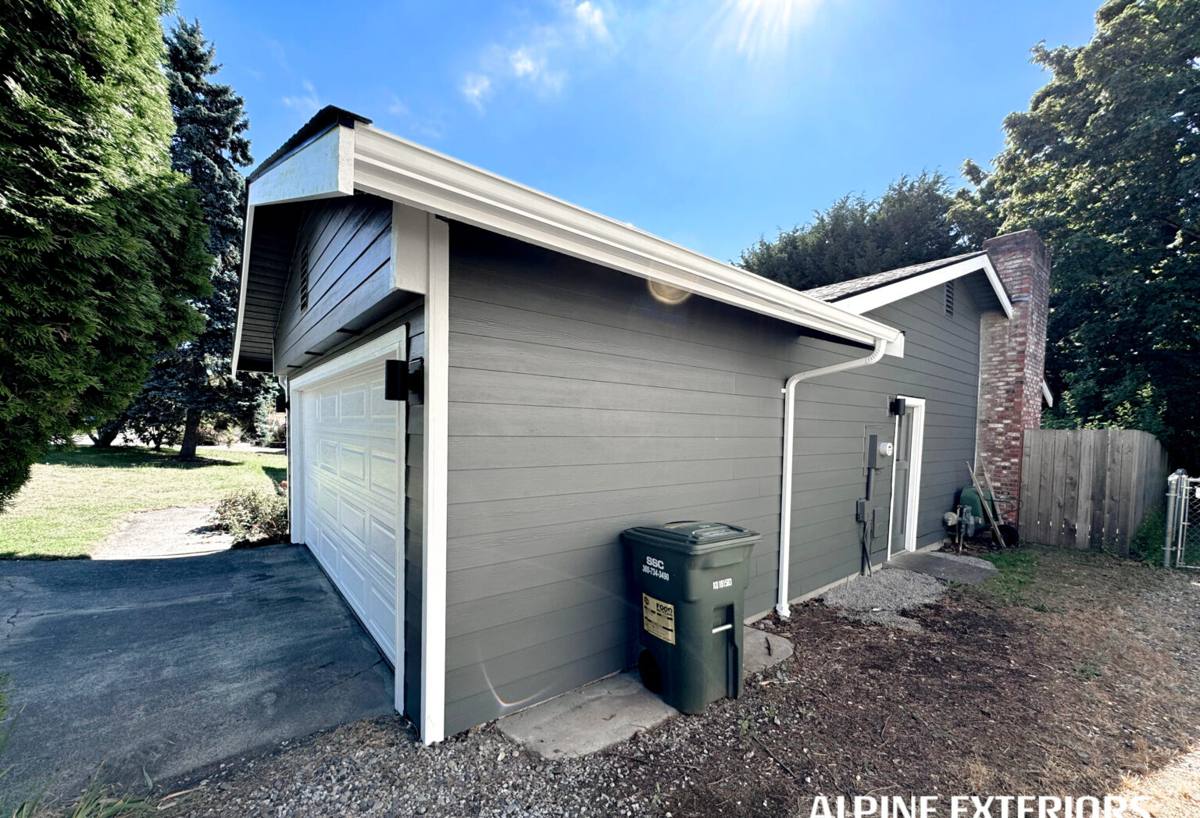
What Sunnyland Homes Actually Need From Their Siding
Moisture Management, Not Just Moisture Resistance
In this climate, the question isn't whether siding will get wet — it will, repeatedly, for months at a stretch. The question is what happens next: does the material shed that water and dry out between rain events, or does it hold moisture against the wall? Products that swell, wick, or trap water behind their surface are the ones that end up rotting from the inside before the outside shows any obvious damage.
Salt-Air Stability
Salt-laden air accelerates the breakdown of paint films and can be harder on fasteners and trim than inland exposure. Siding near the bay needs a finish system that holds its color and seal under that added stress, not just a coating that looks good in a showroom.
A Surface Moss Can't Easily Colonize
Moss needs a damp, textured surface to establish itself, and it will happily do so on siding that stays wet for long stretches in shaded exposures. The material itself, the finish, and correct installation clearances all play a role in how much moss pressure a home ends up dealing with.
Why We Install Only James Hardie Fiber Cement
We've made a deliberate decision as a company: we install James Hardie fiber cement siding, and we don't install vinyl, LP SmartSide, primed spruce, cedar, or other fiber cement brands like Cemplank or Allura. That's not a marketing position — it's a standard we hold because of what we've seen happen to siding in exactly this climate.
Vinyl can crack in cold snaps and warp under heat, and its seams and J-channels give moisture more places to work its way behind the panel over time. Wood species like cedar and primed spruce are genuinely attractive, but they need consistent, ongoing maintenance — recoating, caulking, spot repairs — to hold up against Whatcom County's rain totals, and that maintenance burden is easy to underestimate until you're several years in. LP SmartSide is a wood-strand product with real strengths, but it depends heavily on maintaining an intact factory coating and tight field-applied sealant at every cut edge; any breach lets moisture into the substrate, and strand-based products don't handle that gracefully. Other fiber cement brands compete reasonably on paper, but James Hardie is the manufacturer we've found delivers the most consistent quality control, the deepest regional product engineering, and the strongest track record when installed to spec.
James Hardie is non-combustible, doesn't rot, resists swelling from moisture, and comes with a factory-applied ColorPlus finish that's baked on and warrantied separately from the substrate — which matters directly for salt-air stability. Hardie also engineers its HZ5 product line specifically for climates like ours, with formulations tuned for moisture and freeze-thaw performance rather than a one-size-fits-all national product.
What a Correct Fiber Cement Installation Involves
Fiber cement is only as good as its installation. The material itself is excellent, but a rushed or by-the-numbers install can undercut every advantage it offers. On a Sunnyland home, we pay particular attention to:
- Proper clearance between the bottom of the siding and roofing, decks, patios, and grade — typically at least 1-2 inches — so splash-back and standing water don't sit against the board
- Correct flashing and drainage plane behind the siding, including a weather-resistant barrier that lets any incidental moisture drain and dry rather than pool
- Fastener placement and depth per Hardie's published specs — over-driven or under-driven nails compromise both the weather seal and the finish warranty
- Field-cut edges primed and sealed before installation, since an unsealed cut edge is the single most common point of moisture entry
- Caulking only where Hardie specifies it — not as a substitute for proper flashing and gapping, which is a common shortcut that fails within a few years
- Panel and joint layout planned to shed wind-driven rain rather than catch it, especially on walls facing prevailing weather
Every one of these details is boring on paper and expensive to get wrong. A siding job that looks identical from the curb can behave completely differently in five years depending on whether these steps were actually followed.
Our Process for a Sunnyland Siding Project
1. On-Site Assessment
We start by walking the property and evaluating what's actually happening with the existing siding and the wall assembly behind it — moisture damage, trim condition, ventilation, and any areas where past shortcuts have caused problems. This tells us what needs to change, not just what needs to be replaced.
2. Product and Line Selection
We help you choose the right Hardie product line and profile — lap siding, shingle-style, or panel systems — based on your home's style and its specific exposure, since a shaded, moss-prone side of the house and a bay-facing wall don't always call for the same approach.
3. Tear-Off and Substrate Check
Old siding comes off, and we inspect the sheathing underneath before anything new goes up. Covering damaged sheathing with new siding just hides a problem that will resurface.
4. Weather Barrier and Flashing
We install a proper drainage plane and flashing details at every window, door, and penetration before a single piece of siding goes on. This step is where most long-term failures either get prevented or get built in.
5. Installation to Manufacturer Spec
Siding goes up following Hardie's fastening, clearance, and joint specifications — not shortcuts. This is also what keeps the manufacturer's warranty valid, which matters if you ever need to make a claim.
6. Final Walkthrough
We review the finished work with you, including care and cleaning guidance specific to a Bellingham exposure, before calling the job complete.
Fiber Cement vs. Other Siding Options for This Climate
| Factor | James Hardie Fiber Cement | Vinyl | Cedar / Primed Wood | LP SmartSide |
|---|---|---|---|---|
| Moisture / rot resistance | Excellent — won't rot or swell | Won't rot, but seams trap moisture | Vulnerable without diligent upkeep | Good if coating stays intact |
| Salt-air finish durability | Factory ColorPlus finish, separately warrantied | Can chalk and fade over time | Requires recoating on a set schedule | Depends on factory coating integrity |
| Moss resistance | Dense, stable surface, low moss uptake | Moderate — moss can grip texture | Prone to moss/mildew without maintenance | Moderate |
| Fire resistance | Non-combustible | Combustible | Combustible | Combustible |
| Maintenance burden | Low — periodic wash, no recoating | Low, but seams degrade over time | High — regular sealing/painting | Moderate — edge sealant checks |
Maintenance in a Marine, Moss-Prone Climate
Even a correctly installed Hardie system benefits from a little seasonal attention in this climate. A yearly soft wash removes the fine salt film and organic buildup before it can etch into the finish or give moss a foothold. Keeping gutters clear and downspouts directed away from the wall prevents the kind of concentrated water exposure that stresses any siding material, Hardie included. Trimming back vegetation that shades and dampens a wall for long stretches also cuts down significantly on moss and mildew pressure over time — shaded, north-facing walls in Sunnyland tend to need this the most.
None of this is heavy maintenance compared to a wood or wood-composite system. It's closer to occasional upkeep than a recurring project, which is part of why we standardized on this material for homes in exactly this kind of climate.
What Affects the Cost of a Sunnyland Siding Job
| Cost Factor | Why It Matters |
|---|---|
| House size and wall complexity | More corners, dormers, and trim details mean more cutting, fitting, and flashing work |
| Current siding removal | Tear-off, disposal, and sheathing repair add labor beyond the new material install |
| Product line and profile | Lap, shingle-style, and panel systems carry different material and labor costs |
| Trim and accessory scope | Corner boards, fascia, and window trim replacement affect both cost and long-term water management |
| Access and site conditions | Slopes, tight lot lines, and landscaping can affect staging and labor time |
Why Local Experience in Sunnyland Matters
A crew that has worked on homes throughout Bellingham and Whatcom County knows how differently the same siding product performs on a bay-facing wall versus a shaded interior lot, and adjusts flashing, ventilation, and product choices accordingly. That kind of judgment doesn't come from a spec sheet — it comes from having actually dealt with the moss, the salt exposure, and the driving rain on homes like yours, season after season.
If you're weighing a siding replacement in Sunnyland, we're happy to walk your property, look at what your current siding is telling us, and put together a straightforward, no-pressure estimate for a correctly installed James Hardie system. There's no obligation — just an honest look at what your home needs.