 Bellingham Exterior
 Birchwood's Climate Is Harder on Siding Than It Looks
Birchwood sits close enough to Bellingham Bay and the broader Puget Sound airshed that homes here deal with a slow, steady kind of weathering that's easy to underestimate. Salt-laden air corrodes fasteners and finishes faster than it does further inland. Driving rain off the water pushes moisture sideways into joints and laps that a calmer climate would never test. And Whatcom County's long, damp shoulder seasons keep north- and west-facing walls shaded and wet for months at a stretch, which is exactly the environment moss and algae need to take hold. None of this is dramatic on its own, but stacked together year after year, it's why siding that looks fine on a spec sheet can still fail early on a Birchwood house if it isn't installed with this specific climate in mind.
That's the lens we bring to every siding installation job in this neighborhood. It's not just about hanging boards straight and caulking the seams — it's about building a wall assembly that manages water intentionally, resists moisture absorption at the material level, and holds its finish through decades of marine air and rain.
What Birchwood Homes Actually Need From Their Siding
Moisture Management, Not Just Moisture Resistance
Any siding will shed rain that falls straight down. The test is what happens with wind-driven rain hitting a wall at an angle, which is the norm here more than the exception. That means correctly lapped courses, properly flashed openings, and a continuous weather-resistive barrier underneath the siding itself — the siding is the first line of defense, not the only one.
A Material That Doesn't Feed Moss and Rot
Organic-based siding materials — cedar, primed spruce, and even some engineered wood products — give moss, algae, and fungal growth something to hold onto and, eventually, something to feed on. In a climate with Birchwood's shade and moisture patterns, that's a maintenance burden that starts early and never really stops. Fiber cement doesn't offer that same foothold, which is a big part of why it's become the standard for homes in this kind of environment.
A Finish That Holds Up to Salt Air
Field-applied paint on any siding material breaks down faster near the water — UV, salt, and moisture all work against the bond. A factory-applied finish engineered for long-term adhesion under real weather exposure matters more here than it would fifty miles inland.
Why We Install Only James Hardie Fiber Cement
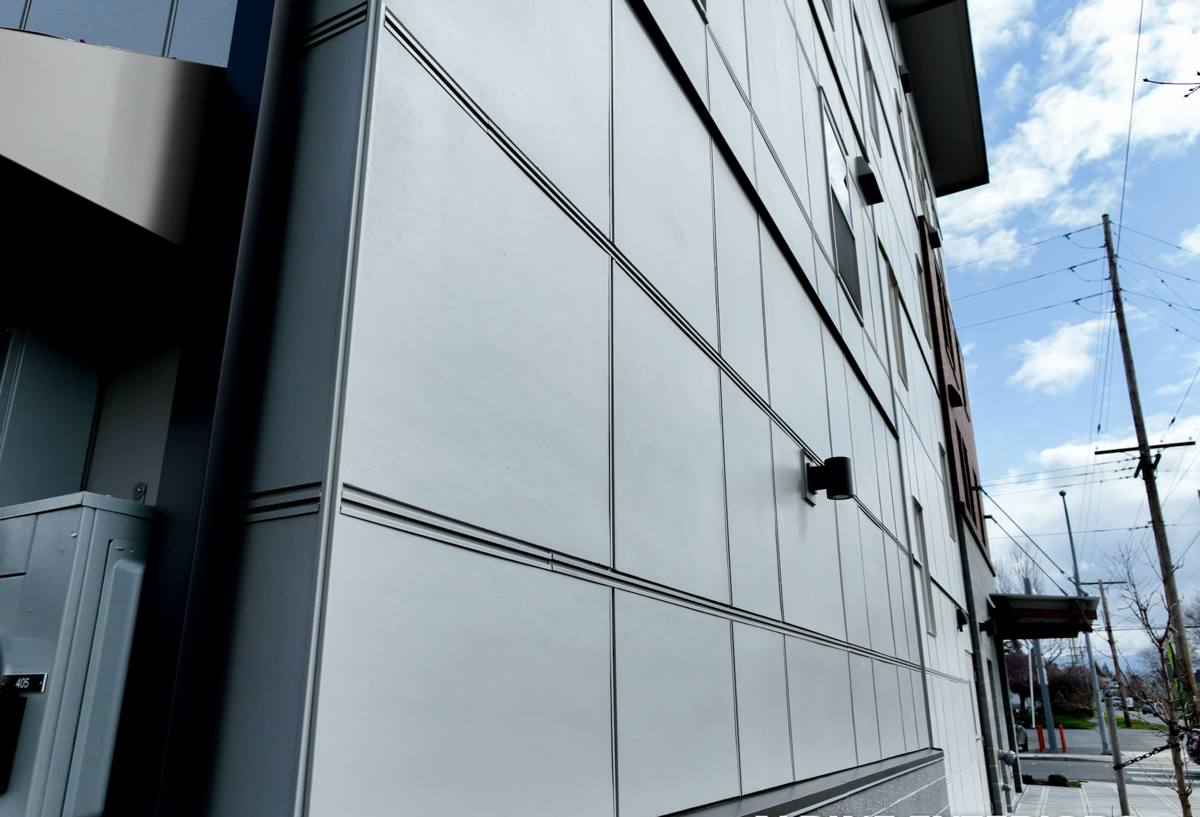
We made a decision, project by project, to stop installing vinyl siding, LP SmartSide, primed spruce, cedar, and other fiber cement brands like Cemplank and Allura — not because those products have no merit, but because after years of work in Whatcom County's climate, James Hardie's fiber cement consistently held up better against the specific stresses Birchwood homes face: salt air, driving rain, and a moss season that runs longer than most homeowners realize.
James Hardie's fiber cement is non-combustible, dimensionally stable in wet climates, and available in HZ5 product lines engineered for regions like ours. Its ColorPlus factory finish is baked on and warranted separately from the substrate, which matters in an environment where field-applied paint takes a beating. It's not the cheapest material on the market, and it's not the easiest to install — it's heavier, requires specific fastening and cutting practices, and punishes shortcuts more visibly than vinyl does. We think that trade-off is worth it for a Birchwood home, and it's why it's the only siding we put on houses.
What a Correct Installation Actually Involves
The material is only half the equation. A lot of premature siding failure isn't a product problem — it's an installation problem. Correct James Hardie installation in this climate means:
- A continuous, properly lapped weather-resistive barrier installed before any siding goes up
- Flashing integrated at every window, door, and roof-to-wall transition — not just caulk covering a gap
- Minimum clearance maintained between the bottom of the siding and grade, decks, patios, and roof lines, per manufacturer specification
- Fasteners driven at the correct depth and location — over-driven or under-driven nails are one of the most common causes of early failure
- Butt joints and corners sealed and flashed to shed water outward, not trap it behind the cladding
- Factory-cut edges caulked or capped so raw, unfinished cement isn't left exposed to weather
- Proper gapping at joints to allow for the material's slight expansion and contraction
Skipping any one of these doesn't usually cause an obvious problem in year one. It shows up in year five or eight, as trapped moisture, staining, or a section of siding that's failing while the rest of the wall looks fine — which is exactly the slow-motion failure pattern Birchwood's climate is good at producing if the details are wrong.
Our Installation Process
Every job follows the same sequence, whether it's a single wall repair or a full re-side:
- Assessment and walk-through. We look at the existing siding, sheathing condition where accessible, drainage around the foundation, and any areas showing moss, staining, or past water intrusion.
- Removal and substrate check. Old siding comes off and we inspect the sheathing underneath for rot or soft spots before anything new goes up — this is the point where hidden problems get caught, not covered over.
- Weather barrier and flashing. A new, continuous weather-resistive barrier goes on, with flashing detailed at every penetration and transition.
- Hardie installation. Boards, panels, or shingle siding are installed to manufacturer specification — correct fastening, gapping, and clearances throughout.
- Trim, caulking, and touch-up. Cut edges are sealed, joints are finished, and any factory finish nicks from handling are touched up with matched product.
- Final walk-through. We go over the finished work with the homeowner before calling the job done.
Cost Factors for a Birchwood Siding Project
Every home is different, but the following factors move the price of a James Hardie installation up or down more than anything else:
| Factor | Why It Matters |
|---|---|
| Home size and wall complexity | More corners, gables, and dormers mean more cutting, flashing, and labor time |
| Siding profile chosen | Lap siding, shingle-style, and panel systems all have different material and labor costs |
| Substrate condition | Rotted sheathing found during tear-off adds repair work before new siding can go on |
| Existing siding removal | Full tear-off costs more upfront than installing over sound existing sheathing, but avoids covering up hidden problems |
| Trim and detail work | Window and door trim, fascia, and corner detailing add finish-carpentry time |
| Access and site conditions | Multi-story sections, tight lot lines, and landscaping near the walls affect staging and labor |
We walk every project in person before quoting, because on paper two similarly sized Birchwood homes can have very different scopes once you account for substrate condition and wall complexity.
Why Hiring a Crew That Already Works Birchwood Matters
Siding installation isn't a one-size-fits-all trade. A crew that mostly works dry, inland climates can do technically fine work and still get water management details wrong for a neighborhood like Birchwood, where wind-driven rain and shaded, moss-prone walls are the norm rather than the exception. A contractor who already works in and around Bellingham knows which wall orientations need extra attention to flashing, how much clearance really matters near grade in a wet climate, and what moss and staining patterns tell you about where water is actually getting in.
That local pattern-recognition is hard to fake and it's a real part of what you're paying for when you hire a local crew over an out-of-area installer passing through on a broader regional contract.
Signs Your Current Siding Needs Attention
Not every siding problem means a full replacement, but these are worth having a professional look at rather than waiting:
- Persistent moss or algae growth that returns quickly after cleaning
- Soft spots, warping, or visible gaps at seams and corners
- Paint that's peeling, bubbling, or chalking heavily in patches
- Staining below window sills or at wall-to-roof transitions
- Siding that feels spongy or shows discoloration near the base of the wall
Any of these can be an early sign of moisture getting behind the cladding rather than just a cosmetic issue, and catching it early is almost always cheaper than catching it late.
Ready to Talk About Your Home
If you're weighing a siding replacement or repair for a Birchwood home, we're glad to take a look and give you a straight, no-pressure assessment of what your walls actually need. Fill out the form below for a free estimate — no obligation, just an honest read on your siding and what a correct James Hardie installation would involve for your specific home.