 Bellingham Exterior
 Siding Replacement for South Hill Homes
South Hill sits up on the slope above downtown Bellingham, and that elevation cuts both ways. The views are part of why people love living there, but the same exposure that gives you a look at the bay also means your siding takes a steady beating from weather moving in off the water. Homes on South Hill's west- and south-facing slopes catch wind-driven rain straight off Bellingham Bay, while the mature tree canopy on many of the older lots keeps shaded wall sections damp and shaded for weeks at a stretch during our gray months. That combination — salt-tinged air, driving rain, and a moss season that can run from October into May — is exactly the kind of exposure that wears out the wrong siding product fast and is exactly why we only install James Hardie fiber cement.
This page is about one thing: replacing tired, failing, or outdated siding on a South Hill home with a system built to actually hold up here, done by a crew that already knows the neighborhood's housing stock and its problem spots.
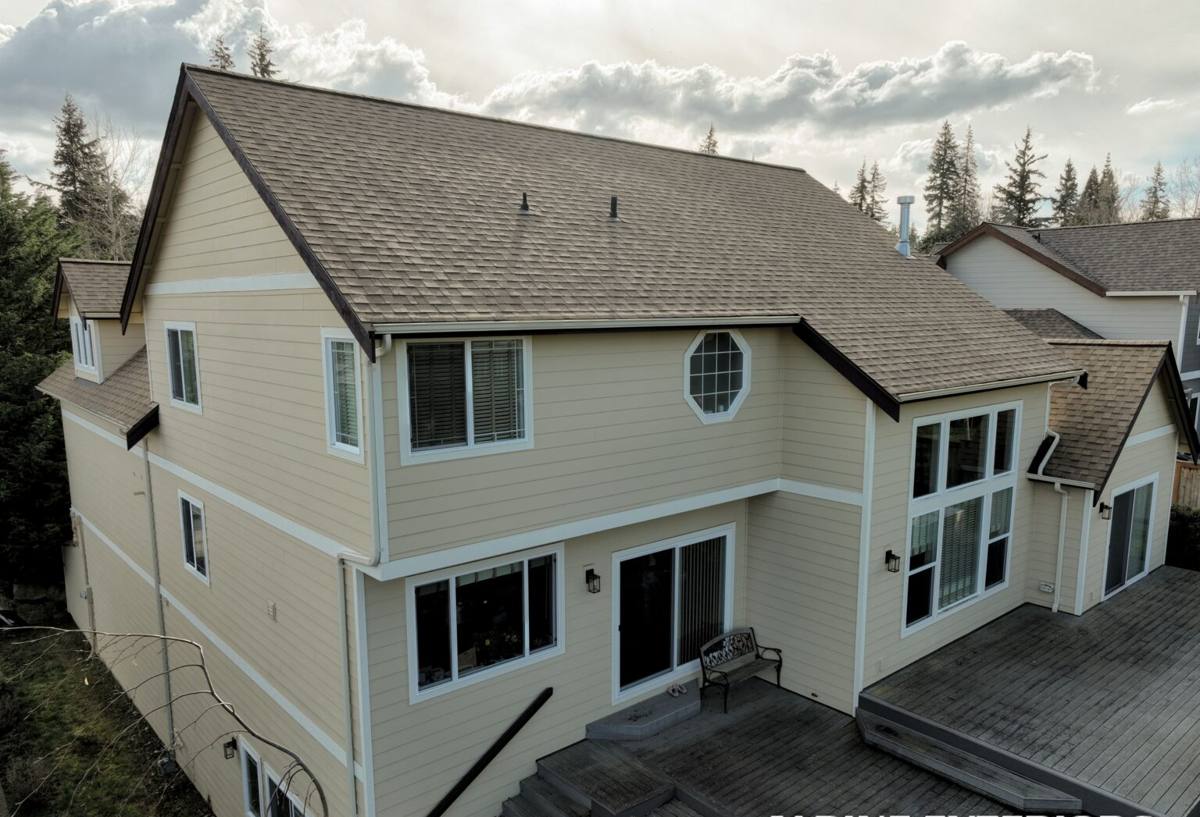
What South Hill's Climate Actually Does to Siding
Salt Air and Moisture Combined
Bellingham isn't a heavy salt-spray coastal town like the outer coast, but South Hill's elevation and bay-facing exposure still put homes in the path of moisture carrying trace salt and organic material off the water. On its own that's manageable. Combined with Whatcom County's rainfall totals and long stretches of damp, low-sun weather, it accelerates corrosion at fasteners and trim, and it feeds the kind of persistent surface moisture that wood-based and wood-fiber siding products are least equipped to handle.
Driving Rain and Wind Exposure
South Hill's slope orientation means rain doesn't just fall — a lot of it arrives sideways during winter storms. Driving rain finds every gap, every under-caulked seam, and every spot where siding wasn't lapped or flashed correctly. Over years, that's how water gets behind siding rather than running off it, and that's where rot and hidden damage start, regardless of what's on the surface.
The Long Moss Season
Shaded, north-facing, and tree-covered walls on South Hill hold moisture long after a storm has passed. That's ideal territory for moss and algae to take hold on siding surfaces, especially anything with a textured or absorbent face. Moss doesn't just look bad — it holds water against the wall surface, which keeps that section of siding perpetually damp and speeds up whatever failure mode the underlying material is prone to.
Signs It's Time to Replace, Not Patch
- Soft, spongy, or crumbling siding when you press on it, especially near the bottom courses or under windows
- Paint that won't hold anymore — blistering, peeling, or needing repainting every few years
- Persistent moss or dark staining that comes back within a season of cleaning
- Visible gaps, warping, or buckling in panels or lap boards
- Soft trim boards or corner boards, which often fail before the field siding does
- Rising energy bills that suggest the wall assembly behind the siding is no longer doing its job
If you're seeing two or more of these, patching individual boards is usually a short-term fix. Once moisture has gotten behind siding in one section, it's often present in adjacent areas that haven't shown visible signs yet.
Why We Only Install James Hardie Fiber Cement
We get asked why we don't offer vinyl, LP SmartSide, or the cheaper fiber cement alternatives like Cemplank or Allura. The honest answer is that after years of doing this work across Whatcom County, we've standardized on one product line because it's the one that consistently holds up to this specific climate without excuses.
Non-Combustible, Dimensionally Stable
James Hardie fiber cement doesn't rot, and it doesn't swell and contract with moisture the way wood-based products do. It's also non-combustible, which matters increasingly to insurers and to homeowners thinking about wildfire smoke seasons even here in Western Washington.
HZ5 Engineering for Our Climate
Hardie's HZ product lines are engineered for specific climate zones, and the versions we install are matched to the wet Pacific Northwest exposure South Hill homes deal with — built to resist moisture intrusion and to hold paint and finish under sustained damp conditions rather than just occasional rain.
ColorPlus Factory Finish
Rather than field-painted siding that's only as good as the weather conditions on install day, ColorPlus finish is baked on at the factory under controlled conditions, which gives it better fade and moisture resistance than most site-applied paint jobs — a real advantage in a place where you're not repainting every wall face in ideal weather.
Warranty That Transfers
Hardie's product warranty is transferable to a new owner, which matters on South Hill where homes turn over and buyers are increasingly asking about siding condition and warranty status during inspection.
What Correct Installation Actually Involves
The product is only half the equation. Most siding failures we get called out to inspect — regardless of brand — trace back to installation shortcuts, not the material itself. On South Hill specifically, correct installation means:
- Proper weather-resistive barrier and rainscreen or drainage gap behind the siding, so any moisture that does get past the surface has somewhere to go
- Correct flashing at every window, door, and roofline intersection — the details driving rain finds first
- Manufacturer-specified fastening patterns and clearances, especially at the ground line where South Hill's damp lower courses take the most abuse
- Proper caulking and sealant at joints, using products rated for this climate, not just whatever's on the truck
- Correct panel and trim overlap to shed wind-driven rain rather than trap it
We install to Hardie's published specifications, not a shortcut version of them. That's a deliberate standard, not a sales pitch.
How Our Process Works
- On-site assessment — we walk the exterior, check for hidden moisture damage at trim, corners, and penetrations, and look at how your specific lot orientation and tree cover are affecting different wall faces
- Scope and product selection — we recommend the Hardie product line, profile, and color that fits your home and exposure, and explain the reasoning
- Tear-off and sheathing check — we remove the old siding and inspect the sheathing underneath for rot or damage before anything new goes up, since covering a compromised wall assembly just hides the problem
- Weather barrier and drainage plane — installed correctly before a single piece of siding goes on
- Installation to spec — fastening, flashing, and sealing done to manufacturer detail, not approximated
- Final walkthrough — we go over the finished work with you before we consider the job done
Why Hire a Crew That Already Works South Hill
South Hill isn't uniform. A house near the top of the slope with open bay exposure has different wind and rain loading than one lower down under tree cover. A crew that's worked the neighborhood knows which wall faces on a given lot orientation tend to hold moisture, where moss comes back fastest, and how the older housing stock here was typically built — which affects what's waiting under the old siding once it comes off. That local knowledge shortens the surprises during tear-off and helps get the detailing right the first time, on the faces of the house that actually need the extra attention.
Cost Factors to Expect
| Factor | Why It Matters on South Hill |
|---|---|
| Home size and wall complexity | More corners, dormers, and roof intersections mean more flashing detail work |
| Extent of hidden damage found at tear-off | Sheathing or framing repair adds scope once old siding comes off, common on older, tree-shaded homes |
| Product line and profile chosen | Lap, shingle, and panel profiles vary in material and labor cost |
| Trim and accessory scope | Corner boards, fascia, and soffit work often get replaced alongside failing siding |
| Site access and slope | Steep South Hill lots can affect staging, scaffolding, and material handling costs |
We give you a real number after seeing the house, not a phone-quote guess — too much of the cost depends on what we find once the old siding is off.
Maintenance After Installation
James Hardie siding installed correctly needs far less upkeep than wood-based alternatives, but South Hill's moss season still calls for occasional attention: a gentle rinse of shaded, tree-covered wall sections once a year keeps organic growth from establishing, and a quick visual check of caulking at trim joints every couple of years catches any sealant that's aged out before it becomes a moisture path. That's a fraction of the maintenance wood-based or vinyl siding typically demands in this climate.
If your South Hill home's siding is past patching, or you just want an honest read on what shape it's in, we're happy to take a look. Reach out for a free, no-pressure estimate — the form below gets you started.