 Bellingham Exterior
 Sudden Valley Is Its Own Microclimate
Sudden Valley sits in a wooded, lake-adjacent pocket of Whatcom County, and that setting changes what siding has to deal with compared to a house a few miles away in open Bellingham. Mature tree cover means constant shade on large sections of most homes. Proximity to Lake Whatcom keeps humidity higher and drying times longer. Add the marine air drifting in from Bellingham Bay and the driving rain that comes with Pacific storms off the Puget Sound corridor, and you have a combination that's genuinely harder on exterior materials than a typical suburban lot. Siding that would hold up fine in a drier, sunnier neighborhood can struggle here.
This page is about one job in one place: fiber cement siding for Sudden Valley homes specifically. Not a general siding overview — what this neighborhood's climate demands, what a correct installation looks like, and why the crew doing the work matters as much as the material itself.
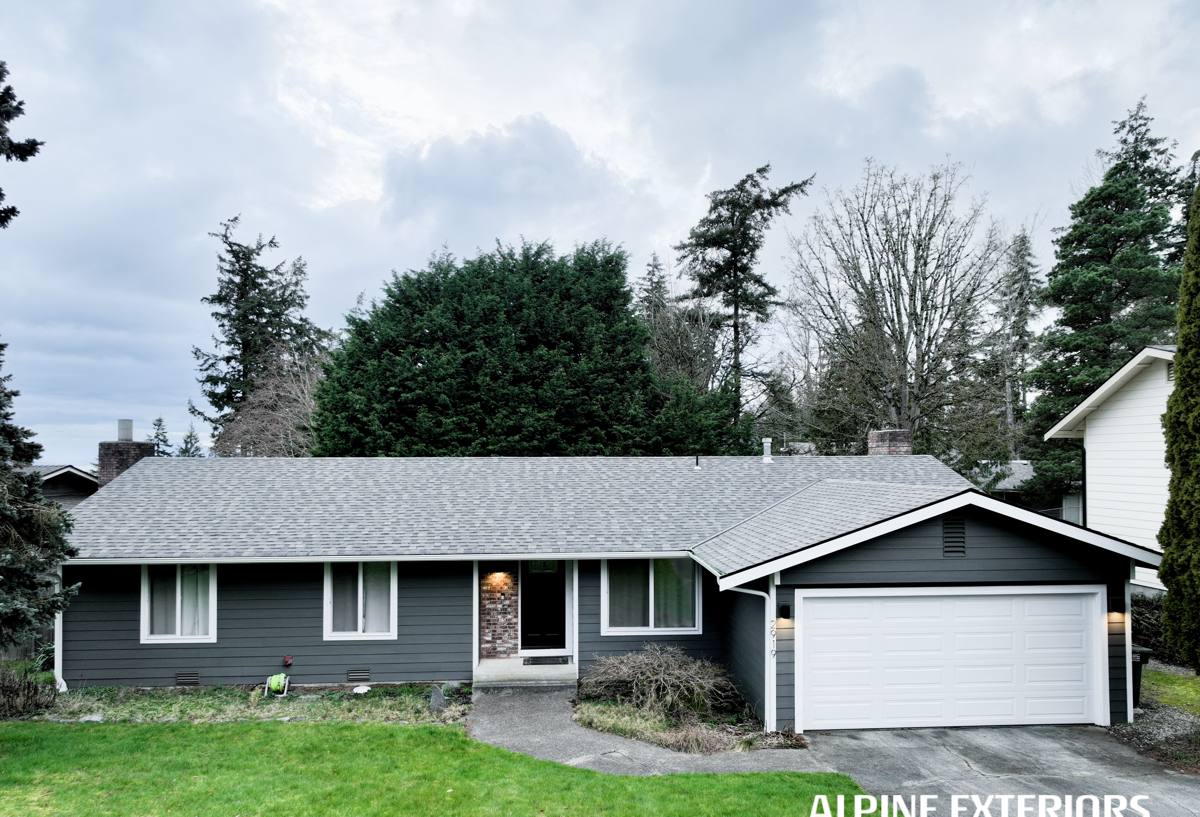
What Shade, Moisture, and Moss Actually Do to a Home's Exterior
Wooded lots are one of the reasons people choose Sudden Valley, but tree cover has a direct cost for siding performance:
- Extended moss season. North-facing walls and anything shaded by conifers can stay damp for days after a storm, giving moss and algae a long runway to establish, especially on textured or porous surfaces.
- Slow drying cycles. Less direct sun means less evaporation. Any siding product that absorbs moisture at the surface or through cut edges holds that moisture longer here than it would in an open, sunny yard.
- Driving rain exposure. Lake-adjacent lots and open water frontage can funnel wind-driven rain directly at walls, pushing water into laps, seams, and fastener penetrations that aren't detailed correctly.
- Organic debris. Needles, leaves, and pollen collect against siding and trim, holding moisture against the surface and accelerating both moss growth and, on the wrong material, softening or swelling.
None of this is unique to Sudden Valley in theory — but the degree to which it shows up here, on nearly every lot, is higher than in most Bellingham neighborhoods. That's why we treat siding jobs in this community as a distinct scope, not a copy-paste of a job from a drier part of town.
Why This Matters More Than It Seems
Moss and algae staining are cosmetic, but they're also a warning sign. A wall that grows moss quickly is a wall that stays wet longer than it should — and materials that swell, delaminate, or rot when they stay wet are the ones that fail early. The siding choice and the installation details both have to account for that reality from day one, not get patched later.
Why We Only Install James Hardie Fiber Cement Here
We don't install LP SmartSide, vinyl, Cemplank, Allura, or bare cedar or spruce siding, in Sudden Valley or anywhere else we work. That's a standard we hold company-wide, but it matters more in a shaded, moisture-heavy neighborhood like this one:
- Engineered wood (LP SmartSide) is wood-based. In a spot where walls stay damp for extended periods, any breach in the factory coating or field-cut edge sealing gives moisture a path into the substrate. It's a well-built product, but it depends on flawless sealing being maintained for its life — a tall order under constant shade and moss pressure.
- Vinyl siding doesn't rot, but it isn't rigid, and it isn't a substrate for anything itself. It also tends to trap moisture behind it if the wall assembly isn't ventilated correctly, and it doesn't hold up as well cosmetically once algae and moss take hold on textured panels.
- Bare cedar or unfinished spruce is a real wood product that needs ongoing refinishing to perform. In a shaded, high-moisture site, that maintenance interval shortens considerably, and skipped maintenance shows up fast as checking, graying, and rot at end grain.
James Hardie fiber cement is cement, sand, and cellulose fiber — it doesn't rot, it doesn't feed moss the way organic material does, and it's non-combustible. The ColorPlus factory finish is baked on under controlled conditions, which holds up better against the mold and mildew that shaded, damp walls invite than a field-applied paint job. That combination is why it's the only product we put on homes, and it's a particularly good fit for a neighborhood like Sudden Valley.
What a Correct Installation Involves
Fiber cement is only as good as the installation behind it. A rushed or undertrained crew can turn a 30-to-50-year product into a callback within a few winters. On a shaded, wet lot, these details matter even more than usual:
Water Management Behind the Siding
Every installation needs a drainage plane — a weather-resistant barrier and, ideally, a rainscreen gap — so any moisture that gets past the siding face has somewhere to go instead of sitting against the sheathing. On lots that stay wet longer, skipping or shortcutting this step is exactly how hidden rot starts behind siding that looks fine from the driveway.
Flashing and Penetrations
Every window, door, deck ledger, and utility penetration is a place water can get behind the siding. Correct step flashing, head flashing, and kick-out flashing at rooflines aren't optional extras — they're what keeps driving rain from finding its way in, especially on walls that catch wind off the lake.
Fastening and Clearances
Hardie's installation instructions specify fastener type, spacing, and placement, along with minimum clearances from grade, roof lines, and decks. Those clearances aren't arbitrary — they keep splash-back and standing moisture away from the bottom edge of the siding, which is the first place failure shows up on a damp lot.
Joints and Caulking
Butt joints, corners, and trim intersections need the right sealant, applied correctly, or they become the first entry point for bulk water. On a shaded wall that doesn't get much sun to help dry out a bad seal, a sloppy joint fails faster than it would elsewhere.
Choosing the Right Hardie Line and Finish for a Wooded, Lake-Adjacent Lot
James Hardie makes climate-engineered HZ product lines, and for the Pacific Northwest's wet weather, the HZ5 formulation is the right baseline. Beyond that, a few choices matter specifically for a shaded, moss-prone site:
| Choice | Why it matters in Sudden Valley |
|---|---|
| Smooth vs. woodgrain texture | Smooth ColorPlus finishes shed algae and moss spores more easily than deep woodgrain texture, which gives organic growth more surface to grip in shaded spots. |
| Matte and darker tones | Hide the early stages of pollen and organic staining better between cleanings than very light, glossy-leaning colors, though no finish is immune. |
| HardiePlank lap vs. HardieShingle | Lap siding sheds water fastest and suits most walls; shingle profile adds character on gables or accent areas but has more shadow lines that hold moisture and debris longer. |
| Trim and soffit material | Matching Hardie trim keeps expansion, moisture behavior, and finish life consistent — mixing in wood trim reintroduces the rot risk the siding itself is designed to avoid. |
We walk through these trade-offs on-site, looking at each elevation's actual sun and shade exposure rather than picking one spec for the whole house.
Our Process for Sudden Valley Jobs
- On-site assessment. We look at moisture patterns on the existing siding, check for soft spots or rot at trim and penetrations, and note which elevations get the least sun.
- Scope and product plan. We spec HZ5 Hardie products, profiles, and colors by elevation, and confirm the water management plan for the specific wall assembly.
- Tear-off and inspection. Removing the old siding lets us inspect sheathing for hidden damage before anything new goes on — this step gets skipped by crews trying to move fast, and it's the step that prevents surprises later.
- Weather barrier and flashing. Housewrap or equivalent barrier, plus flashing at every penetration and transition, installed before a single piece of Hardie goes up.
- Installation to spec. Correct fastening, clearances, and joint treatment, following Hardie's published installation requirements.
- Final walkthrough. We inspect our own work against the plan before calling the job done, and go over care basics for the specific site conditions.
Living With Fiber Cement in a Shaded, Damp Setting
Fiber cement is genuinely low-maintenance compared to wood or engineered wood, but "low-maintenance" isn't "no-maintenance" — especially on a wooded lot. A basic seasonal routine keeps it looking right and catches problems early:
- Rinse siding with a garden hose and soft brush once or twice a year, more often on heavily shaded elevations.
- Clear gutters and downspouts before the fall rains so overflow doesn't run down the wall face.
- Trim back branches and shrubs that keep siding shaded and damp, and clear debris that collects at the base of walls.
- Watch caulked joints and trim intersections for cracking or gaps and have them resealed before a small gap becomes a water path.
- Address any moss growth promptly with a gentle wash rather than pressure-washing, which can force water behind panels or damage the finish.
Why It Matters That We Already Work in This Neighborhood
Sudden Valley is a private community with its own roads, gate access, and often its own architectural review process for exterior changes. A crew unfamiliar with that adds friction — coordinating access, understanding what documentation an HOA might want before work starts, and working respectfully within a tight-knit residential setting. A crew that's already done jobs here knows what to expect and doesn't treat the first day as a learning curve. Combined with a product we stand behind fully and installation practices matched to what this specific climate demands, that experience is what keeps a siding job from becoming a five-year regret.
If you're weighing a siding project for a Sudden Valley home, we're happy to take a look, walk the exterior with you, and lay out honest options — no pressure, no hard sell. Reach out below for a free estimate.