 Bellingham Exterior
 Sunnyland is one of Bellingham's established residential neighborhoods, with a housing stock that spans several decades of construction styles sitting under the same stretch of Whatcom County sky. That matters more than it sounds like it should, because the climate doesn't care how old a house is or what it's clad in. Salt-tinged marine air, rain that comes in sideways as often as it falls straight down, and a moss season that can run most of the year on shaded walls all act on every home in the neighborhood the same way. We install James Hardie fiber cement siding on homes throughout Sunnyland because it's the one system we've found that consistently holds up to that specific combination of stress, and this page walks through what that actually means for a house in this part of Bellingham.
What Bellingham's Climate Does to Siding in Sunnyland
Salt Air
Bellingham sits close enough to the bay that salt-laden moisture moves through the whole city, not just the waterfront blocks. In Sunnyland, that shows up as a slow, steady wear pattern on fasteners, trim, and lower-grade finishes rather than one dramatic event. It's easy to miss year to year and much harder to ignore once corrosion or finish failure has had a decade to work.
Driving Rain
Wind off the Salish Sea pushes rain sideways into this part of Whatcom County, and that changes what a siding system actually has to do. A lap siding installation, a house wrap layer, or a flashing detail that would be fine in a calmer, drier region can still fail here specifically because water is being driven into seams and joints from an angle, not just falling on top of them. Correct lapping and sealed transitions matter more in Bellingham than they would somewhere the rain mostly falls straight down.
A Long Moss Season
Mild temperatures, tree cover, and near-constant dampness combine to keep moss and mildew active on north-facing and shaded walls across Sunnyland for much of the year. Any siding material that holds even a little moisture against the substrate, or that has enough surface porosity to give spores something to grip, becomes a growth surface over time. It tends to show up first in the places homeowners check least often — behind shrubs, under eaves, and on the shaded side of the house.
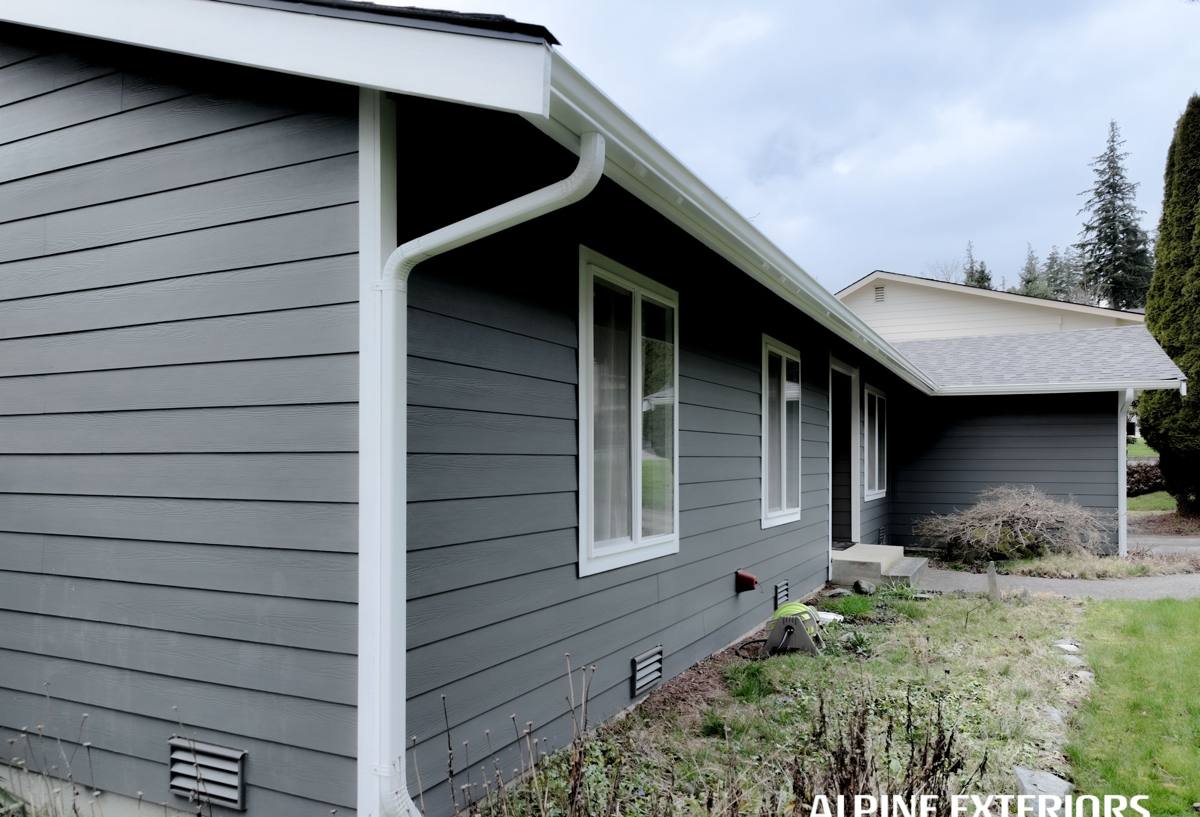
Why We Only Install James Hardie Siding
We don't carry a lineup of siding brands and let price decide the conversation. We install James Hardie fiber cement, and the reason is straightforward: it's what we've consistently seen perform on tear-offs and repair calls in this exact climate.
- Non-combustible core: Fiber cement doesn't feed a fire the way wood-based siding can, which matters for household safety and can matter for insurance considerations as well.
- Factory-applied ColorPlus finish: The color coat is cured in a controlled factory setting rather than brushed on at the job site, which gives it far better resistance to fading and moisture intrusion than field-applied paint.
- Climate-engineered HZ product lines: Hardie's HZ5 formulation is built for regions with sustained moisture and freeze-thaw cycling, which is a closer match to Bellingham's marine climate than a generic national product spec.
- Dimensional stability: Fiber cement doesn't swell, cup, or warp the way engineered wood siding can after repeated wet-season moisture cycles.
- A strong transferable warranty: Hardie backs its products with one of the more substantial warranty structures in the industry, as long as installation follows spec.
We don't install LP SmartSide, vinyl siding, Cemplank, Allura, primed spruce, or cedar. Those are legitimate products, and plenty of contractors install them competently. We made a professional decision that in a climate this consistently wet and salt-exposed, standing fully behind one system is a better position for a Sunnyland homeowner than offering a cheaper option that quietly shifts maintenance risk onto them a few years down the line.
What the Alternatives Trade Off Here
LP SmartSide is an engineered wood product with a resin-treated strand core, and it performs reasonably in drier regions. In a marine climate with this much sustained rain, engineered wood is more sensitive to moisture intrusion at cut edges and fastener penetrations than fiber cement is. Vinyl is inexpensive and low-maintenance in a general sense, but it can warp under direct sun exposure, crack in a cold snap, and trap moisture behind the panel if house wrap and flashing aren't handled carefully — a detail that's easy to get wrong and hard to catch once the siding is up. Cedar and primed spruce look great and age beautifully when maintained, but they need ongoing painting or sealing to keep water out, and in a climate this wet, that maintenance schedule tends to slip in a way that shortens the material's real service life.
What a Correct James Hardie Installation Involves
Choosing the right material only solves half the problem. A Hardie installation performs the way it's engineered to only when the fastening pattern, clearances, joint treatment, and flashing all follow spec together, not as separate steps done in isolation.
Fastening and Clearances
Hardie siding needs to be fastened at the pattern and depth the manufacturer specifies, with correct clearance from grade, roofline, and decking. Skipping this is one of the fastest ways to void a warranty and invite moisture problems that show up years later, long after the crew that cut the corner is gone.
House Wrap and Flashing as One System
Given how much of Bellingham's rain arrives wind-driven, house wrap and flashing can't be treated as two separate checkboxes. Window and door openings, seams, and wall penetrations need flashing that's lapped and sequenced correctly with the house wrap underneath, so water that does reach the wall assembly is directed back out rather than trapped behind the siding.
Joints, Caulking, and Trim
Lap joints and trim transitions are where a rushed installation shows up first — gaps, inconsistent caulking, or boards that weren't properly lapped all give driving rain a path in. We treat these details with the same seriousness as the material choice itself, because a good product installed carelessly will still fail in this climate.
James Hardie Product Lines for Sunnyland Homes
Not every Hardie product fits every house the same way, and part of a correct job is matching the product line to the home rather than defaulting to one option.
| Product | Best Fit | Why It Works in This Climate |
|---|---|---|
| HardiePlank lap siding | Most single-family homes, traditional and contemporary styles | The most common Hardie profile, engineered in the HZ5 formulation for sustained regional moisture |
| HardiePanel vertical siding | Modern styling, accent walls, gable ends | Fewer horizontal laps means fewer joints for wind-driven rain to work into if detailed correctly |
| HardieShingle siding | Craftsman and cottage-style homes | Gives the look of cedar shingle without the ongoing moisture maintenance cedar requires here |
| HardieTrim boards | Window and door casing, corner boards, fascia | Matches the fiber cement wall system so trim and field siding age and perform consistently together |
Color selection matters too. ColorPlus finishes come in a curated palette engineered to hold up against UV and moisture, and we'll walk through which options work best against the tree cover and light conditions typical of a given lot in Sunnyland.
Signs Your Sunnyland Home's Siding Needs Attention
- Moss or dark staining that returns quickly after cleaning, especially on shaded or north-facing walls
- Soft or spongy siding, particularly near the base of the wall or around window and door trim
- Peeling paint, bubbling, or visible warping on siding boards
- Cracked, chipped, or missing sections after wind events
- Visible gaps at seams, corners, or trim joints where water can track in
- A noticeable rise in heating bills that may point to a wall assembly that's no longer sealing properly
Siding Cost Factors for a Sunnyland Home
| Factor | What It Affects | Why It Matters in Sunnyland |
|---|---|---|
| Home size and wall complexity | Total material and labor | More dormers, trim, and roof intersections mean more places for wind-driven rain to find a way in |
| Tear-off vs. overlay | Labor scope and substrate access | A full tear-off exposes hidden moisture damage that's common under decades-old siding in this climate |
| Substrate condition | Repair costs before new siding goes on | Years of trapped moisture behind failing siding can rot sheathing before it's visible from outside |
| Trim and color selection | Material cost and finish longevity | Factory-cured ColorPlus finishes outlast field-applied paint against salt air and UV exposure |
| Site access and lot terrain | Labor time and equipment needs | Mature trees and varied lot grading common in this neighborhood can add staging and setup time |
Real numbers depend on the specific house, which is why we walk the property in person before quoting instead of pricing off square footage alone.
Our Process, Start to Finish
- On-site assessment — we walk the exterior, check the current siding and substrate condition, and note any moisture history or problem areas specific to the home
- Honest scope recommendation — repair, partial re-side, or full tear-off, explained in plain terms with the reasoning behind it
- Product and color selection — matching the right HardiePlank, HardiePanel, or HardieShingle profile and ColorPlus finish to the home and lot
- Tear-off and substrate prep — old siding comes off, and any hidden rot or moisture damage gets addressed before anything new goes up
- House wrap and flashing — installed as one integrated water-management system, not as separate steps
- Siding installation — fastened, lapped, and sealed to Hardie's specification for this region's HZ5 requirements
- Trim, caulking, and final walkthrough — details finished and reviewed with the homeowner before we call the job done
A Quick Checklist Before You Hire
- Confirm the contractor is installing to Hardie's regional HZ5 specification, not a generic national install guide
- Ask how they handle hidden substrate damage found during tear-off, and how that gets communicated before extra work begins
- Verify current Washington state licensing and insurance
- Ask what's covered under the material warranty versus the workmanship warranty, since they're usually separate
- Get a written scope that specifies product line, color, and trim details, not just a total price
Why a Crew That Already Works Sunnyland Matters
A crew that regularly works this part of Bellingham has seen how salt air, driving rain, and a long moss season actually behave on real houses over a full year, not just how a product performs on a spec sheet. That experience shows up in small, practical decisions on install day — which wall orientations stay wet the longest, where extra flashing attention actually pays off, and which shortcuts reliably turn into callbacks two winters later. It also means fewer surprises during the estimate itself, since we're not guessing at how this neighborhood's mix of tree cover, lot grading, and older housing stock affects the job.
Siding problems in Sunnyland rarely start with the siding itself. A leaking roof valley, a poorly flashed window, or a deck ledger trapping moisture against the wall can all surface as siding damage even though the siding is just where the water finally shows up. Because we also handle roofing, windows, and decks, we can look at a home as one connected exterior system and trace a problem back to where it actually starts, instead of re-siding over a leak that's still there underneath.
If your Sunnyland home needs new siding, repair work, or just an honest second opinion on what's really going on behind an aging wall, we're glad to take a look. Reach out using the form below to schedule a free, no-pressure estimate.