 Bellingham Exterior
 Birchwood's Roofs Work Harder Than Most
Birchwood sits close enough to Bellingham Bay and the broader Whatcom County coastline that its roofs deal with a combination most inland homes never see: salt-laden air, long stretches of driving rain off the water, and shaded, moisture-holding conditions that make moss a year-round concern rather than a seasonal nuisance. An asphalt shingle roof in this neighborhood isn't just shedding water — it's fighting slow corrosion of exposed metal, resisting granule loss from constant damp cycling, and hosting moss colonies that can lift shingle edges if nobody's paying attention.
None of that means asphalt shingles are a poor fit for Birchwood. They remain one of the most practical, cost-effective roofing systems available, and when the underlayment, ventilation, flashing, and shingle selection are matched to this specific climate, they perform well for decades. The problems we see in this neighborhood almost always trace back to a roof that was installed using generic, one-size-fits-all methods instead of details suited to a coastal Whatcom County home.
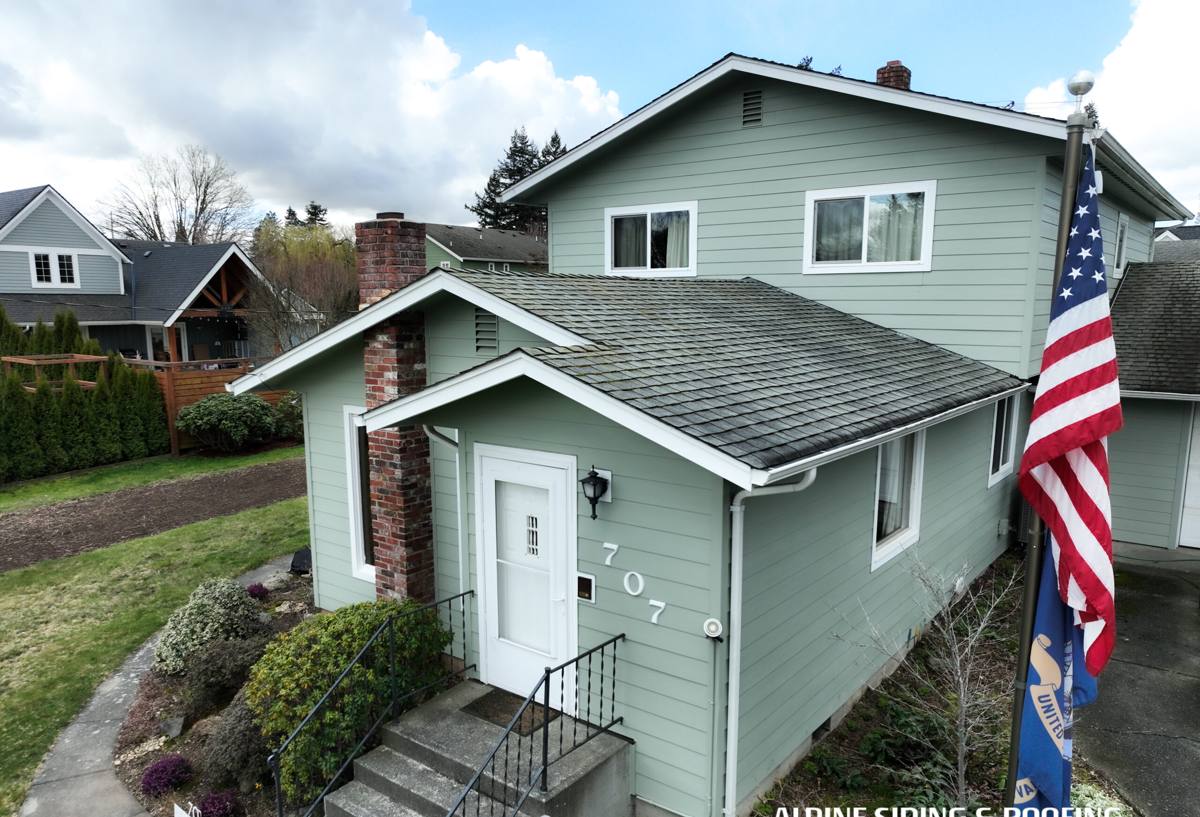
What Correct Asphalt Shingle Roofing Requires Here
A Real Moisture Barrier, Not Just Felt Paper
Standard 15 or 30-pound felt underlayment was designed for drier climates with less sustained rain exposure. In Birchwood, we treat a synthetic or self-adhering underlayment as the baseline, with a proper ice-and-water barrier at eaves, valleys, and any low-slope transitions — the spots where wind-driven rain is most likely to work its way backward under the shingle course.
Ventilation That Matches the Attic, Not a Generic Chart
Salt air and moisture accelerate wear on shingles from below just as much as from above. An attic that can't breathe traps humidity, which shortens shingle life, encourages mold on the sheathing, and can void manufacturer warranties outright. We calculate intake and exhaust ventilation for the actual attic — not a rule-of-thumb estimate — because Birchwood's tree cover and coastal humidity mean many homes need more airflow than the roof was originally built with.
Flashing Details That Actually Get Attention
Chimneys, skylights, dormers, and sidewall transitions are where the overwhelming majority of roof leaks start — not the open field of shingles. Salt air speeds up corrosion on lower-grade flashing metals, so we favor materials and details built to hold up over time rather than the thinnest option that will pass a quick inspection.
Shingle Options for Birchwood: How We Help You Choose
Not every asphalt shingle product performs the same way in a moss-prone, salt-air environment. Here's how the common categories stack up for a Birchwood roof specifically:
| Shingle Type | Moss & Algae Resistance | Wind/Rain Performance | Typical Fit for Birchwood |
|---|---|---|---|
| Standard 3-tab | Lower — flatter profile holds less debris but offers less algae-resistant granule coverage in base-grade lines | Adequate on sheltered roofs; weaker in open, wind-exposed areas | Budget-driven replacements on simpler rooflines |
| Architectural (laminated) | Moderate to high with algae-resistant granules | Stronger wind rating, better water shedding on steeper pitches | Most common recommendation for full re-roofs here |
| Impact-rated architectural | Same granule technology as standard architectural | Highest durability against debris and wind-driven branches | Homes with heavy tree cover or a history of storm damage |
We don't push one brand as universally "the" answer — the right choice depends on your roof's pitch, sun exposure, tree cover, and how long you plan to stay in the home. What we do insist on, as a professional standard, is algae-resistant granule technology on any shingle going onto a Birchwood roof. Skipping that feature to save a small amount up front tends to show up as premature streaking and granule loss within a few years, given how much moisture this area holds.
Our Process, Start to Finish
- On-site inspection. We walk the roof (or inspect from the attic and eaves when walking isn't safe or necessary) and check decking condition, existing ventilation, flashing points, and moss buildup before quoting anything.
- Honest scope discussion. If a repair will genuinely hold for a few more years, we say so. If the decking or underlayment is already compromised, we explain why a full replacement is the more responsible recommendation.
- Written estimate. Materials, tear-off scope, disposal, and any decking repair allowances are spelled out — no vague lump sums.
- Tear-off and decking check. Old material comes off down to the deck so we can inspect for rot or soft spots that a re-layer (installing over existing shingles) would hide.
- Underlayment and flashing installation. This is where most of the long-term performance is decided, and it's the step generic roofing jobs shortcut most often.
- Shingle installation to manufacturer spec. Correct nailing pattern, exposure, and starter course — details that directly affect wind and warranty performance.
- Ventilation confirmation and cleanup. We verify intake/exhaust balance and do a full magnetic sweep and site cleanup before calling the job done.
Moss, Algae, and Salt Air: The Maintenance Reality
Even a correctly installed roof in Birchwood needs periodic attention because of the local environment. Moss doesn't just look bad — its root structure holds moisture against the shingle surface and can lift tabs over time, creating entry points for water. Salt-laden air accelerates corrosion on exposed nail heads, flashing, and any lower-grade metal components. A simple annual or biannual check catches small issues before they become deck-level problems.
- Clear moss and debris from valleys and low-slope areas, where water and organic buildup collect
- Check gutters for granule buildup, which signals accelerated shingle wear
- Look for lifted or curling shingle edges, especially on the north-facing or shaded slopes where moss grows fastest
- Inspect flashing around chimneys and skylights for rust streaks or gaps
- Confirm attic ventilation isn't blocked by insulation, storage, or debris
- Trim back overhanging branches that keep sections of the roof shaded and damp longer than necessary
Signs Your Roof Needs Attention — Not Necessarily Replacement
Homeowners often assume any roof issue means a full tear-off. That's frequently not the case. Watch for these signs and have them evaluated rather than ignored or over-reacted to:
- Granules collecting in gutters or at downspout outlets
- A few cracked or missing shingles after a windstorm, isolated to one area
- Dark streaking that's algae growth rather than structural damage
- Soft spots felt underfoot during a walked inspection (a sign decking may need attention)
- Daylight visible through the attic roof deck at any point
What Drives the Cost of a Birchwood Roofing Project
| Factor | Why It Matters Here |
|---|---|
| Roof size and pitch | Steeper pitches require more safety measures and labor time, affecting overall cost |
| Layers of existing roofing | Tear-off of multiple old layers adds disposal and labor cost but is often necessary to properly inspect decking |
| Decking condition | Coastal moisture means some Birchwood homes need partial deck replacement discovered only after tear-off |
| Shingle grade selected | Algae-resistant, impact-rated, and higher wind-rating products cost more upfront but reduce maintenance and re-work |
| Ventilation upgrades | Adding proper intake/exhaust venting during the same project is far cheaper than a separate future visit |
| Flashing and detail work | Chimneys, skylights, and multiple roof planes add complexity beyond a simple, single-slope replacement |
We provide broad ranges early in the conversation and a firm number once we've actually inspected the roof — every Birchwood home's combination of these factors is different, and we'd rather give you an accurate number than a fast one.
Why a Crew That Already Works Birchwood Matters
A roofing crew that regularly works this specific pocket of Bellingham already knows which slopes tend to hold moss the longest, which flashing details fail first under sustained coastal rain, and how local tree cover affects drainage and drying time after a storm. That familiarity shows up in fewer surprises during tear-off, more accurate estimates, and a finished roof built around how this neighborhood's weather actually behaves — not a textbook climate zone. It also means we're a known, reachable local business if a warranty question or storm-related concern comes up years down the road, rather than an out-of-area crew that's hard to track down.
Workmanship and Warranty
Manufacturer material warranties cover the shingles themselves, but most roof failures we're called to inspect trace back to installation details — flashing, ventilation, or underlayment — rather than a defective shingle. We stand behind our installation workmanship separately from the manufacturer's material warranty, and we'll walk you through exactly what each one covers before work begins, so there's no confusion later about who's responsible for what.
If your Birchwood roof is due for a look — whether it's a full replacement, a repair, or just an honest second opinion — we're happy to come out for a free, no-pressure estimate. Use the form below to get started.