 Bellingham Exterior
 James Hardie Siding Built for Birchwood's Climate
Birchwood homes sit in one of the more demanding stretches of weather in Whatcom County for exterior materials. Salt-tinged marine air moves through the area steadily, wind carries rain sideways instead of letting it fall straight down, and a moss season that can stretch across most of the year settles in on shaded and north-facing walls. None of that is unusual for this part of Washington, but it adds up fast on a wall assembly that wasn't built with those specific stresses in mind. Siding that looks fine going up in dry weather can start showing real problems within a few wet seasons if the material and the installation weren't matched to what Birchwood actually throws at a house.
This page is about one thing specifically: James Hardie fiber cement siding on Birchwood homes. Not siding in general, and not a different product with a different set of trade-offs — what correct Hardie installation looks like in this neighborhood, why it's the only siding system we install here, and how our process runs from first walk-through to final cleanup.
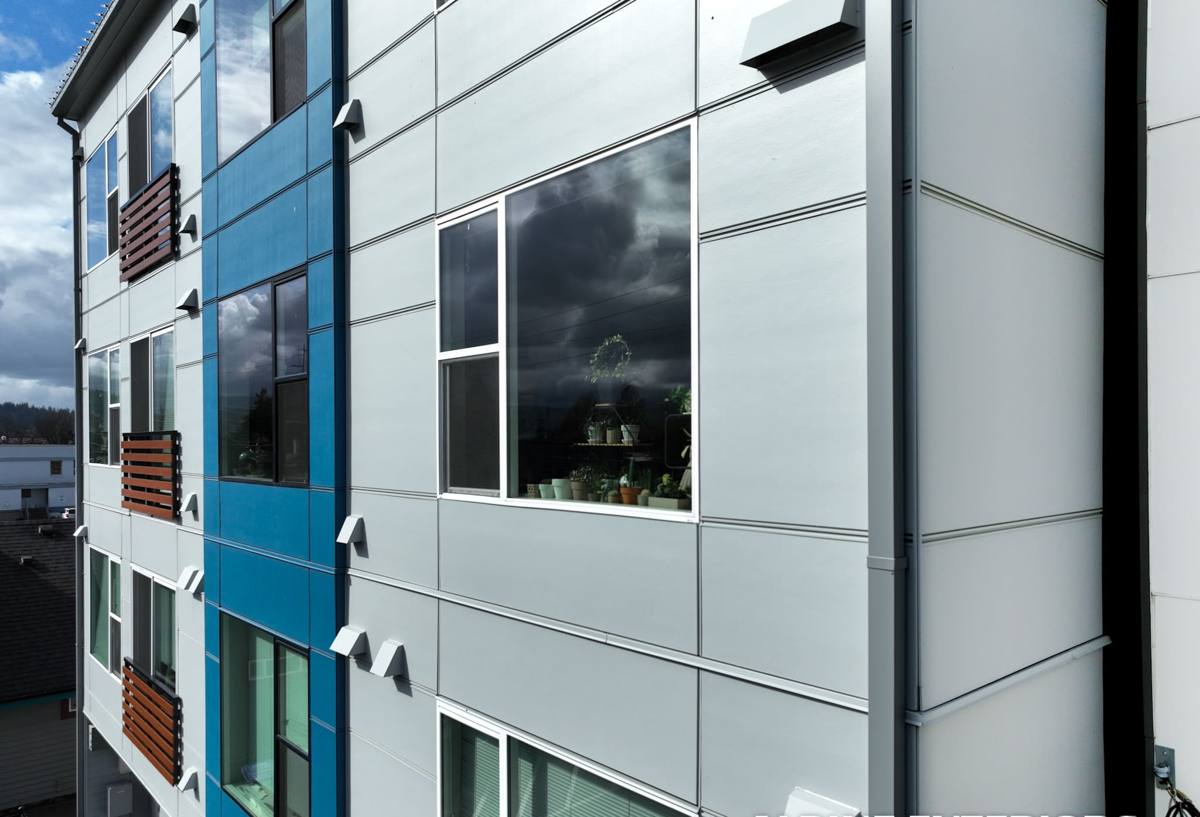
What Birchwood's Climate Does to Siding
Salt Air and Corrosion
Even homes set back from the immediate waterfront in Birchwood get a steady dose of salt-laden air. That air is hard on exposed fasteners, flashing metal, and lower-grade finishes, speeding up corrosion in ways a drier inland climate simply doesn't produce. Siding hardware and trim details that would be fine in most parts of the country can start failing early here if they weren't specified for coastal exposure.
Wind-Driven Rain
Rain in this part of Whatcom County rarely arrives straight down. It gets pushed sideways into lap joints, trim edges, and seams, which is a tougher test than a simple annual rainfall total suggests. A siding system that would perform fine under calm, vertical rainfall can still let water in here specifically because the water is coming from the side, not just from above.
A Long Moss Season
Mild temperatures, shade from mature trees, and near-constant moisture combine to give Birchwood a moss and mildew season that runs long compared to drier parts of the state. Any siding material that holds even a little moisture against its surface becomes a growth surface over time, and it typically shows up first on north-facing walls and shaded elevations well before it's visible from the street or driveway.
Why James Hardie Is the Right Fit for This Neighborhood
We install James Hardie fiber cement siding exclusively, in Birchwood and across the rest of our Whatcom County service area. That's not a brand preference pulled off a supplier catalog — it's a standard we arrived at after seeing, repeatedly, which siding materials actually hold up in this specific mix of salt air, wind-driven rain, and sustained moss exposure, and which ones quietly become a maintenance burden a few years in.
- Non-combustible fiber cement core: Hardie siding doesn't feed a fire the way wood-based siding products can, which matters for household safety and can matter for insurance underwriting as well.
- Factory-applied ColorPlus finish: The color is baked on under controlled factory conditions rather than brushed on in the field after installation, so it resists fading, chalking, and moisture damage far longer than a site-applied paint job.
- Climate-engineered HZ product lines: Hardie's HZ5 formulation is specifically built for regions with heavy moisture exposure and freeze-thaw cycling, which describes coastal Whatcom County, including Birchwood, well.
- Dimensional stability: Fiber cement doesn't swell, cup, or warp the way engineered wood siding can after repeated wet-season moisture cycles.
- Strong transferable warranty: Hardie backs its products with one of the more substantial warranty structures in the siding industry, provided the installation follows the manufacturer's spec.
We don't install LP SmartSide, vinyl siding, Cemplank, Allura, primed spruce, or cedar. Each of those has a place in the broader market and plenty of homeowners are satisfied with them elsewhere. But we made a professional decision that in a climate that pushes this much sustained moisture and salt exposure at a wall, one system we can fully stand behind is worth more than a lower-cost option that quietly shifts maintenance risk onto the homeowner a few years down the road.
What a Correct Hardie Installation Actually Involves
Buying the right material is only half the job. James Hardie siding performs the way it's designed to only when it's installed to spec, and the details that matter most in Birchwood are the ones that are easiest to rush.
Fastening and Clearances
Hardie specifies fastening patterns, nail spacing, and clearances from grade, roofline, and adjacent surfaces for a reason. Skipping or loosening those specs to save time is one of the more common causes of early failure on fiber cement siding, since it changes how the material handles moisture and movement over time.
Lapping, Sealing, and Joint Details
In a climate where rain is driven sideways as often as it falls straight down, how joints are lapped and sealed matters as much as the siding material itself. Poorly lapped seams or under-caulked trim joints give wind-driven rain a direct path behind the siding, which is exactly the failure mode Birchwood's weather is built to exploit.
House Wrap and Flashing Integration
Siding is one layer of a larger water-management system that includes house wrap and flashing at windows, doors, and penetrations. If those layers aren't integrated correctly with the siding, water that gets past the outer surface has nowhere to go but into the wall assembly. This is where a rushed or inexperienced install shows up years later as rot, not on day one.
Field Cuts and Factory Edges
Every field cut on a fiber cement board exposes raw material that needs to be sealed and back-primed correctly, or it becomes a weak point for moisture intrusion at corners, window returns, and trim transitions. Factory edges are protected by the ColorPlus finish; field cuts are not, unless the crew treats them that way.
Our Process for a Birchwood Job
- Walk-through and assessment: We look at the whole exterior, not just the siding that's visibly failing, including trim, flashing, and any signs of trapped moisture behind the current wall covering.
- Honest scope conversation: We tell you whether the job is a full tear-off, a partial repair, or something in between, and explain why, rather than defaulting to whichever option is more profitable for us.
- Tear-off and substrate check: Removing the old siding is when hidden moisture damage becomes visible. We address any rot or compromised sheathing before new siding goes up, not after.
- House wrap and flashing installation: This layer gets installed and integrated with window and door flashing before a single piece of Hardie siding is hung.
- Hardie installation to manufacturer spec: Correct fastening, clearances, lapping, and sealed field cuts, following Hardie's published installation requirements rather than shortcuts that void the warranty.
- Final walk-through and cleanup: We review the finished job with you and leave the site clean, with a clear explanation of any care or maintenance notes specific to your home.
Repair vs. Full Replacement
Not every siding issue in Birchwood calls for a complete tear-off. A section that took storm damage, or trim that's failed around one window, can sometimes be repaired and matched into existing Hardie siding without redoing the whole exterior. But when moisture has been tracking behind the wall for a while, or the existing siding is an older product nearing the end of its service life, patching it usually just delays a larger job and lets hidden damage keep spreading. We'll give you a straight answer about which situation you're actually in.
Cost Factors for a Birchwood Hardie Project
| Factor | What It Affects | Why It Matters in Birchwood |
|---|---|---|
| Home size and wall complexity | Total material and labor | More corners, trim, and joints mean more places for wind-driven rain to find a way in |
| Tear-off vs. overlay | Labor scope and substrate access | Tear-off reveals hidden moisture damage that's common under older siding in this climate |
| Substrate condition | Repair costs before new siding goes on | Trapped moisture behind failing siding can rot sheathing before it's ever visible from outside |
| HZ5 vs. standard formulation | Material cost and long-term performance | HZ5 is engineered for heavy moisture and freeze-thaw exposure, which fits this coastal climate |
| Trim and ColorPlus selection | Material cost and finish longevity | Factory-applied finishes resist salt air and UV far longer than field-applied paint |
| Site access and lot conditions | Labor time and equipment needs | Shaded, tree-covered lots common in Birchwood can add setup and staging time |
Exact numbers depend on the specific home, which is why we walk the property in person before giving a real estimate rather than quoting off a generic price list.
Signs Your Birchwood Home's Siding Needs Attention
- Moss or dark staining that returns quickly after cleaning, especially on shaded or north-facing walls
- Soft or spongy siding, particularly low on the wall or around window and door trim
- Peeling paint, bubbling, or visible warping on siding boards
- Cracked, chipped, or missing sections after storms or wind events
- Visible gaps at seams, corners, or trim joints where wind-driven rain can track in
- Rising energy bills that may point to a wall assembly that's no longer sealing properly
Roofing, Windows, and Decks Alongside Your Siding
Siding problems often trace back to something else entirely. A leaking roof valley, a poorly flashed window, or a deck ledger board trapping moisture against the house can all show up as siding damage even when the siding itself isn't the actual source. Because we also handle roofing, windows, and decks, we can look at a Birchwood home as one connected exterior system instead of diagnosing a wall in isolation and missing where the water is really getting in.
Why Hiring a Crew That Already Works Birchwood Matters
A crew that works across Whatcom County regularly sees how salt air, wind-driven rain, and moss actually behave on real houses through a full year, not just how a product performs on a manufacturer's spec sheet. That kind of repeated, local exposure shapes practical decisions on install day: which wall orientations stay wet the longest, where extra flashing attention pays off, and which details are worth the additional time so you're not dealing with a callback two winters later. Birchwood's particular mix of coastal exposure and shaded, tree-covered lots means those details aren't identical to every other town in the county, and a crew with real local experience accounts for that instead of applying a one-size-fits-all approach to every job.
Get a Free, No-Pressure Estimate
If your Birchwood home needs new James Hardie siding, repair work, or an honest second opinion on what's going on behind an aging wall, we're glad to take a look. Reach out using the form below to schedule a free estimate, no pressure and no upsell script.