 Bellingham Exterior
 Why Blaine's Climate Is Hard on Siding
Blaine sits at the northwest corner of Whatcom County, wedged between Semiahmoo Bay, Drayton Harbor, and the Canadian border, which means homes here take on a combination of weather stresses that inland Bellingham properties don't see as intensely. Salt-laden air moves off the water and settles on exterior surfaces daily, accelerating corrosion of fasteners and finishes. Winter storms roll in off the Strait of Georgia with driving, wind-blown rain that hits siding sideways rather than straight down, forcing water into laps, seams, and butt joints that a calmer climate would leave alone. And because Blaine rarely gets long dry stretches in fall, winter, or spring, north-facing and shaded walls stay damp long enough to grow a persistent coat of moss and algae.
None of this is unusual for a Pacific Northwest coastal town, but it does mean siding decisions that work fine in drier parts of the country don't hold up the same way here. A product that resists moss on paper, or a finish that's rated for average rainfall, has to actually prove itself against salt air and near-constant marine humidity. That's the bar we hold every Blaine siding replacement to.
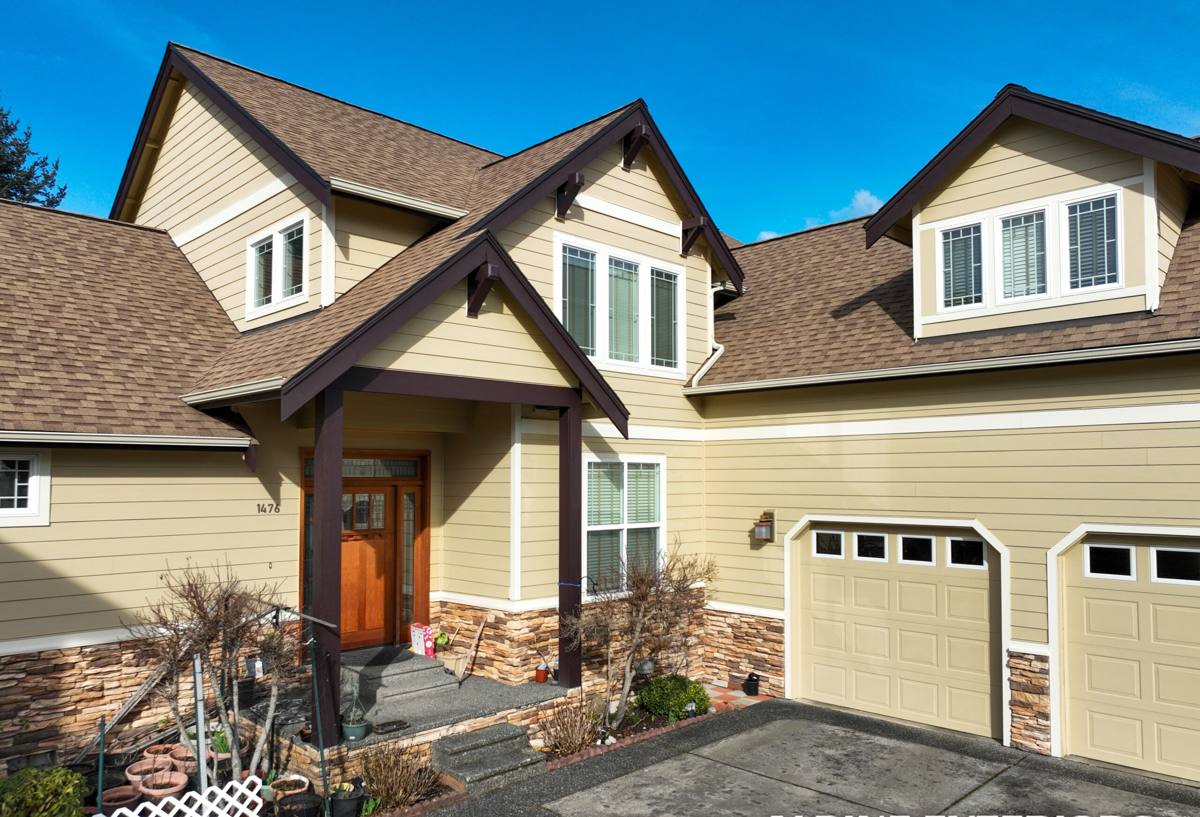
Signs a Blaine Home Needs Siding Replacement, Not Just Repair
Not every siding problem calls for a full replacement, but in a climate like Blaine's, certain signs mean patching is just delaying the inevitable:
- Soft or spongy spots when you press on the siding, especially near the bottom courses and around windows
- Paint that keeps failing within a year or two of repainting, no matter the brand or prep work
- Persistent moss or black streaking that returns within weeks of cleaning
- Visible warping, cupping, or separation at panel seams
- Rusted or bleeding fasteners showing through the surface
- A musty smell or interior wall staining that suggests moisture is getting past the siding entirely
If you're seeing more than one of these, especially on walls that face the water or prevailing storm direction, the siding has likely stopped doing its job as a weather barrier, even if it still looks passable from the street.
Why We Only Install James Hardie Fiber Cement
We don't install vinyl, LP SmartSide, Cemplank, Allura, or primed wood siding, and in a town like Blaine that decision matters more than it might inland. Vinyl siding expands, contracts, and can warp with the temperature swings and wind loads coastal properties see, and its seams are a weak point against wind-driven rain. Wood and wood-based composite products like LP SmartSide depend on an intact factory coating to keep moisture out; once that coating is compromised by scratches, poor caulking, or years of damp exposure, the substrate underneath can swell or deteriorate, and that risk only grows in a climate that rarely lets siding fully dry out between rain events.
James Hardie fiber cement is engineered differently. It's a cement, sand, and cellulose fiber composite that doesn't rot, doesn't feed moss the way wood fiber can, and isn't fuel for fire the way wood-based products are. Hardie's ColorPlus factory finish is baked on under controlled conditions rather than field-painted, which gives it better adhesion and color retention against UV and salt exposure than a job-site paint job. For a coastal Whatcom County property, that combination of moisture resistance, dimensional stability, and finish durability is why we standardized on it and stopped installing alternatives.
What Hardie Gets Right for a Marine Climate
| Concern in Blaine | How Hardie's HZ5 Product Line Addresses It |
|---|---|
| Salt air corrosion | Fiber cement substrate doesn't corrode; paired with stainless or hot-dip galvanized fasteners for the coastal zone |
| Wind-driven rain | Engineered for Hardiezone HZ5 (harsh climate) performance, with correct lap and flashing details to shed water sideways |
| Moss and algae | Cement-based surface doesn't provide the organic food source that wood fiber does, though periodic cleaning is still needed on shaded walls |
| Sun and finish fade | ColorPlus factory finish is more UV- and fade-resistant than field-applied paint |
| Fire exposure | Non-combustible material, a real consideration during dry summer stretches with wildfire smoke events |
What a Correct Installation Involves
Fiber cement siding is only as good as the installation behind it, and this is where a lot of siding jobs quietly fail years down the road, especially in a wet climate where mistakes don't dry out fast enough to self-correct. A correct James Hardie installation in Blaine includes:
Water Management Behind the Siding
Before a single plank goes up, the wall needs a properly lapped weather-resistant barrier, correctly integrated flashing at every window, door, and penetration, and a drainage plane that lets any incidental moisture escape rather than pool against the sheathing. This is the part of the job that's invisible once the siding is on, and it's also the part that determines whether the wall stays dry for the next 30 to 50 years.
Proper Clearances and Fastening
Hardie specifies minimum clearances from grade, roofing, and decks, and specific fastener types and spacing for coastal exposure zones. Skipping these to save time or material is the single most common cause of premature siding failure we see when we're called in to look at another contractor's work.
Caulking and Joint Treatment Done Right, Not Everywhere
Hardie's panel and joint system is designed with specific caulked and uncaulked details. Over-caulking traps moisture; under-caulking lets it in. Following the manufacturer's installation manual, not a generic caulk-everything approach, is what keeps a marine-climate wall performing.
Our Process for a Blaine Siding Replacement
- On-site assessment — we walk the exterior, check for hidden moisture or sheathing damage, and evaluate which walls have taken the most weather exposure
- Scope and product selection — plank style, exposure, and ColorPlus color chosen for the home and its exposure to water, wind, and sun
- Tear-off and substrate check — old siding removed, sheathing inspected and repaired where water has already gotten in
- Weather barrier and flashing installation — the water management layer that determines long-term performance
- Hardie installation to manufacturer spec — correct clearances, fasteners, and joint treatment for a harsh-climate zone
- Final walkthrough — trim, caulking, and touch-up review with the homeowner before we call the job done
What Affects the Cost of a Siding Replacement
Every home is different, but the same handful of factors drive most of the cost variation we see on Blaine projects:
| Factor | Why It Matters |
|---|---|
| Extent of hidden water damage | Rotted sheathing or framing found during tear-off has to be repaired before new siding goes on |
| Home size and wall complexity | More corners, dormers, and trim details mean more labor and cut waste |
| Plank style and exposure width | Lap siding, shingle-style panels, and board-and-batten all price differently |
| Access and site conditions | Waterfront lots, steep grades, and tight setbacks can add scaffolding or staging time |
| Trim and accessory work | Fascia, soffits, and window trim replacement often gets bundled into a siding project |
We give a firm number after seeing the house in person, not a phone estimate, because the hidden-damage factor above is impossible to judge accurately from a photo.
Why It Matters That We Already Work in Blaine
A crew that regularly works Blaine and the rest of coastal Whatcom County already knows how to detail a wall for HZ5 exposure, which fastener spec holds up against salt air, and which walls in a given orientation tend to take the worst of the winter storms. That's different from a contractor who mostly works drier inland areas and treats a Blaine job like any other. Local experience also means we're a known, reachable business if a warranty question comes up years later, not a crew that drove in from out of the area for one job and is hard to track down after.
Caring for Your Siding After Installation
Hardie siding is low-maintenance, not zero-maintenance, and a little upkeep goes a long way in this climate:
- Rinse the exterior annually, focusing on shaded and north-facing walls where moss takes hold first
- Keep gutters clear so overflow doesn't run down the siding face
- Trim back vegetation and irrigation spray that keeps a wall section perpetually damp
- Re-caulk trim joints if you notice gaps opening up over time
- Have flashing and caulking spot-checked every few years, especially after a rough storm season
If you're weighing a siding replacement for a Blaine property, we're glad to come take a look, walk the exterior with you, and give you an honest, no-pressure estimate for what a correct James Hardie installation would involve on your home.