 Bellingham Exterior
 Why Ferndale Homes Need Siding Built for This Coastline
Ferndale sits close enough to the water and the marine air moving off Bellingham Bay and the Strait of Georgia that homes here take on a specific kind of punishment. It's not the dramatic kind — no hailstorms, no hurricane-force gusts most years — it's the slow, grinding kind. Salt-laden air corrodes fasteners and finishes. Driving rain off Whatcom County's prevailing westerlies drives moisture sideways into every lap and seam. And a wet, shaded moss season that can run eight months out of the year keeps north-facing and tree-shaded walls damp long after the rest of the house has dried out.
Siding that isn't engineered for that combination fails in predictable ways: swelling at butt joints, cupping and delaminating panels, paint that chalks and peels years ahead of schedule, and moss or algae staining that never fully washes off. We install James Hardie fiber cement siding on Ferndale homes because it's the one product line we trust to hold up under this exact set of conditions, installed the way the manufacturer actually specifies — not the shortcut version.
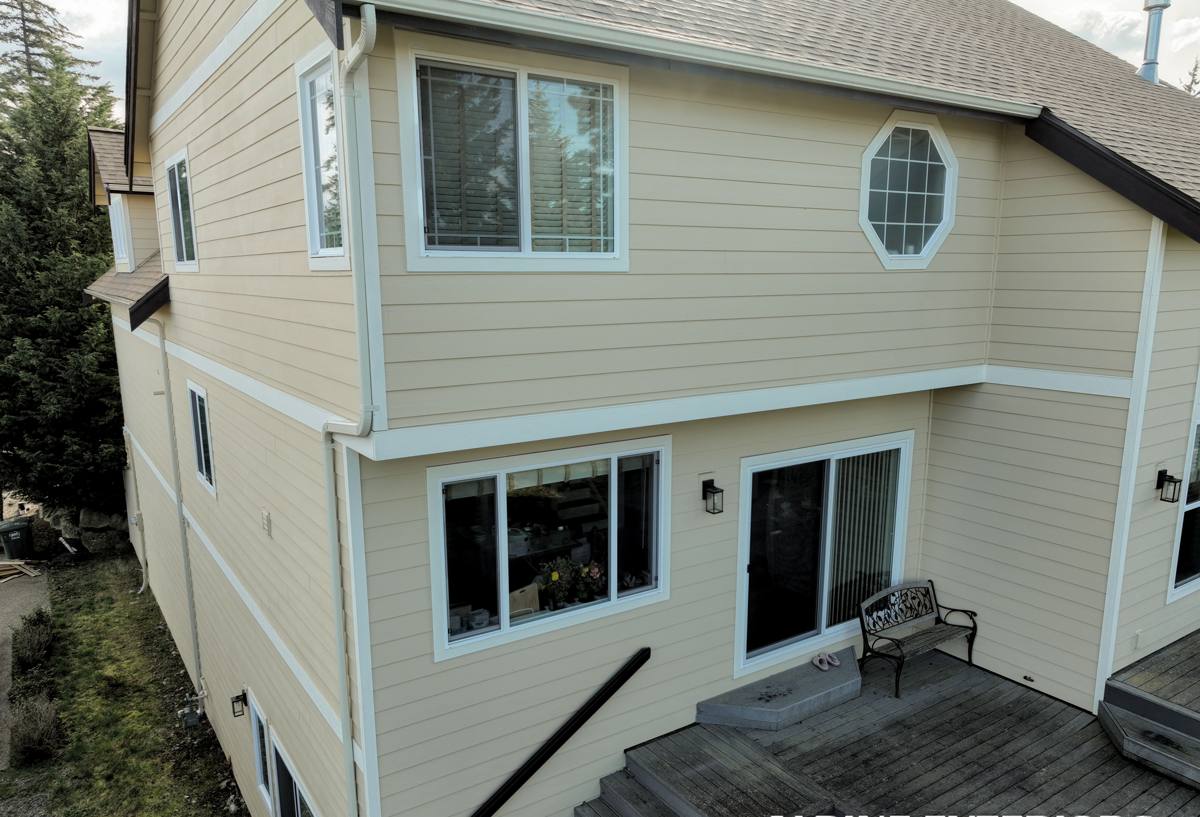
What Ferndale's Climate Actually Does to a Wall
Salt Air and Metal Fasteners
Proximity to salt water accelerates corrosion on any exposed or undersized fastener. Over years, corroding fasteners bleed rust streaks through paint and lose their grip on the substrate, which is how you end up with siding that's technically still attached but rattling loose at the edges. Correct fastener selection and placement matter more here than in an inland neighborhood.
Driving Rain and Wind-Driven Moisture
Whatcom County storms don't always arrive straight down. Wind off the Strait pushes rain sideways into wall assemblies, which means every horizontal lap, every window and door flashing detail, and every seam has to be built to shed water even when it's not falling straight. A product that swells or wicks moisture at the joints turns every one of those seams into a weak point.
Moss, Algae, and Prolonged Dampness
Ferndale's tree cover and marine humidity mean shaded and north-facing walls can stay damp for long stretches of the fall, winter, and spring. Wood-based and wood-composite siding products absorb that moisture and stay soft longer, which is exactly the environment moss and mildew need to take hold. Siding that doesn't absorb water in the first place breaks that cycle.
Why We Standardized on James Hardie for This Kind of Exposure
We install James Hardie fiber cement exclusively — no vinyl, no LP SmartSide, no cedar, no primed spruce. That's not a marketing position, it's a decision built around what actually survives a Whatcom County winter without turning into a maintenance project. Fiber cement is engineered from cement, sand, and cellulose fibers, which means it doesn't absorb water the way wood-based products do, doesn't provide the organic material moss and algae feed on, and doesn't swell or rot at cut edges and joints the way engineered wood can when water finds its way in.
James Hardie also builds region-specific product lines — HardiePlank, HardiePanel, and HardieShingle are all available in HZ10 formulations engineered for wetter, more humid climates like ours, as opposed to the HZ5 line built for hot-dry regions. That distinction matters more in Ferndale than it does in most of the country, and it's one reason we don't treat "fiber cement" as a single interchangeable product — the specific formulation has to match the exposure.
The factory-applied ColorPlus finish is another piece of this. It's baked on and cured under controlled conditions rather than sprayed on-site, which gives it far better resistance to fading, chalking, and peeling than field-applied paint — and it comes backed by its own multi-year finish warranty separate from the substrate warranty. In a climate where UV, salt, and moisture are all working against a painted surface at once, that factory finish is doing real work.
What a Correct James Hardie Installation Actually Involves
Fiber cement siding is only as good as the installation behind it. Most of the failures we get called out to inspect on older Ferndale homes trace back to installation shortcuts, not the product itself. A correct install includes:
- Proper weather-resistive barrier and flashing at every window, door, and penetration, lapped correctly to shed water downward and outward
- Minimum clearances maintained between siding and grade, roofing, decks, and other abutting surfaces so water has somewhere to go
- Correct fastener type, length, and placement — James Hardie specifies this precisely, and it's one of the most commonly skipped details
- Proper joint treatment at butt seams, with pre-primed or factory-finished edges caulked and sealed to manufacturer specification
- Rain screen or drainage plane detailing appropriate for a high-moisture climate like Whatcom County
- Field-cut edges sealed and touched up so raw fiber cement isn't left exposed to weather
Skip any one of these and you can still end up with moisture intrusion behind siding that looks fine from the curb — which defeats the entire point of switching to a more durable product.
How Our Process Works on a Ferndale Job
We start with a walk of the home to assess existing siding condition, look for signs of moisture damage or rot in the sheathing underneath, and check trim, flashing, and drainage details around windows and rooflines. From there we scope the tear-off, confirm whether sheathing repair or replacement is needed, and plan the weather barrier and flashing details before a single piece of Hardie goes up. Installation follows manufacturer fastening and clearance specs exactly, joints and edges are sealed, and we do a final walk-through to check caulking, touch-up, and trim details before calling the job done.
Fiber Cement vs. the Alternatives, for This Climate Specifically
| Factor | James Hardie Fiber Cement | Vinyl | Wood-Based / Engineered Wood |
|---|---|---|---|
| Moisture absorption | Doesn't absorb water into the material | Doesn't absorb, but seams and J-channels trap water behind panels | Absorbs moisture at cut edges and joints, swells over time |
| Moss/algae resistance | No organic material to feed growth; factory finish sheds moisture | Can host growth in grooves and seams | Organic substrate is prone to moss and mildew in damp shade |
| Salt air durability | Non-organic substrate holds up well; fasteners are the main concern | Can become brittle and discolor faster near salt air | Wood is vulnerable to salt-accelerated decay |
| Finish longevity | Factory-baked ColorPlus finish, separately warrantied | Color is through-body but fades and chalks over decades | Field-applied paint needs recoating on a shorter cycle |
| Fire performance | Non-combustible | Combustible, can melt/deform near heat | Combustible |
None of this means the alternatives are junk products — vinyl and engineered wood both have legitimate uses and reasonable installations exist. It's that when we weigh moisture behavior, maintenance burden, and long-term appearance against this specific coastal climate, fiber cement is the product we're willing to put our name behind.
Maintenance Ferndale Homeowners Should Actually Expect
James Hardie siding is low-maintenance, not no-maintenance. In this climate, that means:
- An annual rinse-down to clear pollen, road film, and early moss growth before it takes hold, especially on shaded or north-facing walls
- Periodic visual checks of caulking at joints, windows, and trim — caulk is usually the first thing to give out, well before the siding itself
- Keeping gutters clear and downspouts directing water away from the wall, since even the best siding suffers if it's sitting in constant runoff
- Trimming back vegetation and tree cover where it's keeping a wall section shaded and damp longer than the rest of the house
Compared to repainting a wood-based system every five to seven years, or replacing brittle, sun-damaged vinyl panels, this is a modest ask — but it's not zero.
Why Hiring a Crew That Already Works Ferndale Matters
Whatcom County building requirements, typical lot drainage patterns, and the specific way local wind and rain hit a wall aren't things you learn from a manufacturer's install manual alone — they're things you learn by doing the work here repeatedly. A crew that already installs Hardie siding around Bellingham and Ferndale has seen how local moisture patterns interact with flashing details, knows which wall orientations need the most attention to drainage, and isn't guessing at clearances based on a climate zone that doesn't match ours.
There's also a practical accountability piece: a local crew is easy to reach if a warranty question comes up five or ten years down the road, and has a reputation in the community worth protecting. That's worth factoring in alongside price when you're comparing bids for a job that's supposed to last decades.
Signs Your Current Siding Is Already Losing the Fight
A few things worth checking before you decide whether this is a "someday" project or a "this year" project:
- Soft or spongy spots when you press on siding, especially near the bottom courses or around window trim
- Paint that's peeling, bubbling, or chalking heavily rather than just fading evenly
- Visible gaps, warping, or cupping at panel seams
- Persistent moss or algae staining that comes back within weeks of cleaning
- Rust streaking below fasteners or trim
Any one of these on its own isn't necessarily an emergency, but a couple together usually means moisture is already getting past the surface.
Getting Started
If you're weighing a siding replacement on a Ferndale home, or just want an honest read on whether your current siding still has years left in it, we're happy to take a look. The estimate is free, there's no pressure to sign anything on the spot, and you'll get a straight answer about what your home actually needs.