 Bellingham Exterior
 Cordata's Siding Problem Isn't Like Anywhere Inland
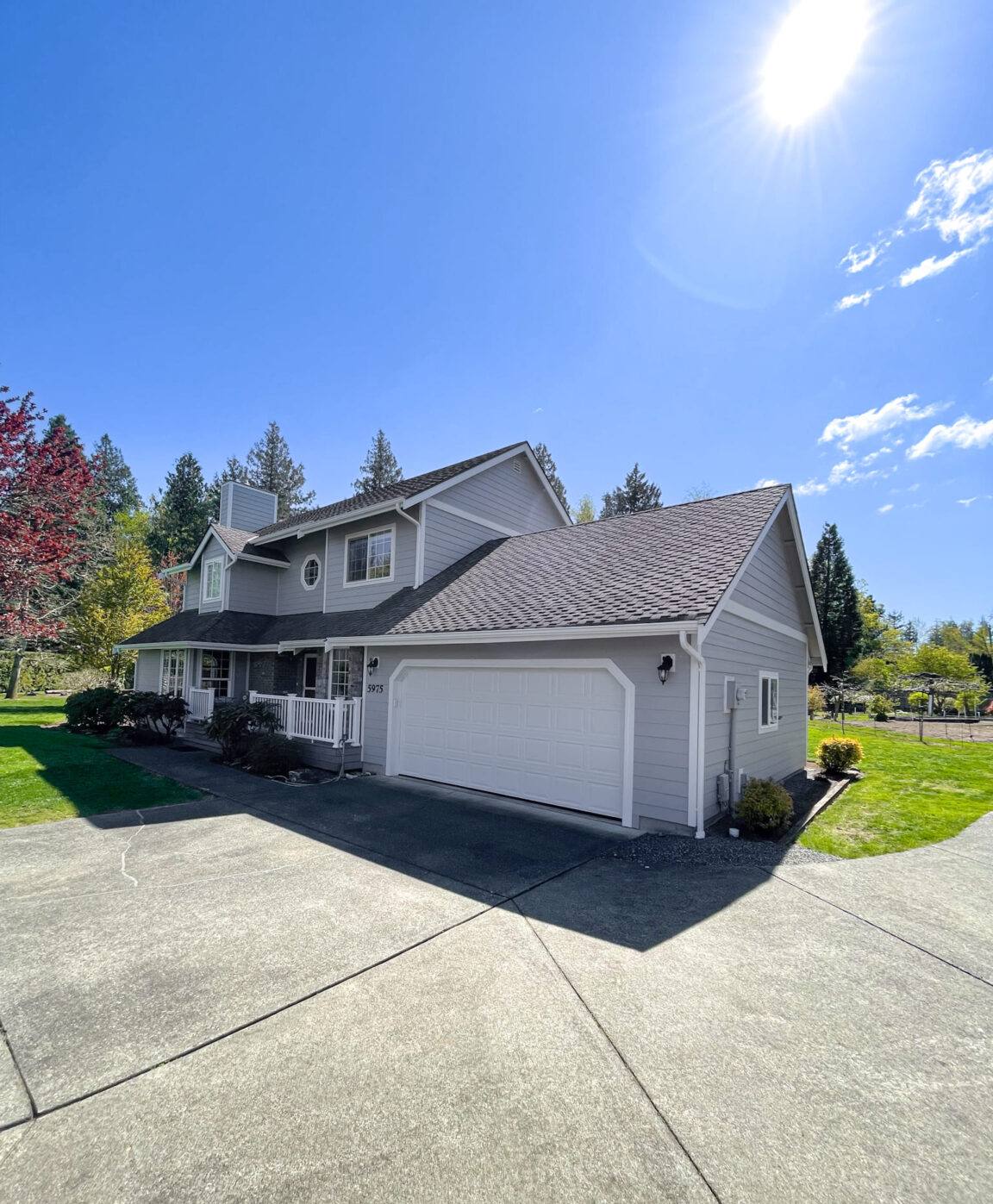
Cordata sits in north Bellingham, close enough to Bellingham Bay and the I-5 corridor that homes here deal with a specific combination of stresses most inland Whatcom County properties don't face in the same mix. Marine air drifts in off the Sound carrying salt that slowly attacks fasteners, trim, and paint film. Driving rain off the water pushes horizontally into wall assemblies rather than falling straight down, which means siding laps, butt joints, and flashing details matter more here than in drier climates. And the tree cover common to newer Cordata subdivisions — built into or right up against mature conifers — keeps north and west-facing walls shaded and damp for long stretches, which is exactly the recipe for moss and algae growth on siding.
None of that is dramatic on its own. The problem is cumulative. A siding product or installation detail that's "fine" in a dry climate can fail quietly over a decade of Whatcom County winters, and by the time it shows up as soft trim or a stained wall, the fix is bigger than it needed to be.
What Cordata Homes Actually Need From Their Siding
Moisture management, not just moisture resistance
Siding that simply repels rain isn't enough in a driving-rain climate. What matters is what happens to the water that inevitably gets behind the cladding — through a nail hole, a hairline gap at a joint, a window flashing that's slightly off. A correctly installed siding system gives that water a way out: a drainage plane, properly lapped weather-resistive barrier, and flashing that directs water down and away from wall sheathing instead of trapping it.
Resistance to moss, mildew, and algae staining
On shaded lots — common throughout Cordata — the north and west walls stay damp longer after every rain. Siding material and finish quality both affect how much moss and algae actually take hold versus rinse off. A dense, factory-cured fiber cement panel with a durable factory finish sheds this kind of growth far better than a porous or field-finished material that gives spores something to grab onto.
Fastener and hardware corrosion resistance
Salt-laden air accelerates corrosion on exposed fasteners, hose bibs, and trim hardware. Nails and screws that aren't rated for the exposure will bleed rust streaks down the face of the siding within a few years — a cosmetic problem that's actually a sign the wrong hardware went into the job.
Why We Install Only James Hardie Fiber Cement
We standardized on James Hardie products for every siding job we take on, including work in Cordata, because fiber cement handles this specific climate combination better than the alternatives on balance. It's non-combustible, it doesn't rot or support insect damage the way wood-based products can, and Hardie's ColorPlus factory finish is baked on and warranted against fading and peeling — which matters when a wall is going to sit shaded and damp for months at a stretch.
James Hardie also engineers its product line by climate zone. For the Pacific Northwest, that means the HZ5 formulation, built specifically for wetter, more variable weather rather than a one-size-fits-all mix. That's a meaningful difference from siding rated for a generic national spec.
We don't install LP SmartSide, vinyl, or other fiber cement brands. That's a standard we hold across every job, not a sales pitch specific to this page — we'd rather turn down work than install something in this climate that we don't believe holds up to our own standard for the long haul.
What a Correct Installation Actually Involves
The material is only half the equation. A lot of the siding problems we get called out to look at in Whatcom County trace back to installation shortcuts, not product failure. On a Cordata job, the details we hold non-negotiable include:
- Proper weather-resistive barrier installed and lapped shingle-style so water sheds outward, never inward
- Correct fastener type, length, and spacing per James Hardie's published installation instructions — not generic siding nails
- Minimum clearance gaps at the ground, roofline, deck, and any horizontal surface where siding meets another material
- Z-flashing or equivalent at every horizontal joint and window/door head, not caulk used as a substitute for flashing
- Butt joints backed and sealed per manufacturer spec so the driving rain common here can't drive straight through
- Proper nail penetration into framing or approved sheathing — over-driven or under-driven fasteners are one of the most common defects we find on re-siding jobs
Skipping any one of these doesn't usually cause an immediate problem. It shows up in year six or eight as a soft spot, a stain, or a section that's pulling away — long after the original crew is gone.
Our Process for a Cordata Siding Job
1. On-site assessment
We walk the property and look specifically at shaded exposures, drainage around the foundation, existing moss or algae patterns, and the condition of the current wall assembly once siding comes off. This tells us if there's hidden moisture damage that needs to be addressed before new siding goes on — covering a wet problem with new siding just delays it.
2. Tear-off and sheathing check
Old siding comes off in sections so we can inspect sheathing condition as we go, rather than discovering rot after the whole house is stripped. Any damaged sheathing gets replaced before the weather barrier goes on.
3. Weather barrier and flashing
This is the step that determines how the house performs in year ten, not year one. We install and lap the barrier correctly and flash every penetration and joint per spec, before a single piece of Hardie board goes up.
4. Hardie installation to manufacturer spec
Fastening, gapping, and joint treatment follow James Hardie's published requirements — this is also what keeps the manufacturer's product warranty intact, since improper installation can void it.
5. Final inspection and walkthrough
We check clearances, caulking, trim, and finish before calling the job done, and walk the property with the homeowner so they know what was done and why.
Cost Factors on a Cordata Siding Job
Every job is different, but the same variables tend to drive cost up or down on siding replacements in this part of Whatcom County:
| Factor | Why It Matters Here |
|---|---|
| Hidden sheathing or framing damage | Shaded, damp walls common in Cordata sometimes hide moisture damage behind old siding that has to be repaired before new siding goes on |
| Number of stories and wall complexity | Multi-story homes and cut-up wall lines (dormers, bump-outs) take more labor and material per square foot |
| Trim and detail work | Corner boards, window trim, and fascia details add labor beyond flat wall coverage |
| Access and site conditions | Tight lots, mature trees, or difficult staging areas — common on wooded Cordata lots — can slow crew access and add setup time |
| ColorPlus vs. field-painted finish | Factory-applied ColorPlus finish costs more up front but removes a repaint cycle from the maintenance schedule |
We give a firm, itemized estimate before any work starts — there's no reason a homeowner should have to guess at scope.
Why Hiring a Crew That Already Works Cordata Matters
Siding installation quality depends a lot on whether the crew doing the work actually understands the conditions on that specific lot. A crew that's used to installing in a dry inland climate can do everything "by the book" and still miss the details that matter most here — the extra attention to flashing at driving-rain exposures, the fastener choices that hold up against salt air, the joint sealing that accounts for a wall that stays wet longer than average.
Working regularly in this part of Whatcom County also means knowing what local permitting and inspection expects, having a realistic read on weather windows for tear-off and install, and being able to stage material and schedule crews without the guesswork of a first-time job in the area. That familiarity doesn't show up on a quote, but it shows up in how the wall performs five and ten years later.
Maintaining James Hardie Siding in a Climate Like This
Correctly installed Hardie siding is genuinely low-maintenance, but "low-maintenance" isn't "no-maintenance" in a marine, moss-prone climate. A short annual routine goes a long way:
- Rinse shaded, north- and west-facing walls where moss and algae tend to establish, before growth gets heavy
- Keep gutters clear so overflow doesn't run down wall sections and keep them wet longer than necessary
- Trim back vegetation and tree limbs that keep siding sections in constant shade and reduce airflow
- Check caulking at trim and penetrations periodically and re-seal if it's cracked or pulling away
- Watch for any staining or soft spots near ground level, decks, or roof-wall intersections and address early
James Hardie backs its products with a strong transferable warranty when installed to spec — one more reason correct installation isn't optional, it's what protects the coverage a homeowner is paying for.
If you're planning a siding project in Cordata or anywhere else in the Bellingham area, we're happy to take a look and give you a straight, no-pressure estimate — just fill out the form below.