 Bellingham Exterior
 Why Silver Beach Siding Has to Work Harder
Silver Beach sits along the Lake Whatcom shoreline on Bellingham's south side, and that setting creates a siding environment that's noticeably tougher than a typical suburban lot. Mature tree canopy, lake-driven humidity, and slopes that keep some walls in shadow most of the day all add up to siding that stays damp longer than siding on an open, sun-exposed street. If a product can't shed water fast and resist moss and mildew, it shows up here first.
We work this neighborhood regularly, and the pattern is consistent: homes with south- or street-facing walls in full sun often look fine for years, while the shaded, lake-facing sides of the same house show green streaking, soft trim, or failing paint well ahead of schedule. Installation quality and material choice both matter more here than in drier, more open parts of Whatcom County.
Shade, Lake Humidity, and a Long Moss Season
Moss and algae need three things to take hold on siding: moisture, shade, and time. Silver Beach offers all three for a good chunk of the year. Overhanging trees keep walls from drying out after rain, and the lake adds ambient humidity that lingers in the air even on days when it isn't actively raining. Once moss gets a foothold in seams, laps, or caulk lines, it holds water against the substrate and accelerates whatever damage is already happening underneath.
Driving Rain and Wind Off the Water
Open water exposure changes how rain hits a house. Instead of falling mostly straight down, wind off the lake drives rain sideways into walls, gable ends, and around window and door openings. Siding that relies on caulk and paint alone to keep water out — rather than a properly built drainage plane behind it — eventually lets that wind-driven moisture find its way in, usually starting at seams, corners, and butt joints.
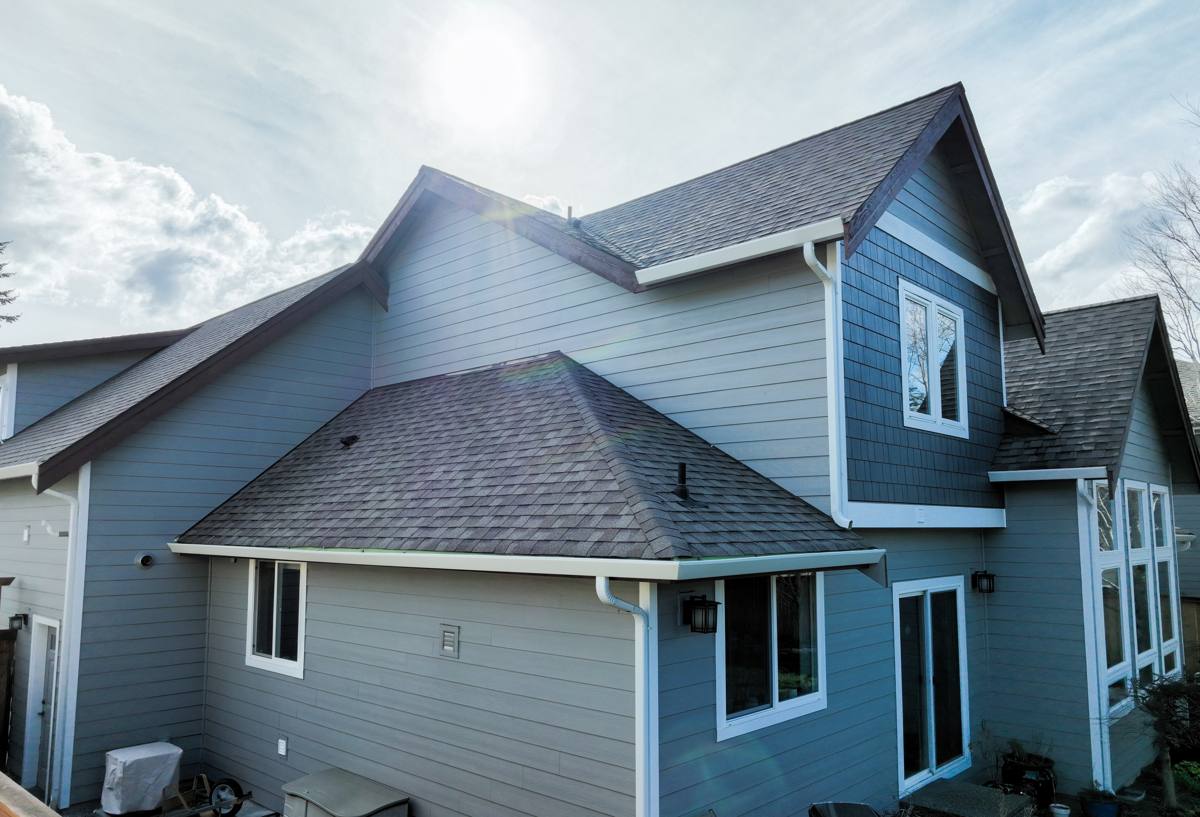
What Correct Siding Installation Actually Involves
Siding is a system, not a single product. The board itself matters, but so does everything behind it. Most siding failures we get called out to inspect in this area aren't failures of the siding material — they're failures of installation detail that let water get behind a wall that was never designed to dry out.
The Drainage Plane Homeowners Never See
Correct installation starts with a weather-resistive barrier applied over the sheathing, lapped shingle-style so water sheds downward and outward instead of pooling. On homes in shaded, humid spots like Silver Beach, we also look hard at whether a rainscreen gap (a thin ventilated space between the barrier and the siding) makes sense, since it lets any moisture that does get behind the siding actually dry out instead of sitting against the wood sheathing.
Flashing, Fastening, and Joint Placement
Every window, door, roof-to-wall intersection, and horizontal trim board is a place water wants to get in. Flashing has to be integrated with the weather barrier in the right order — not caulked over as an afterthought. Fastener placement, spacing, and depth matter too: overdriven nails crack fiber cement and create entry points for water, while underdriven fasteners leave boards loose enough to work and eventually crack on their own.
Why We Install Only James Hardie Fiber Cement
We don't install vinyl, LP SmartSide, primed spruce, cedar, or other fiber cement brands. That's a deliberate standard, not a sales pitch, and it matters more in a spot like Silver Beach than almost anywhere else in Bellingham.
Moisture-Stable and Non-Combustible
Fiber cement doesn't absorb and swell the way engineered wood products can, and it doesn't provide the same organic material for moss and mildew to feed on the way wood-based sidings do. James Hardie boards are also non-combustible, which is a meaningful consideration on wooded, tree-canopied lots where wildfire exposure and ember risk have become a bigger part of home insurance and building conversations across Western Washington.
ColorPlus Finish and the HZ5 Product Line
James Hardie's ColorPlus finish is baked on in a factory-controlled process, which holds color and resists fading and moisture intrusion at the surface far better than field-applied paint. Hardie also engineers its HZ (HardieZone) product lines for specific climate zones — the Pacific Northwest falls under HZ5, formulated for high-moisture, freeze-thaw conditions rather than the drier, hotter climates other regions deal with. That's the version we install here, not a generic national product.
A Warranty That Actually Transfers
James Hardie backs its siding with a long, transferable limited warranty on the product itself, plus a separate finish warranty on ColorPlus boards. A transferable warranty is a real selling point if the home changes hands — something worth knowing if you're planning to sell in the years after a re-side.
Siding Options Compared for Silver Beach Conditions
| Factor | James Hardie Fiber Cement | Vinyl | Wood / LP SmartSide |
|---|---|---|---|
| Moss & mildew resistance | High — inorganic material, factory finish sheds water | Moderate — doesn't feed moss but panels trap moisture behind them | Low — organic substrate is a food source once damp |
| Performance in driving rain | Strong when installed with proper flashing and drainage plane | Prone to water intrusion at seams and panel laps | Vulnerable at cut edges and fastener points if moisture gets in |
| Fire resistance | Non-combustible | Can melt or deform under heat exposure | Combustible |
| Finish longevity | Factory ColorPlus finish, long fade resistance | Color molded through material but can chalk over time | Field-applied paint or factory coating, shorter repaint cycle |
| Typical warranty | Long, transferable limited warranty | Varies widely by manufacturer | Shorter, often prorated |
Our Process for a Silver Beach Project
- On-site assessment — we walk the whole exterior, paying particular attention to shaded walls, roof-to-wall intersections, and any areas already showing moss, staining, or soft trim.
- Tear-off and sheathing check — old siding comes off and we inspect the sheathing underneath for rot or soft spots before anything new goes up. This is the step that catches problems the old siding was hiding.
- Weather barrier and flashing — a new weather-resistive barrier is installed and properly lapped, with flashing integrated at every window, door, and penetration.
- James Hardie installation — boards are cut, fastened, and joined to Hardie's published installation specifications, which is what keeps the manufacturer warranty valid.
- Trim, caulking, and paint touch-up — factory-finished ColorPlus boards need minimal field painting, which also means fewer future maintenance cycles for the homeowner.
- Site cleanup — old materials, fasteners, and debris are hauled off before we consider the job done.
Signs Your Silver Beach Home May Need New Siding
- Green or black streaking that keeps coming back after cleaning, especially on shaded or lake-facing walls
- Soft, spongy, or bubbling siding when pressed, particularly near the bottom courses or around windows
- Paint that's peeling or blistering faster than it should, even after a repaint
- Visible gaps, warping, or cupping at board seams and butt joints
- A musty smell or visible staining on interior walls that back up to exterior siding
- Siding that's more than 20-25 years old and has never been fully inspected behind the surface
What Drives Cost on a Silver Beach Project
Every re-side is priced around the specifics of the house, but a few factors show up consistently in this neighborhood:
- Tree cover and access — mature landscaping near the house can mean more careful staging, trimming coordination, and sometimes longer dry-out windows between steps.
- Sloped lots near the shoreline — grade changes affect scaffolding, material staging, and how efficiently a crew can move around the structure.
- Condition of the sheathing underneath — if tear-off reveals rot or moisture damage, that repair work is a separate cost from the siding itself, but it's far cheaper to address now than to cover it up.
- Trim and detail complexity — homes with more corners, dormers, and window trim take longer to flash and finish correctly than a simple rectangular footprint.
Why a Crew That Already Works Silver Beach Matters
A contractor who's done multiple jobs in this specific area already knows how the microclimate behaves — which walls stay damp longest, where moss tends to establish first, and how much drying time to build into a schedule around Bellingham's wetter stretches of the year. That local pattern recognition shows up in better sequencing and fewer callbacks.
It also matters for permitting and code compliance. Bellingham has its own permitting process for exterior work, and a crew that pulls permits here regularly knows what inspectors are looking for on drainage planes, flashing details, and fire-rated assemblies where they apply. That's not something you want a contractor learning for the first time on your house.
Get a Straightforward Estimate
If your Silver Beach home is showing moss, staining, or siding that's simply past its service life, we're happy to take a look and walk you through what we'd recommend and why. There's no pressure and no obligation — just a straight assessment from a crew that installs one product because we trust it to hold up here. Use the form below to request a free estimate.