 Bellingham Exterior
 Why Edgemoor Siding Wears Differently Than Siding Inland
Edgemoor sits close enough to the water that homes here deal with a combination most inland Whatcom County neighborhoods don't: salt-laden air, wind-driven rain coming off Bellingham Bay, and long stretches of shade and dampness that keep moss and algae established on north and west-facing walls for much of the year. Any one of those conditions is manageable. All three together, applied to the same siding for fifteen or twenty years, is what actually shortens a siding system's life.
Salt air is corrosive to exposed metal fasteners and trim flashing, and it accelerates the breakdown of lower-grade paint films faster than a standard weathering estimate would predict. Driving rain doesn't fall straight down here — it gets pushed sideways into lap joints, corner boards, and butt seams, which means water intrusion problems in Edgemoor tend to show up at horizontal and vertical seams before they show up as flat-wall failures. And moss holds moisture against the siding surface for days after a storm has passed, which is a slow, steady problem more than a dramatic one — it just never fully dries out.
None of this is unique to any one brand of siding. It's a description of the job the siding has to do here. The material and the installation both have to be chosen with that job in mind, not a generic "siding replacement" spec pulled from a catalog.
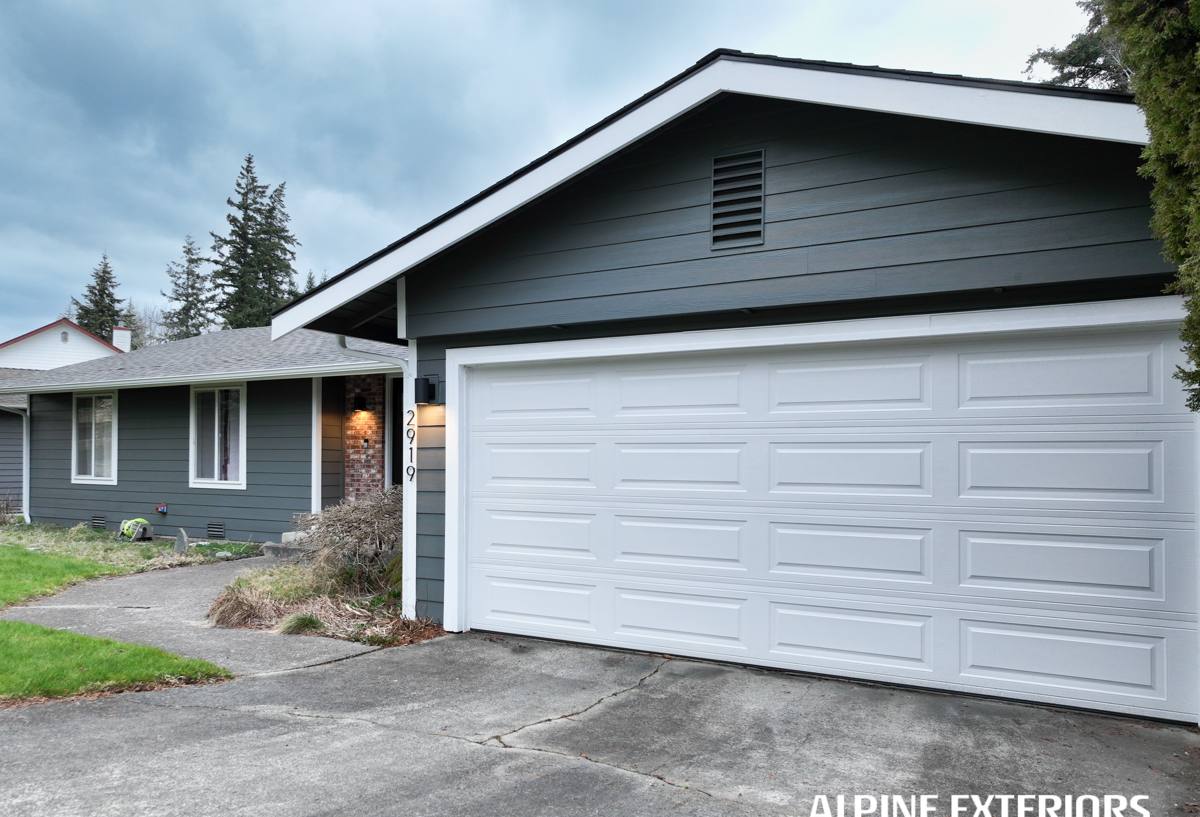
What Failing Siding Looks Like on an Edgemoor Home
Homeowners usually call us after noticing one or more of the following. None of these are emergencies on their own, but together they're a pattern worth having looked at before a wall assembly starts absorbing water it can't dry out.
- Persistent dark green or black staining on north and west walls that returns within weeks of being cleaned
- Soft or spongy spots near the bottom courses of siding, especially near grade or downspouts
- Paint that's chalking, peeling, or has gone flat and dull well ahead of its expected repaint interval
- Visible gaps opening up at butt joints, corner boards, or window and door trim
- Rust streaks below nail heads or metal flashing
- A musty smell in an exterior-facing room, or interior drywall that feels cool and damp to the touch
Any of these can be a surface issue or a sign of something happening behind the siding. The only way to know which is to open a section up and look — which is exactly what a proper replacement estimate should include, not skip.
Why We Install Only James Hardie Fiber Cement
We don't install LP SmartSide, vinyl, Cemplank, Allura, primed spruce, or cedar, and Edgemoor's climate is a good example of why. Each of those products has real strengths, but each also has a weak point that this specific environment tends to find:
- Vinyl expands and contracts with temperature swings and can warp or buckle; its seams are also a common entry point for wind-driven rain, and it doesn't hold paint at all if a homeowner ever wants a color change.
- Wood-based products (LP SmartSide, primed spruce) use engineered or solid wood as their base, and wood is dimensionally reactive to sustained moisture — exactly the condition moss-shaded walls create here.
- Cedar is a genuinely attractive natural material, but it requires ongoing sealing or staining to resist the rot and insect issues that a damp, salt-air climate accelerates.
- Other fiber cement brands (Cemplank, Allura) are chemically similar to Hardie, but we've standardized on one product line and one factory finish system so our crews install to a single spec they know cold, and homeowners get one clear warranty structure instead of comparing fine print.
James Hardie fiber cement is non-combustible, doesn't support the kind of moisture-driven rot that wood products can develop, and its ColorPlus factory finish is baked on and warranted against fading and peeling in a way field-applied paint isn't. For a wall that's going to face salt air and shade-driven moss for the next several decades, that combination matters more here than in a drier, more sheltered part of the county.
The HZ5 Zone and Why It's Relevant Here
James Hardie engineers its siding lines to different climate zones, and Whatcom County — including Edgemoor — falls in the HZ5 zone, which is Hardie's designation for wetter, more moisture-exposed regions of the Pacific Northwest. HZ5 products are formulated and finished with that moisture exposure in mind, rather than being a one-size-fits-all national product. Installing the wrong climate-zone variant, or installing the right product with the wrong detailing, is one of the more common ways a fiber cement job underperforms — the material gets blamed for what was actually an installation or specification mistake.
What a Correct Siding Replacement Actually Involves
Siding replacement is often sold as a surface-level swap, but the parts you don't see are what determine whether the wall stays dry for the next 20-30 years. A correct job on an Edgemoor home includes:
Full Tear-Off and Inspection
We remove the existing siding down to the sheathing rather than installing over it. That's the only way to find hidden rot, compromised sheathing, or prior water damage before it's sealed behind new material.
Sheathing Repair
Any soft, delaminated, or water-damaged sheathing gets replaced. Installing new siding over bad sheathing just relocates the problem a few years down the road.
Weather-Resistive Barrier and Flashing
A correctly lapped weather-resistive barrier, along with new flashing at windows, doors, and roof-to-wall intersections, is what actually stops wind-driven rain from reaching the sheathing. This is the step most likely to get shortcut on a low-bid job, and it's the one that matters most in a climate that pushes rain sideways.
Correct Fastening and Clearances
Hardie specifies fastener type, spacing, and minimum clearances from grade, decks, and roof lines. Getting these wrong voids warranty coverage and is a common cause of early butt-joint failure — exactly the failure point Edgemoor's driving rain tends to expose first.
Factory-Finished ColorPlus Panels
Because the color coat is applied and cured at the factory rather than sprayed on site, it holds up more consistently against UV, salt air, and the chalking that field-painted siding tends to show first.
Our Process, Start to Finish
| Step | What Happens |
|---|---|
| 1. On-site assessment | We walk the exterior, check for moisture and rot at vulnerable points, and measure for material |
| 2. Written estimate | A clear scope of work and price, including any sheathing repair contingencies |
| 3. Tear-off | Existing siding removed, sheathing inspected and repaired as needed |
| 4. Weather barrier and flashing | New house wrap and flashing installed and lapped correctly at all penetrations |
| 5. Hardie installation | Panels installed to manufacturer spec for the HZ5 zone, with correct fastening and clearances |
| 6. Trim and detail work | Corner boards, trim, and caulking finished to match the home |
| 7. Final walkthrough | We review the finished work with you before calling the job complete |
What Drives the Cost of an Edgemoor Siding Job
Every home is different, but the following factors are what actually move the price on a siding replacement in this area:
| Factor | Why It Matters |
|---|---|
| Extent of hidden rot or sheathing damage | Found during tear-off; can't be accurately priced until the wall is opened up |
| Home size and wall complexity | More corners, dormers, and trim detail means more labor per square foot |
| Siding profile and color | Lap width, shingle-style panels, and custom ColorPlus colors vary in material cost |
| Site access | Tight lots, slopes, or limited staging area near the water add time |
| Trim and accessory scope | New corner boards, fascia, or window trim add to the total beyond the field siding itself |
We don't quote a number without seeing the home, but we'll always explain which of these factors are driving your estimate up or down so there are no surprises.
Why a Crew That Already Works Edgemoor Matters
Siding installation quality depends heavily on judgment calls that a spec sheet can't fully cover — how tight to run flashing laps given this particular wall's rain exposure, where moss growth patterns suggest a wall has been staying damp longer than it should, how much clearance to leave near grade on a lot that slopes toward the water. A crew that has worked a number of homes in this specific neighborhood has already seen how the local exposure plays out on real walls, not just in a manufacturer's install guide. That's a different level of judgment than a crew installing here for the first time, and it shows up in how the job holds up ten and twenty years out, not on the day it's finished.
After Installation: Keeping It Right
Correctly installed Hardie siding is low-maintenance, not no-maintenance. A short annual routine keeps it performing the way it's designed to in this climate:
- Rinse off moss and algae buildup on shaded walls once or twice a year before it becomes established
- Keep gutters clear so water isn't overflowing directly onto siding below
- Trim back vegetation that's holding moisture against a wall or blocking airflow
- Recaulk trim joints if you notice separation, rather than waiting for water to find its way in
- Walk the exterior after major windstorms and check corners and butt joints for movement
If you're seeing early signs of wear, staining that won't clean off, or you're simply due for a siding replacement and want a straight answer about what your home actually needs given its exposure, we're happy to take a look. The estimate is free, there's no pressure, and you'll get a clear explanation of what we find — good or bad — using the form below.