 Bellingham Exterior
 James Hardie Siding in Barkley: Matching the Product to the Climate
Barkley is a well-established part of Bellingham, and a lot of the homes here are old enough that their original siding is well past the point of just needing a fresh coat of paint. When homeowners in this neighborhood start looking into replacement, the question isn't just "what looks good" — it's what will actually hold up to salt air drifting in off the water, driving rain that comes in sideways more often than straight down, and a moss season that runs longer here than in most of the state. That combination is why we install James Hardie fiber cement siding exclusively, and why this page focuses specifically on what that product needs to look like when it goes on a Barkley home rather than a generic install anywhere else.
This isn't a general overview of siding options. It's a look at James Hardie specifically — the product system, what correct installation involves in this climate, and how our process works from first look to finished wall.
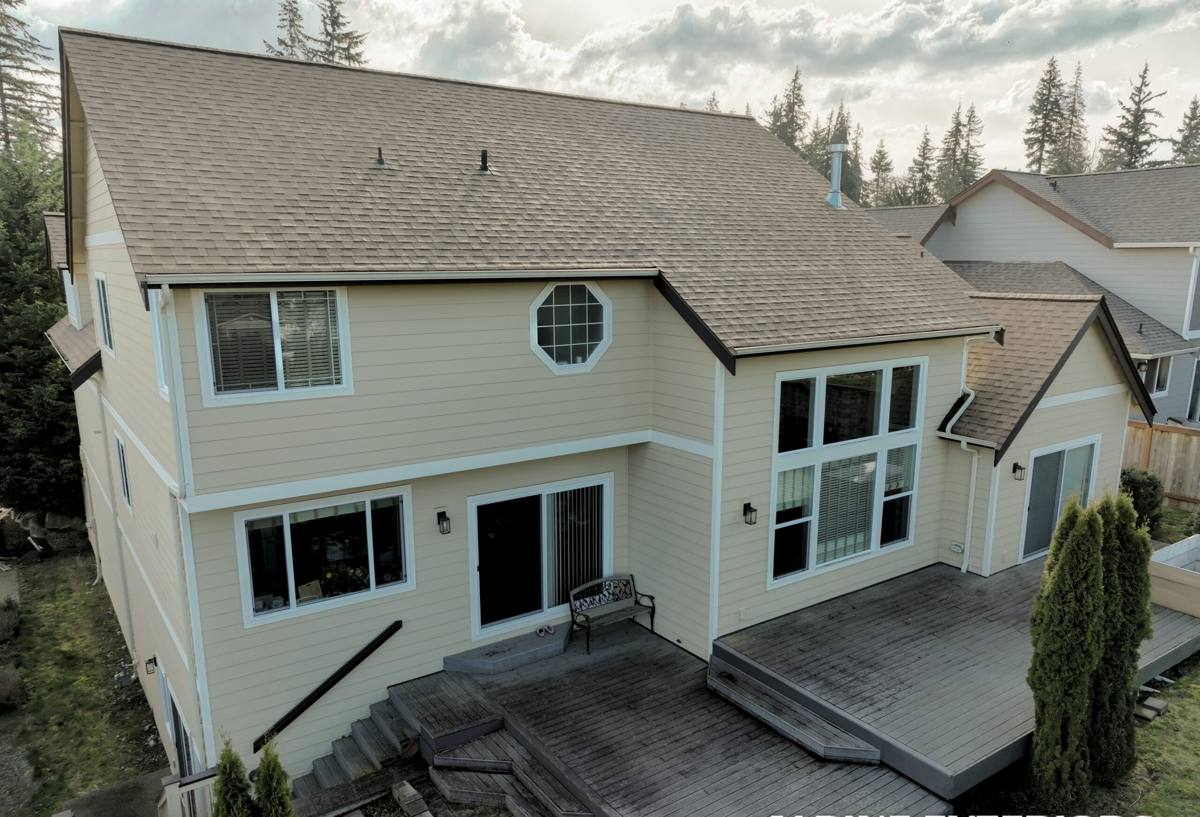
What This Climate Actually Does to a Wall
Salt-laden air doesn't just make a house feel damp near the water — it accelerates corrosion on exposed fasteners and hardware, and it keeps painted or coated surfaces wet longer than they'd stay in a drier inland climate. Any siding finish that isn't built for sustained exposure breaks down faster here than the marketing on the box suggests.
Driving rain compounds it. Wind-driven water doesn't run straight down a wall the way it would in a calm shower — it gets forced sideways into laps, seams, and fastener points that a dry-climate installation wouldn't have to account for. Flashing details and clearances that would be adequate somewhere else start to matter a great deal more, because wind-driven water finds every gap that wasn't detailed correctly the first time.
Moss and mildew round it out. Shaded walls and anything under tree cover stay damp for long stretches through fall, winter, and much of spring — exactly the condition moss needs to take hold. On a wood-based product, that ongoing dampness isn't just cosmetic; it's a real durability problem, since sustained moisture against an absorbent material eventually leads to swelling, softening, and rot at the edges. James Hardie's fiber cement composition doesn't give moss and mildew the same foothold, which is a big part of why it's the product we standardized on for this specific climate.
The James Hardie Product System, Not Just the Board
James Hardie isn't a single product — it's a system, and understanding the pieces helps explain why correct installation matters as much as the material itself.
ColorPlus Technology
Most James Hardie siding we install carries a ColorPlus finish, which is baked onto the board in a controlled factory setting rather than sprayed or brushed on-site after installation. That process gives the finish better adhesion and more consistent coverage than a field-applied coat, and it's backed by its own finish warranty covering fading and peeling. In a climate with this much sustained moisture and UV cycling, a factory-cured finish holds its color and integrity longer than a coating applied on a ladder in variable weather.
Climate-Engineered HZ Formulations
James Hardie doesn't make one board for the whole country — it engineers different HZ formulations for different climate zones, accounting for moisture exposure, freeze-thaw behavior, and humidity. The Pacific Northwest calls for a different formulation than a hot, dry climate would, and using the correct HZ product for this region is part of what makes the material perform the way it's engineered to over the long run.
Panel, Plank, and Shingle Profiles
James Hardie's lineup includes lap siding (the most common horizontal plank look), vertical board-and-batten panels, and shingle-style siding for accent areas or full facades. Barkley has a mix of home styles and eras, and matching the right profile to a given house — rather than defaulting to one look for every project — is part of an honest consultation, not an upsell.
| James Hardie Product | Typical Use | What It Offers |
|---|---|---|
| HardiePlank lap siding | Full-home horizontal siding, the most common choice | Traditional look, wide color range, proven long-term performance |
| HardiePanel vertical siding | Modern facades, accent walls, board-and-batten style | Clean vertical lines, often paired with trim battens |
| HardieShingle | Accent gables, dormers, cottage-style homes | Staggered or straight-edge shingle look without the moisture sensitivity of wood shingles |
| HardieTrim | Corner boards, window and door trim, fascia | Matches the siding's durability at the joints and edges where water pressure concentrates |
Why We Don't Install Anything Else
We don't install vinyl siding, LP SmartSide, primed spruce, cedar, or other fiber cement brands. That's a professional standard we hold ourselves to, not a limit on what we're capable of doing. In a climate like this one, the products that tend to struggle over the long run share a common thread: they either absorb moisture directly, depend on a field-applied coating to keep water out indefinitely, or expand and contract enough with temperature and humidity swings that seams gradually work themselves loose.
That's not a claim that every alternative is a bad product — vinyl, engineered wood, and primed wood all have legitimate uses in the right climate and budget. But in a salt-air, high-rain, long-moss environment like Barkley's, the maintenance burden and moisture risk on those materials tends to land back on the homeowner within a decade or two, in the form of recaulking, repainting, or panel replacement that a correctly installed fiber cement system requires far less often. James Hardie's non-combustible composition, factory-applied finish, and strong transferable warranty are why it's the one product we're willing to put our name behind here.
What Correct Installation Actually Involves
James Hardie performs the way it's engineered to only when it's installed to the manufacturer's actual specifications — not a shortcut version of them. On a Barkley project, that means:
- Correct fastener type, length, and spacing, driven to the proper depth so the board isn't over- or under-driven
- Weather-resistive barrier (house wrap) installed and lapped correctly, with every seam sealed before the first board goes up
- Flashing detailed at every window, door, and penetration so water is directed out and away rather than trapped behind the cladding
- Proper clearance between the bottom of the siding and grade, roofing, decks, and hardscape, since consistently damp ground keeps lower courses wet longer without adequate standoff
- Correctly caulked and painted cut edges at every field cut, since an exposed, unsealed cut edge is one of the few places fiber cement can take on moisture
- Attention to which walls take the most direct wind-driven rain based on orientation, and adjusting detailing accordingly rather than treating every elevation the same
Skipping or shortcutting any one of these steps can undercut the material's real-world performance, no matter how good the product itself is. This is also where a lot of the difference between a mediocre installation and one that lasts thirty-plus years actually shows up — not in the board itself, but in the details around it that most homeowners never inspect directly.
How Our Process Works
We start with a walk-through of the existing exterior, not a sales pitch. That means looking at what's currently on the walls, checking for moisture damage or rot in the sheathing underneath, and being honest about whether a full replacement is warranted or whether the home could hold for a while longer with targeted repair.
If a project moves forward, our process runs through a consistent sequence: removing the existing siding and inspecting the sheathing underneath for damage that needs to be addressed before anything new goes on, installing or repairing the weather-resistive barrier, flashing every window and door opening, installing the James Hardie boards to the manufacturer's fastening and clearance specifications, and finishing with trim, caulking, and touch-up paint at cut edges. We walk the finished project with the homeowner before calling it complete, so any questions about the work get answered on-site rather than after the fact.
Timelines vary by home size and how much substrate repair turns up once the old siding comes off, but we give a realistic schedule up front rather than a best-case estimate that assumes nothing goes wrong underneath.
Color and Style Choices for Barkley Homes
Barkley has a mix of architectural styles, from older single-family homes to more contemporary builds, and James Hardie's ColorPlus palette has enough range to fit most of them without needing a custom field-applied paint job. Because the finish is factory-cured, the color options are consistent board to board in a way that's harder to guarantee with an on-site paint application. For homeowners who want a specific custom color outside the ColorPlus range, primed Hardie boards can still be field-painted, though that shifts some of the long-term finish maintenance back onto a conventional paint schedule instead of the factory warranty.
We'll walk through color and profile options as part of the estimate, but the short version is: darker colors show less moss staining over time on shaded walls, while lighter colors tend to show heat and UV wear differently. Neither is wrong — it's a conversation worth having based on how much shade and direct rain a given elevation actually gets.
Cost Factors Worth Understanding
Every Barkley project is different, but the same variables tend to drive most of the cost difference between one estimate and another.
| Factor | Why It Affects Cost |
|---|---|
| Condition of the existing sheathing | Rot or moisture damage found after tear-off requires repair before new siding can go on |
| Home size and wall complexity | More corners, gables, and cutouts mean more cutting, flashing, and labor time |
| Profile and product mix | Combining lap siding with shingle or panel accents adds material and labor variety |
| Trim and detail work | Corner boards, window trim, and fascia replacement add to the scope beyond the flat wall area |
| Access and site conditions | Steep lots, limited driveway access, or multi-story walls affect staging and labor time |
We don't give ballpark numbers over the phone without seeing the actual condition of a home, because the sheathing condition alone can shift a project significantly once the old siding comes off.
Signs a Barkley Home Might Need New Siding
Most homeowners reach out because something specific caught their eye, not because they've been tracking every inch of their exterior. Worth watching for:
- Visible moss or green staining on shaded or north-facing walls
- Paint that keeps failing or peeling no matter how often it's redone
- Soft spots or slight give when pressing near a window or door trim
- Siding that's cupping, warping, or separating at seams
- Rust streaks below fasteners or hardware
- Visible daylight or drafts around older window and door trim
Any one of these on its own doesn't necessarily mean a full replacement is needed, but they're worth having looked at directly rather than assuming they'll resolve on their own — moisture damage in this climate tends to compound rather than stay static.
Why a Crew That Already Works Barkley Matters
A lot of what separates a siding job that lasts from one that starts failing early comes down to details a crew unfamiliar with this specific neighborhood tends to miss: which wall orientations take the heaviest wind-driven rain, where moss establishes first based on shade and drainage patterns, how much clearance siding needs above grade given how consistently damp the ground stays here, and how flashing needs to be layered to shed water through an entire wet season rather than just look right on a dry install day.
A crew that installs James Hardie in this part of Whatcom County regularly starts to recognize these patterns house to house. That familiarity shows up in small on-site decisions — where a J-channel actually needs to go, where caulk is appropriate versus where flashing is required, how fastener spacing should adjust for local wind exposure — that homeowners rarely notice directly but absolutely feel in how the exterior performs over the following decades.
If your Barkley home needs new siding, or you'd just like an honest read on whether your current siding still has some life left in it, we're glad to take a look. Reach out using the form below to schedule a free, no-pressure estimate.