 Bellingham Exterior
 Fiber Cement Siding for Puget's Waterfront Conditions
Puget sits close enough to the water that its homes take on a specific combination of exterior stress: salt-laden air drifting in off Puget Sound, rain that gets pushed sideways by wind more often than it falls straight down, and a moss season that can run for most of the year on shaded, tree-covered lots. None of these three conditions is unusual on its own for Whatcom County. Together, applied to the same walls for ten or twenty years straight, they're a harder test on siding than most manufacturers design for by default. This page is specifically about fiber cement siding for homes in the Puget area, what the local climate demands from that material and its installation, and why we install James Hardie fiber cement exclusively on the homes we work on here.
We're not covering roofing, windows, or decks on this page. This is a deep look at one service, fiber cement siding, for one part of Bellingham, because the details that actually matter for a Puget-area home are specific enough to deserve their own explanation rather than a generic siding overview.
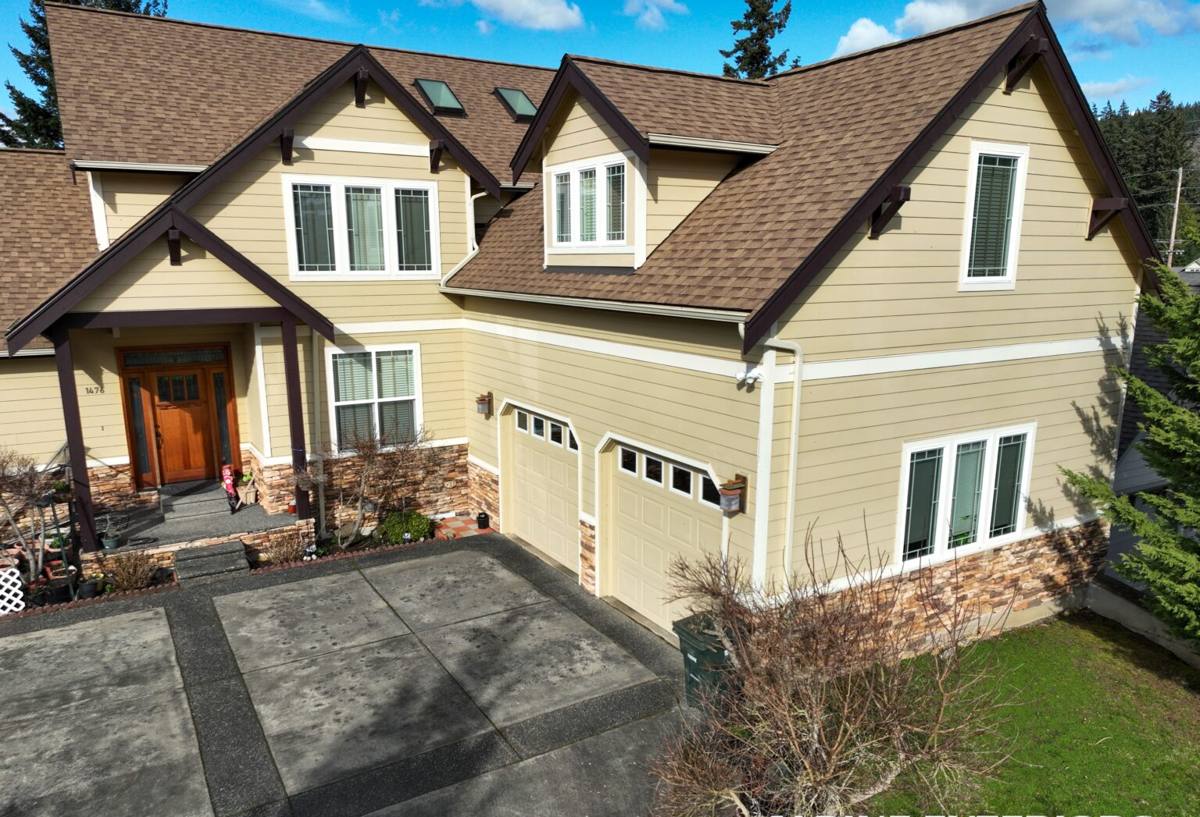
What Puget's Climate Actually Does to a Wall
Salt Air Off the Sound
Homes in Puget aren't necessarily right on the shoreline, but proximity to Puget Sound means salt-laden marine air is a routine part of daily exposure for most properties in the area, not just waterfront lots. That kind of exposure works slowly. It accelerates corrosion on fasteners, flashing, and trim hardware, and it speeds up the breakdown of lower-grade factory finishes. None of this shows up on install day. It shows up years later as rust bleed at nail heads, chalky or faded paint, and trim that's worked loose at the fasteners.
Driving Rain
Rain that arrives with real wind behind it doesn't run straight down a wall, it gets forced sideways into lap joints, trim seams, and any spot where the water-management detailing isn't right. That's a much tougher test for caulked joints, cut edges, and window flashing than a simple annual rainfall number would suggest, and it's a big part of why installation technique matters as much as material choice in this specific part of Whatcom County.
A Long Moss Season
Mild temperatures and near-constant moisture add up to active moss and mildew growth across most of the calendar year, especially on north-facing walls, shaded elevations, and anywhere mature trees keep a surface from drying out between storms. Organic growth on a siding surface traps moisture against the wall behind it, and that compounding effect, not any single storm, is where a lot of long-term siding problems actually start.
Why We Install Only James Hardie Fiber Cement
We don't offer a lineup of siding brands and let price sort out the decision for a Puget homeowner. We install James Hardie fiber cement, and only James Hardie, because of what we've consistently seen on tear-offs and repair calls in exactly this kind of coastal-influenced climate.
Climate-Engineered HZ5 Formulation
James Hardie engineers its siding differently for different climate zones, and the HZ5 line is built for regions with sustained moisture exposure and freeze-thaw cycling, which is a closer match to Whatcom County's wet, mild winters than a formulation built primarily for hot, dry markets. That's a concrete engineering reason, not a marketing detail, and it's a core part of why we standardized on this manufacturer specifically rather than fiber cement as a generic category.
ColorPlus Factory Finish
Instead of relying on a coat of paint applied on site, Hardie's ColorPlus finish is baked on in a controlled factory environment in multiple coats before the boards ever reach Puget. That finish is backed by its own warranty, separate from the substrate warranty, and it's formulated specifically to resist fading and hold its color against salt air and UV exposure better than a field-applied finish.
A Non-Combustible, Dimensionally Stable Core
Fiber cement is an inorganic material, a blend of Portland cement, sand, and cellulose fiber cured into rigid boards. It doesn't have a wood-based or foam core that can absorb water and swell, cup, or warp the way engineered wood and some other siding materials can after repeated wet-season moisture cycles, and it's non-combustible, which matters for household safety and can matter to insurers as well.
Fiber Cement Compared to the Alternatives
We don't install vinyl, LP SmartSide, Cemplank, Allura, primed spruce, or cedar, and we think that's worth explaining honestly rather than just stating it as policy. Each of those is a legitimate product with real advantages elsewhere. Here's how they compare to James Hardie fiber cement on the factors that matter most in a climate like Puget's.
| Material | Moisture & Salt Air Behavior | Maintenance in This Climate |
|---|---|---|
| James Hardie fiber cement | Inorganic core resists moisture absorption; ColorPlus finish holds up against salt air and UV | Low; no periodic repainting of the substrate required |
| Vinyl siding | Seams and J-channels aren't sealed and can let wind-driven rain track behind the panel | Low, but can warp or crack under heat and cold swings |
| LP SmartSide (engineered wood) | Wood-fiber core depends on intact coating and sealed edges to resist moisture | Moderate; cut edges and fasteners need consistent sealing over decades |
| Cedar / primed spruce | Organic material, hospitable to moss and mildew in sustained damp conditions | High; needs a regular paint or stain schedule to stay protected |
Fiber cement as a category is the right direction for a climate like this. We standardized on James Hardie specifically within that category for its factory-applied finish, its climate-specific HZ engineering, and the strength of its transferable warranty when the installation follows spec.
What Correct Installation Actually Involves
Material choice is only half the equation. A rushed or out-of-spec installation can undercut even the best siding product, and that's especially true in a climate that tests every seam and fastener as hard as Puget's does.
Clearances at Grade and Roofline
Hardie specifies minimum clearance between the bottom of the siding and grade, decks, and roofing. Skipping that clearance to make a job look tidy is one of the more common shortcuts we find on older installations, and it's a direct path to wicking and softness at the lowest courses of siding.
Fastening and Spacing
James Hardie publishes exact fastener type, spacing, and placement requirements, and following that spec rather than a shortcut version of it is what keeps panels secure through coastal wind loads and keeps the manufacturer's warranty valid if a problem ever comes up.
Flashing at Every Penetration
Windows, doors, hose bibs, vents, and light fixtures all interrupt the siding plane, and each interruption is a place water can get behind the cladding if it's flashed incorrectly. This is the slowest, least visible part of an installation, and it's usually the part that decides whether a wall stays dry behind the siding for decades or starts trapping moisture within a few seasons.
Sealed Field Cuts
Any panel cut on site, around a window, at a corner, at the end of a run, needs its cut edge sealed or primed per Hardie's specification before it goes up. An unsealed field cut is one of the more common places fiber cement actually takes on water, not because the material failed, but because the cut wasn't finished correctly.
How We Handle a Puget Installation, Step by Step
- Site and exposure assessment. We look at how each wall faces the Sound, which elevations take direct wind and salt air, which sit shaded under trees, and where existing moss or past water damage points to a chronic issue rather than a one-time event.
- Tear-off and sheathing inspection. Old siding comes off and the sheathing underneath gets checked before anything new goes up. Installing over damaged sheathing just buries the problem for a few years.
- Weather-resistive barrier installation. The barrier goes on with proper overlap and taped seams at every penetration, before flashing and siding go over it. This hidden layer does most of the real work of keeping wind-driven rain out of the wall assembly.
- Siding installed to manufacturer spec. Panels go up following Hardie's fastening, spacing, and clearance requirements as the baseline, not as an option, with field cuts sealed as they're made.
- Final walkthrough. We walk the finished job with the homeowner, confirm the work matches the estimate, and go over what basic upkeep looks like for a home in this part of Bellingham.
Living With Fiber Cement Siding in Puget: Maintenance That Actually Matters
Fiber cement needs far less upkeep than wood or engineered wood, but "low maintenance" isn't the same as "no maintenance," especially with a moss season this long. A short annual routine keeps a correctly installed Hardie system performing the way it's supposed to.
- Rinse siding down at least once a year, more often on shaded or north-facing walls where moss and mildew take hold fastest.
- Trim back branches and shrubs that keep siding shaded and damp, since airflow is one of the simplest ways to shorten how long a wall stays wet after a storm.
- Keep gutters and downspouts clear so overflow doesn't run down the face of the siding and cause localized staining or moisture concentration.
- Check caulking at trim, window, and door joints once a year and have any cracked or missing sealant replaced before the wet season sets in.
- Avoid pointing a pressure washer directly into butt joints or seams; a garden hose and soft brush are usually enough and won't force water behind the panel.
- Watch the roof-to-wall intersections for signs of staining, which can indicate a kickout flashing issue rather than a siding problem.
Cost Factors for a Puget Fiber Cement Project
Every estimate depends on the specific house, but a few factors consistently drive both price and timeline on a fiber cement siding project in this area.
| Factor | Why It Matters in Puget |
|---|---|
| Square footage and number of stories | More area and height mean more labor, and taller walls often need staging or lift equipment |
| Trim and roofline complexity | Homes with more windows, dormers, and roof transitions require more flashing and cutting |
| Sheathing condition found at tear-off | Years of trapped moisture behind older siding can mean hidden rot that needs repair before new siding goes up |
| Wall orientation and wind exposure | Elevations facing the Sound typically warrant closer attention to flashing and drainage detail |
| Product line and finish selection | James Hardie offers multiple panel styles, textures, and ColorPlus color options at different price points |
We walk the property in person before quoting, since square footage alone doesn't capture how much flashing, trim work, or substrate repair a specific house actually needs.
A Checklist for Evaluating Any Fiber Cement Installation
Whether you're getting an estimate from us or a second opinion elsewhere, these are reasonable things to confirm before calling a fiber cement siding job done:
- Documented clearance between the bottom of the siding and grade, decks, and roofing
- Corrosion-resistant fasteners suited to a marine-influenced climate, not standard-grade hardware
- Flashing visible and properly lapped at every window, door, and wall penetration before it's covered by siding
- All field-cut edges sealed or primed rather than left raw
- A continuous, properly lapped weather-resistive barrier underneath the siding
- Installation that follows James Hardie's published fastening and spacing spec, not a generalized approach
Why a Crew That Already Works Puget Matters
Installation quality on paper and installation quality on an actual wall in Puget aren't always the same thing. A crew that regularly works this stretch of Bellingham, close to Puget Sound, makes different judgment calls than one installing fiber cement occasionally between jobs elsewhere: where extra flashing attention genuinely pays off, which elevations stay damp longest through the moss season, and which details can't be shortcut regardless of schedule pressure. That judgment comes from doing this work repeatedly in this specific place, on homes dealing with this specific combination of salt air, driving rain, and prolonged dampness, not from applying a generic siding checklist the same way everywhere in Whatcom County.
If you're considering new fiber cement siding for a home in Puget, or want a straightforward second opinion on an existing installation, we're glad to come take a look. Reach out using the form below to schedule a free, no-pressure estimate.