 Bellingham Exterior
 Why Silver Beach Homes Take a Different Kind of Beating
Silver Beach sits close enough to open water that homes here deal with a combination most inland Bellingham neighborhoods don't: salt-laden air working on fasteners and trim, driving wind-driven rain that finds every gap in a siding system, and a moss season that runs long even by Whatcom County standards. Add mature tree cover shading north- and east-facing walls, and you get siding that stays damp longer after every storm and never gets a real chance to dry out between them.
Most siding failures we see in this neighborhood aren't dramatic. They're slow — a fastener that corrodes and lets a panel work loose, a caulk joint that fails and lets moisture behind the cladding, moss that holds water against a wall for weeks at a time. None of that shows up the first year. It shows up five or ten years in, and by then the damage is usually behind the siding, not just on it.
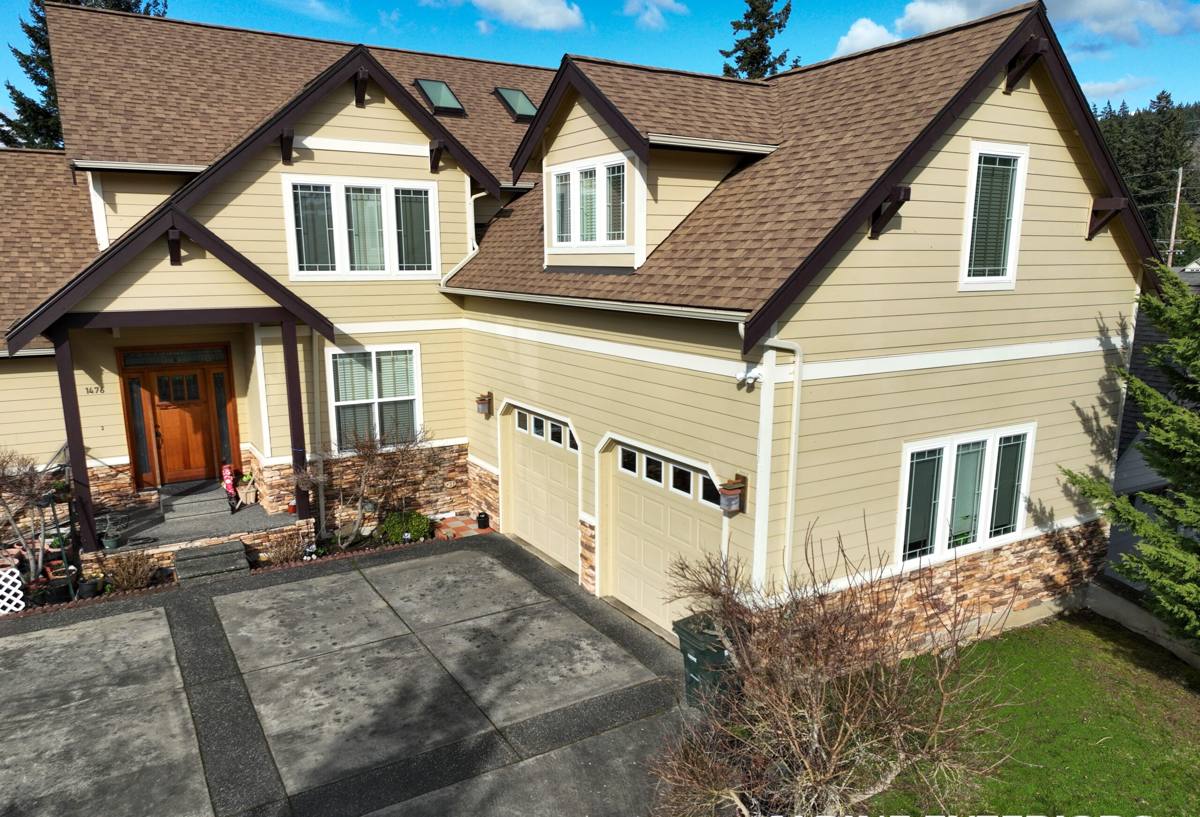
What James Hardie HZ5 Actually Solves Here
James Hardie fiber cement siding is made from cement, sand, and cellulose fibers, engineered to resist the things that break down wood-based and vinyl siding in this climate. It doesn't absorb water the way wood does, so it doesn't swell, cup, or rot at the edges. It's also non-combustible, which matters less for moisture but is part of why we standardized on it as a product line.
James Hardie makes region-specific formulations under its HZ program, and homes in the Pacific Northwest — including Bellingham and the rest of Whatcom County — fall under the HZ5 engineering zone. HZ5 products are formulated for climates with sustained moisture exposure, which is exactly the profile a home near the water deals with. It's not a marketing label; the moisture-management performance of the panel itself is tuned for regions like this one rather than the drier climates HZ10 products are built for.
ColorPlus Factory Finish vs. Field-Painted Siding
One of the most overlooked decisions on a Hardie project is finish. James Hardie offers both primed panels meant for field painting and ColorPlus panels, which are baked on with a factory finish before the siding ever reaches the site. In a climate with this much rain and UV cycling, the difference in real-world performance is significant.
| Factor | ColorPlus Factory Finish | Field-Painted (Primed) |
|---|---|---|
| Cut-edge sealing | Factory-sealed process reduces exposed raw edges | Depends entirely on job-site caulking and touch-up quality |
| Fade resistance | Engineered for UV and moisture cycling | Varies by paint product and applicator |
| Repaint interval | Typically well beyond 10 years | Often needs attention within 5-8 years in wet coastal climates |
| Warranty structure | Backed by James Hardie's finish warranty | Finish is covered by the paint manufacturer, not Hardie |
| Upfront cost | Slightly higher material cost | Lower material cost, added labor/paint cost later |
For a Silver Beach home, we lean toward ColorPlus on most projects. The factory finish is doing exactly the job this climate demands: keeping water out at the edges and holding color through repeated wet-dry cycling without relying on a field paint crew's timing and technique.
What Correct Installation Involves in This Climate
James Hardie siding performs the way it's rated to perform only when it's installed to spec, and the margin for error shrinks in a wet, salt-exposed environment. A correct install here means:
- Proper clearance between the bottom of the siding and grade, decks, roofing, and other horizontal surfaces, so water has somewhere to go instead of wicking up into the panel
- A continuous, correctly lapped water-resistive barrier behind the siding, with flashing integrated at every window, door, and penetration — not just caulk covering a gap
- Corrosion-resistant fasteners, sized and spaced to Hardie's specifications, since salt air is exactly the environment where the wrong fastener fails early
- Correct nailing patterns and blind-nailing where called for, so panels aren't over-driven or under-driven in ways that crack the material or leave it loose
- Field-cut edges primed or sealed before installation, since an unsealed cut edge is the single most common point of moisture entry on an otherwise correct job
None of this is unusual or specialized knowledge in the trade — it's what the manufacturer's installation manual actually calls for. The problem is that it takes longer to do right, and it's invisible once the siding is up. A rushed install and a correct one can look identical the day the crew leaves.
Our Process for Silver Beach Siding Projects
- Assessment. We look at the existing siding, sheathing, and any signs of trapped moisture or rot before quoting anything, since problems behind the old siding change the scope.
- Tear-off and sheathing check. Old siding comes off and we inspect the sheathing underneath. Any soft or water-damaged sheathing gets addressed before anything new goes up — covering a problem is not an option.
- Water-resistive barrier and flashing. We install or repair the weather barrier and flashing details at every window, door, and penetration point before siding starts.
- HZ5 panel installation. Panels go up with correct clearances, fastener spacing, and butt-joint treatment, following James Hardie's published fastening schedule for this region.
- Trim, caulking, and cut-edge sealing. Every field-cut edge is sealed, and joints are caulked with a product suited to the movement and moisture load this climate produces.
- Final walkthrough. We check the finished job against the same details we started with — clearances, flashing, fastening — before calling it complete.
Common Problem Areas We Find on Silver Beach Homes
A few patterns show up often enough on homes in this neighborhood that we check for them specifically. North- and east-facing walls under tree cover tend to hold moss longest and are usually where we find the earliest signs of moisture-related wear. Older homes with siding installed too close to grade or to a deck surface often show rot or staining right at that transition, even when the siding higher up the wall looks fine. And homes with vinyl or older wood siding frequently have corroded fasteners or trim hardware that salt air has worked on for years, sometimes long before the siding itself shows visible failure.
We flag these during assessment rather than after the tear-off starts, so there aren't surprises mid-project — and so we can tell you honestly whether an area needs more than a siding swap before we bid it.
Maintenance Checklist for Coastal-Climate Hardie Siding
Hardie siding is low-maintenance compared to wood or vinyl, but "low-maintenance" isn't "no-maintenance," especially this close to the water. A simple annual routine goes a long way:
- Rinse the siding periodically to clear salt residue and airborne grime buildup, especially on walls facing open water
- Trim back vegetation and tree limbs that keep siding shaded and damp, particularly on north-facing walls
- Inspect caulk joints around windows, doors, and trim once a year and re-caulk any that have cracked or pulled away
- Remove moss and algae with a soft wash and an appropriate cleaner rather than a close-range pressure washer, which can force water behind panels or damage the finish
- Check flashing at penetrations — vents, hose bibs, light fixtures — since these are common points where a small gap turns into a bigger problem
- If your siding is field-painted rather than ColorPlus, keep an eye on fade and chalking so repainting happens before the finish actually fails
Why We Only Install James Hardie — And Why Local Experience Matters
We standardized on James Hardie because, installed correctly, it holds up to exactly the conditions Silver Beach deals with: sustained moisture, salt air, and long stretches without full drying. We don't install vinyl, LP SmartSide, or other fiber cement alternatives, because we'd rather stand fully behind one product system we know performs here than split our expertise — and our warranty conversations — across several.
That same logic applies to who's on the crew. A contractor who's worked in Silver Beach and similar Bellingham-area, Whatcom County neighborhoods before knows what to check for before the tear-off starts — where moisture tends to hide, which details matter most in this specific climate, and how to sequence a job around this area's weather rather than around a generic install checklist. That experience doesn't show up as a line item on a quote, but it's the difference between a siding job that looks right at handoff and one that actually performs right for the next thirty years.
If you're weighing a siding project for a Silver Beach home, we're glad to take a look and give you a straightforward, no-pressure estimate — what we'd recommend, what it would involve, and why. Use the form below to get started.