 Bellingham Exterior
 Ferndale's Weather Is Hard on Roofs — Here's Why
Ferndale sits close enough to the water that homes here take a different kind of weather beating than roofs further inland. Winter storms roll in off the Strait of Georgia and Puget Sound with sustained wind and horizontal rain, the kind that doesn't just wet a roof but drives moisture sideways and up under anything that isn't sealed tight. Add the salt-laced air common to this part of Whatcom County, and you get faster corrosion on exposed metal — flashing, fasteners, gutter hardware — than you'd see on a roof thirty miles east.
Then there's moss. Western Washington's long, wet, mild-temperature season is close to ideal moss-growing weather, and moss season here runs a good chunk of the year, not just a few weeks. Moss holds moisture against the roof surface, works into shingle laps and granule beds, and quietly lifts tabs and degrades the roofing material long before a homeowner notices anything from the ground.
None of this means Ferndale roofs are doomed — it means storm damage repair here has to account for conditions a generic roofing job in a drier climate wouldn't. A repair that doesn't address moisture intrusion, salt exposure, and moss regrowth is a repair that's likely to need doing again within a year or two.
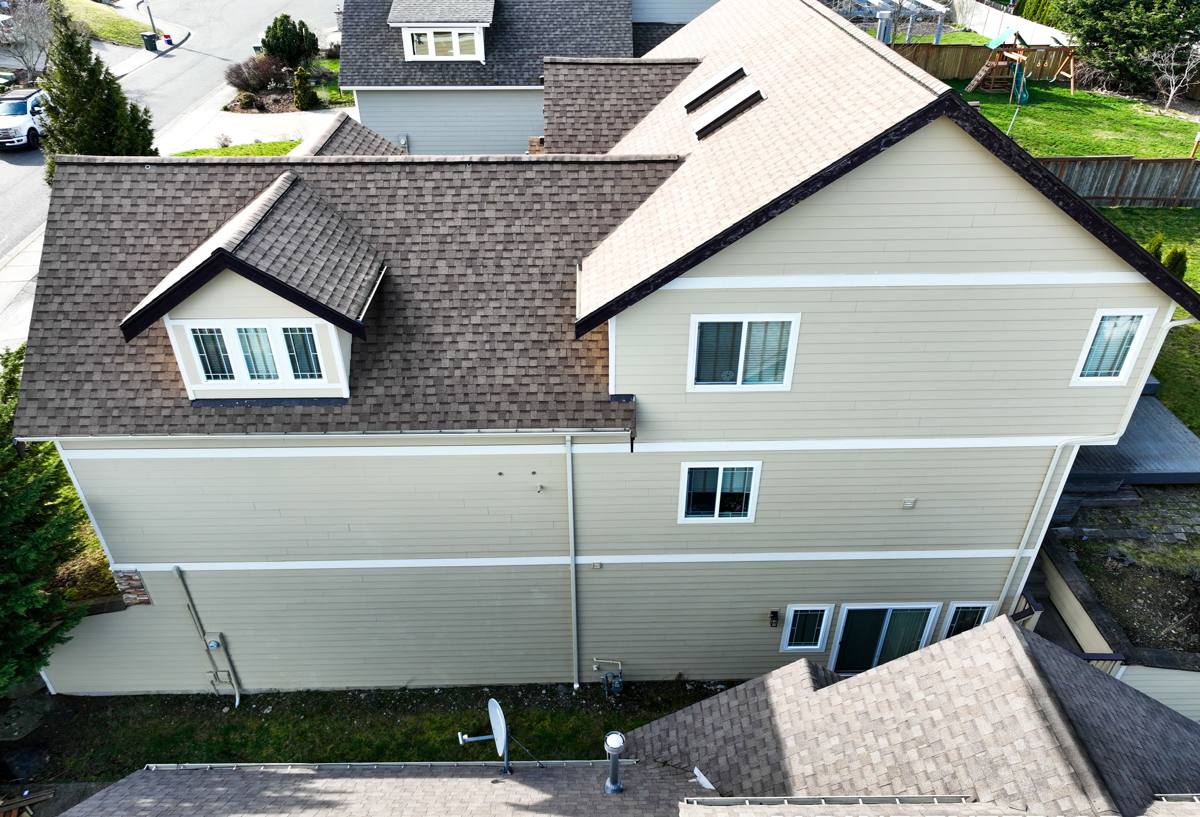
What Actually Counts as Storm Damage
Storm damage isn't always a dramatic hole in the roof. Most of what we find after a windstorm or heavy rain event is quieter than that, and easy to miss from a quick look:
- Wind-lifted or creased shingle tabs, especially along roof edges, ridges, and any area exposed to prevailing wind
- Torn, bent, or displaced flashing around chimneys, skylights, and roof-to-wall transitions
- Impact damage from tree limbs or debris — cracked shingles, dented vents, punctured underlayment
- Wind-driven rain intrusion at valleys, eaves, and anywhere sealant or flashing has aged out
- Clogged or damaged gutters that overflow during heavy rain and push water back under the roof edge
- Granule loss on asphalt shingles from wind abrasion and moss-related surface breakdown
Some of these are visible without getting on the roof. Others — a compromised underlayment, a slow leak that's been tracking along a rafter for months — only show up once someone who knows what to look for actually gets up there.
What a Correct Storm Repair Actually Involves
It Starts With a Real Inspection, Not a Guess
A proper storm damage repair starts by identifying every point of damage, not just the one the homeowner noticed. We check the roof surface, the flashing details, the decking underneath where accessible, and the attic side for moisture staining or daylight coming through where it shouldn't. Storm damage tends to cluster — if wind lifted three shingles on one slope, there are usually more nearby that are loosened but not yet visibly torn.
Checking What's Under the Surface
Shingles are the visible layer, but the decking and underlayment underneath do the real work of keeping water out. If wind-driven rain has been getting past damaged shingles for any length of time, the plywood or OSB decking can be soft, delaminated, or stained — and that has to be addressed before new roofing goes back down, not covered over. Skipping this step is the single most common shortcut in a rushed storm repair, and it's the one that causes the repair to fail from underneath.
Flashing and Sealant Get Replaced, Not Just Re-Caulked
Salt air and constant moisture age sealants and metal flashing faster here than in drier regions. A correct repair replaces damaged flashing with new material matched to what's already on the roof, rather than smearing sealant over a cracked or corroded piece and calling it done. Caulk is a short-term patch, not a fix.
Patch Job vs. Proper Repair
| Factor | Quick Patch | Proper Storm Repair |
|---|---|---|
| Scope of inspection | Only the visible damaged area | Full slope and surrounding details checked for related damage |
| Decking check | Skipped | Inspected where accessible; replaced if soft or delaminated |
| Flashing | Re-sealed with caulk over existing metal | Damaged flashing replaced with new, properly lapped material |
| Materials | Whatever's on the truck, may not match existing roof | Matched to existing shingle type, weight, and color where possible |
| Typical lifespan of the fix | Months to a couple years | Matches the expected life of the surrounding roofing |
| Insurance documentation | Usually none | Photos and written scope suitable for a claim, if needed |
A patch has its place — sometimes a homeowner needs a fast stopgap before a bigger repair can be scheduled, especially mid-storm-season. The problem is when a patch gets sold as a permanent fix. It rarely holds up through a second Whatcom County winter.
How We Handle a Storm Damage Call in Ferndale
- Inspection and documentation. We get on the roof (or use safe close-range inspection when conditions don't allow it), photograph every area of damage, and check the attic side for signs of moisture intrusion.
- Honest scope and estimate. We tell you what's actually damaged, what's at risk of failing soon, and what can reasonably wait. We don't pad a storm claim with unrelated work, and we don't downplay damage that needs attention.
- Temporary protection if needed. If there's active leaking or exposed decking, we get it covered and weathertight before a full repair can be scheduled — this matters most during active storm season when another system can roll through in days.
- The repair itself. Matching materials where possible, replacing flashing rather than resealing it, and confirming decking is sound before new roofing goes back down.
- Final check. We walk the completed repair and the surrounding roof area so nothing gets missed and you know exactly what was done.
Working With Insurance
Most storm damage repairs in this area do go through a homeowner's insurance policy, and the documentation matters as much as the repair. We provide clear photos and a written scope of the damage that your adjuster can work from. We're not a public adjuster and we don't negotiate your claim for you, but we make sure the physical evidence and the repair estimate are solid enough to support a fair claim outcome.
Signs Your Roof Needs a Storm Damage Inspection
- Shingles visible in the yard or gutters after a windstorm
- Visible tabs that look lifted, curled, or missing from the ground
- New or worsening water stains on ceilings or in the attic after a rain event
- Daylight visible through the roof deck from inside the attic
- Flashing around a chimney or vent that looks bent, separated, or rusted
- A sudden increase in granules collecting at downspouts
- Heavy moss buildup that's started lifting shingle edges
Any one of these is worth a call. Roof damage that goes unaddressed through even one more Whatcom County winter tends to get significantly more expensive to fix.
Why It Matters to Hire a Crew That Already Works Ferndale
Storm damage repair isn't just a roofing skill — it's a familiarity with how this specific climate attacks a roof over time. A crew that regularly works Ferndale and the surrounding Whatcom County area knows what salt-air corrosion looks like on ten-year-old flashing, knows which roof orientations take the worst of the prevailing storm wind, and knows how aggressive the moss problem gets on north-facing slopes shaded by trees. That local pattern recognition speeds up the inspection and makes the difference between catching related damage early and missing it until it becomes a bigger repair.
It also matters for response time. When a storm comes through and damages roofs across the area, a local crew can typically get out for an inspection and temporary protection faster than a company dispatching from further away — and in a wind-driven rain event, the gap between "damaged" and "actively leaking into the house" can be a matter of days.
A Note on Roofing Materials for Storm-Prone Areas
When storm damage repair opens up the question of whether a section of roof should be repaired or partially replaced, material choice matters more here than in milder climates. We generally steer homeowners toward well-rated architectural asphalt shingles with a strong wind rating, paired with self-adhering underlayment at eaves, valleys, and other water-prone details — not because other products don't exist, but because that combination has a proven track record of standing up to sustained wind and constant moisture without demanding unusual maintenance. Any material choice involves trade-offs in cost, appearance, and upkeep, and we'll walk through those honestly rather than push a single option.
If your roof took a hit in a recent storm — or you're just not sure whether what you're seeing is normal wear or something that needs attention — we're happy to take a look. Estimates are free, there's no pressure, and you'll get a straight answer about what's actually going on with your roof. Use the form below to get started.