 Bellingham Exterior
 Siding Installation Built for Barkley's Climate
Barkley homes sit close enough to Bellingham Bay and the surrounding wetlands that siding takes a beating most homeowners never fully see until a repaint or a repair reveals what's underneath. Between salt-tinged marine air, driving rain that comes in sideways off Puget Sound during fall and winter storms, and a moss season that can stretch from October through May under Whatcom County's tree canopy, siding here works harder than it does almost anywhere else in the state. A siding installation done right in Barkley isn't just about appearance — it's about choosing a material and a process that can actually stand up to those three forces working on the house at the same time.
This page covers what that looks like in practice: what the climate actually does to siding over time, what correct installation requires, how our process works from estimate to finish, and why a crew that already works this neighborhood catches problems a first-timer would miss.
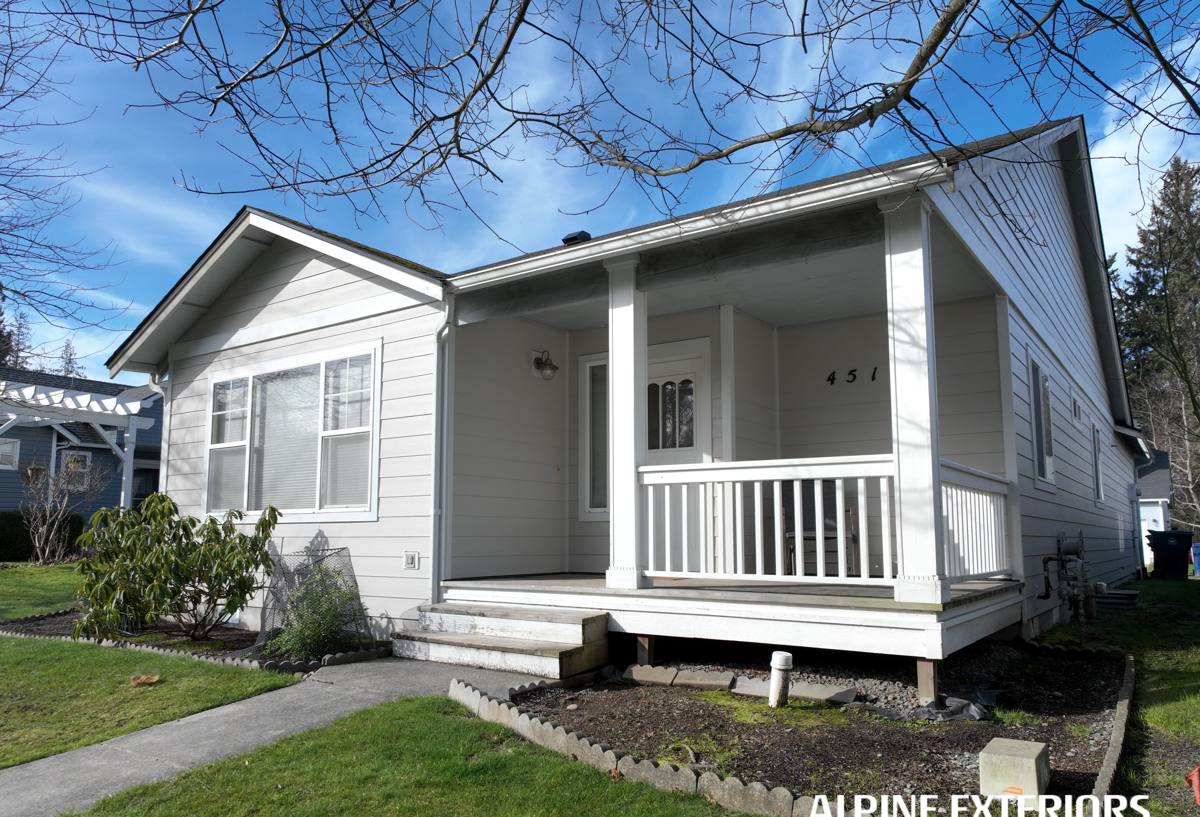
What Bellingham's Climate Does to Siding Over Time
Salt Air and Moisture
Proximity to the bay means airborne moisture carries trace salt content, and that moisture doesn't stay outside the wall assembly — it works into seams, fastener heads, and any gap in the exterior finish. Over years, this accelerates corrosion on unprotected fasteners and trim, and it keeps wood-based sidings damp longer between rain events than they'd stay in a drier inland climate.
Driving Rain
Storms off the Sound don't just fall straight down — wind pushes rain sideways into wall surfaces, soffits, and anywhere siding meets a window, door, or roofline. Siding that isn't installed with proper flashing and drainage behind it will eventually let that wind-driven water find a way in, even if the surface material itself is sound.
The Long Moss Season
Shaded lots and north-facing walls in Barkley stay damp for months at a time. That's ideal conditions for moss and algae growth, which holds moisture against the siding surface even longer and accelerates whatever degradation is already underway. Wood-based and some engineered wood products are particularly vulnerable here because moss growth combined with trapped moisture is exactly the failure mode their manufacturers warn about.
None of this means Barkley homes need exotic materials or unusual construction. It means the basics — material selection, water management, and fastening — have to be done correctly, because this climate has zero tolerance for shortcuts.
Why We Only Install James Hardie Fiber Cement
We made a deliberate decision to install James Hardie fiber cement siding exclusively, and it comes down to how the material performs against exactly the conditions described above.
- Non-combustible core: fiber cement doesn't feed a fire the way wood-based products can, which matters for insurance and for peace of mind.
- Moisture-resistant by composition: fiber cement doesn't swell, rot, or delaminate the way wood, particleboard-based, or some engineered wood sidings can when they stay wet for extended periods.
- ColorPlus factory finish: the finish is baked on at the factory under controlled conditions, which holds color and resists the fading and chalking that field-applied paint struggles with in a wet, low-sun climate.
- Climate-engineered HZ5 product line: Hardie manufactures a version of its product specifically engineered for cold, wet, freeze-thaw climates like the Pacific Northwest, rather than a one-size-fits-all formulation.
- Transferable warranty: a strong, transferable product warranty backed by a manufacturer with decades in the fiber cement category, which adds resale value homeowners can point to.
We don't install vinyl, LP SmartSide, Cemplank, Allura, primed spruce, or cedar. Each of those products has legitimate uses and reasonable arguments in its favor — but every one of them asks a homeowner to accept a maintenance burden, a moisture vulnerability, or an installation sensitivity that we don't think makes sense for this specific climate. Fiber cement, installed correctly, is the product we're willing to put our name behind on a Barkley home.
What Correct Siding Installation Actually Involves
The material is only half the equation. A huge share of siding failures we see on older Barkley homes trace back to installation shortcuts, not the siding itself. Correct installation means:
Water Management Behind the Siding
A continuous weather-resistant barrier (WRB) goes on the wall sheathing first, with proper overlap and taping at every seam. Flashing gets installed at every window, door, and roofline intersection so water is directed out and away from the wall assembly rather than trapped behind the siding.
Drainage Plane and Clearances
Fiber cement performs best with a drainage gap that lets any moisture that does get behind the panel drain and dry out rather than sit against the sheathing. Manufacturer-specified clearances from grade, roof lines, and decks are non-negotiable — skipping them is one of the most common ways a siding job voids its own warranty.
Fastening to Spec
James Hardie publishes exact fastener type, spacing, and penetration requirements. Under-fastening or using the wrong fastener type is invisible on install day and shows up years later as popped nails, buckling, or panel movement.
Caulking and Sealant Placement
Sealant belongs at specific joints, not everywhere. Over-caulking can trap moisture just as easily as under-caulking lets it in — this is a detail that separates a crew that knows the product from one that's guessing.
Our Installation Process
Every Barkley siding installation follows the same sequence, regardless of house size or siding condition going in:
- On-site assessment: we inspect the existing wall assembly, sheathing condition, and any moisture damage before quoting anything.
- Detailed estimate: a written scope covering material, prep work, flashing, and any sheathing repair identified during assessment.
- Tear-off and sheathing check: old siding comes off and sheathing is inspected for rot or soft spots before anything new goes on — this is where hidden moisture damage from years of driving rain typically surfaces.
- WRB and flashing installation: the water management layer goes in first, per manufacturer spec, at every penetration.
- Hardie panel installation: fastened, spaced, and gapped to manufacturer specification for the HZ5 climate zone.
- Trim, caulking, and final inspection: finish details are completed and the full installation is walked and checked against spec before we call the job done.
Comparing Siding Options for a Barkley Home
| Factor | James Hardie Fiber Cement | Vinyl | Engineered Wood / Cedar |
|---|---|---|---|
| Moisture behavior in wet climate | Resists rot, doesn't swell or delaminate | Doesn't rot, but can warp and gap over time | Vulnerable to moisture absorption and rot if finish fails |
| Moss and algae resistance | Factory finish resists staining, surface cleans easily | Can stain and hold algae in shaded areas | Prone to holding moisture under moss growth |
| Fire performance | Non-combustible | Combustible, can melt or warp near heat | Combustible |
| Finish longevity | Factory-baked ColorPlus finish | Color molded in, can fade and chalk | Field-applied paint/stain needs recoating |
| Long-term maintenance | Low — periodic wash, repaint on a much longer cycle | Low, but replacement panels are hard to color-match later | Higher — regular refinishing and moisture monitoring |
This table reflects general product performance characteristics as manufactured and installed to spec, not a claim about any specific competitor's workmanship.
Signs Your Current Siding May Already Be Failing
Barkley homeowners considering a siding replacement should walk the exterior and check for these before deciding on timing:
- Dark streaking or persistent moss growth on north- or shade-facing walls that returns quickly after cleaning
- Soft spots or visible flex when you press on the siding, especially near ground level or under downspouts
- Paint that's chalking, peeling, or fading unevenly panel to panel
- Visible gaps, warping, or buckling at seams and corners
- Popped or rusting fastener heads showing through the surface
- Interior signs like musty smells or peeling interior paint on exterior-facing walls, which can indicate moisture already past the siding layer
Any one of these on its own might just need a repair. Several together, especially on a home that's been through a decade or more of Bellingham winters, usually means the wall assembly itself needs attention, not just the surface.
Why a Crew That Already Works Barkley Matters
Siding installation isn't just a product decision — it's a set of judgment calls made on site, and those calls are better informed by a crew that has already worked the specific conditions of this neighborhood. Knowing which walls in this part of Bellingham take the worst of the driving rain, how much shade cover typically drives moss growth on a given lot orientation, and what sheathing condition tends to look like on homes of a certain age in this area all shape how a job gets scoped and executed. A crew installing here regularly also knows the local permitting expectations and inspection process, so the job moves without avoidable delays.
If you're weighing a siding replacement for a Barkley home and want a straight answer about condition, scope, and cost, we're happy to take a look. Reach out for a free, no-pressure estimate using the form below.