 Bellingham Exterior
 Why Birch Bay Siding Wears Differently Than Inland Bellingham
Birch Bay sits right on the Strait of Georgia, and that changes what siding has to survive. Homes a few miles inland in Bellingham deal with rain and humidity; homes in Birch Bay deal with all of that plus direct salt air off the water, wind-driven rain that hits siding at an angle instead of falling straight down, and long stretches of shade and moisture that keep north-facing walls damp for weeks at a time. Salt air is corrosive to fasteners and hard on finishes. Wind-driven rain finds every gap in caulking, flashing, and lap joints that would never leak on a calmer site. And Whatcom County's moss season — realistically most of the fall through spring — gives organic growth a long runway to take hold on anything that stays wet.
None of this means Birch Bay siding fails faster across the board. It means the failure points are different, and a repair crew that doesn't account for salt exposure and wind-driven rain will patch the visible problem and miss the one that caused it.
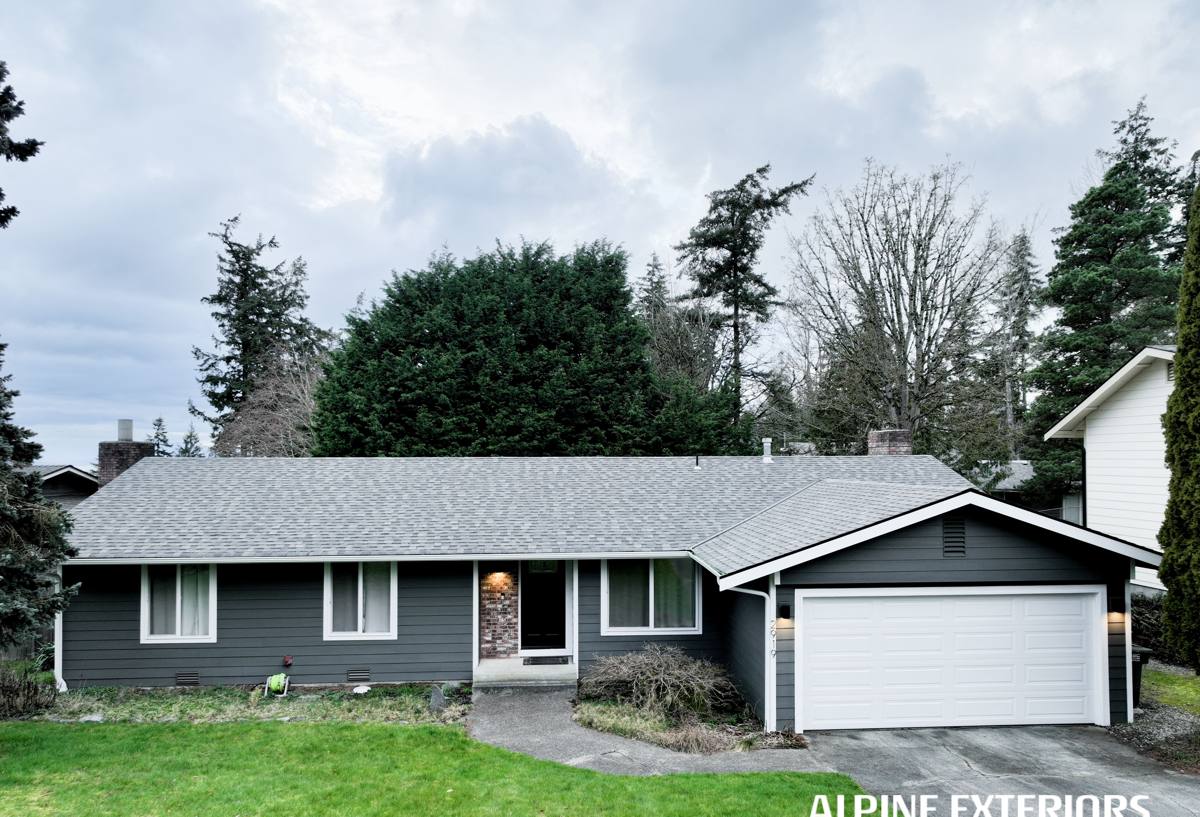
Signs Your Siding Needs Repair
Most homeowners call us after noticing one obvious problem, but siding damage is rarely isolated. A short inspection almost always turns up two or three related issues once we're up close. Here's what we look for, and what you should look for too:
- Cracked, warped, or buckling boards, especially on walls facing the water or prevailing wind
- Soft or spongy siding when pressed — a strong sign of moisture getting behind the material
- Green or black staining that keeps coming back within a season or two of cleaning
- Caulk that has pulled away from joints, corners, or trim
- Nail pops or fasteners backing out, more common where salt air has attacked the metal
- Peeling or bubbling paint, or finish that looks chalky and faded compared to the rest of the wall
- Visible gaps at butt joints or around window and door trim
- Interior signs — a musty smell, a damp patch on drywall, or a stain near an exterior wall
Any one of these is worth a look. Several at once usually means water has been getting behind the siding for a while, and the repair needs to address the water path, not just the surface.
What's Actually Driving Most Repair Calls Here
Salt air and fasteners
Airborne salt accelerates corrosion on anything less than fully corrosion-resistant. Older homes with standard fasteners or older caulk formulations show wear years before a comparable inland home would. When we open up a wall for repair, checking fastener condition is part of the job, not an afterthought.
Wind-driven rain
On an exposed site, rain doesn't just run down the face of a wall — it gets pushed sideways and upward into laps, seams, and trim intersections. A repair that only addresses the board itself and ignores the flashing and water-resistive barrier behind it tends to fail again in the same spot within a season or two.
Moss and prolonged moisture
Shaded walls, tree cover, and the region's damp fall-through-spring stretch mean some sections of a home stay wet far longer than others. Moss and algae don't just look bad — they hold moisture against the siding surface, which accelerates whatever degradation is already happening underneath.
Repair or Replace? How We Actually Decide
Not every damaged section needs to come off the whole wall, and not every stain means the whole house needs new siding. The honest answer depends on what's happening behind the surface, which is why we don't quote repairs sight unseen.
| Situation | Typical Approach | Why |
|---|---|---|
| Isolated crack or impact damage, framing dry underneath | Targeted repair, matched material | Structure and water barrier are sound — no reason to touch more than necessary |
| Recurring moss/staining on one exposed wall, siding still solid | Clean, treat, re-caulk, monitor | Cosmetic and moisture-management issue, not a material failure |
| Soft siding with visible sheathing rot behind it | Open the wall, repair sheathing, re-side that section | Patching over rot just hides an active problem |
| Widespread cracking, buckling, or fastener failure across multiple walls | Full re-side likely more cost-effective than repeated repairs | Repairing one failure point at a time on aging siding rarely stays ahead of the next one |
We'll tell you plainly which category your home falls into, including when a repair is genuinely the right call and a full re-side would be overkill.
What a Correct Repair Actually Involves
A siding repair that holds up on an exposed Birch Bay wall involves more steps than swapping a board:
- Remove the damaged section without tearing into more of the surrounding siding than necessary.
- Inspect what's underneath — sheathing, house wrap or building paper, and flashing at any windows, doors, or penetrations nearby.
- Address the water path, not just the board. If flashing is damaged or the barrier is compromised, that gets fixed before anything new goes back on.
- Repair or replace framing if rot has reached it — patching over soft wood just delays the same repair call.
- Install matched material, properly fastened and lapped to shed wind-driven rain rather than trap it.
- Seal and finish so the repaired section performs — and looks — consistent with the rest of the wall.
Skipping any of these steps is how a repair turns into a callback a year later.
Our Process for a Birch Bay Repair Job
We start with an in-person inspection, not a phone estimate — siding damage that looks minor from the driveway sometimes isn't, and vice versa. From there:
- We check moisture levels around the damaged area, not just the visible surface
- We identify whether the cause is material failure, a flashing or caulking gap, or ongoing moisture exposure from shade and wind
- We give you a clear scope — what needs to be opened up, what we expect to find, and what the repair will involve
- We match materials and finish so the repaired section blends with the surrounding siding
- We check the broader wall and adjacent sections while we're there, so small issues get flagged before they become repair calls of their own
We're not interested in reopening the same wall every couple of years. The goal is a repair that actually resolves the cause.
Why We Repair With James Hardie Fiber Cement
We install and repair with James Hardie fiber cement exclusively — we don't install vinyl, LP SmartSide, or other fiber cement brands. For repair work specifically, that has practical advantages. Hardie's ColorPlus factory finish is engineered for UV and weather resistance in a way that's harder to replicate accurately on-site, which matters when we're matching a patch to siding that's already weathered a few seasons in salt air. Fiber cement doesn't feed moss and algae growth the way untreated wood siding can, and it's non-combustible, which matters to a lot of homeowners regardless of coastal exposure. Hardie's HZ product lines are engineered for specific climate zones, including the wetter, wind-exposed conditions common along this stretch of coastline, and the product carries a strong transferable warranty when installed to spec.
We won't tell you Hardie is the only siding material that can hold up here — that's not an honest claim. What we'll tell you is that after years of repair calls and installs, it's the product we're willing to put on homes and stand behind, including the repairs we do to it later.
Why a Crew That Already Works Birch Bay Matters
Siding repair on an exposed coastal property isn't the same job as a repair three miles inland, and a crew that mostly works sheltered Bellingham neighborhoods may not think to check for salt-accelerated fastener corrosion or wind-driven rain paths that a calmer site would never produce. Working this area regularly means we already know what tends to fail here, where moisture tends to collect, and how to scope a repair that accounts for it — instead of learning that on your house.
It also means we're not a stranger showing up once. If a repair needs a follow-up check after the next storm season, we're a local call, not a drive from somewhere else in the county.
After the Repair: Keeping It From Coming Back
A good repair should reduce your maintenance burden, not just patch the symptom. Once the work is done, a little seasonal attention goes a long way on an exposed property: keep gutters and downspouts clear so water isn't sheeting down walls, rinse off salt spray and moss buildup on shaded or waterfront-facing walls a couple of times a year, and have caulking and trim checked periodically rather than waiting for a visible gap. None of this is expensive or time-consuming — it's just easy to forget until something fails.
If you're seeing cracking, staining, soft spots, or caulk pulling away from your siding, it's worth having someone look at it before Whatcom County's next wet stretch makes the problem worse. We're happy to come out, take an honest look, and put together a free, no-pressure estimate for what the repair actually needs — nothing more, nothing less.