 Bellingham Exterior
 Composite Decking Built for Happy Valley's Climate
Happy Valley sits close enough to Bellingham Bay and the surrounding wetlands that homes here deal with a specific combination of stresses: salt-laden air moving up from the water, long stretches of driving rain through the fall and winter, and shaded, tree-lined lots that stay damp well after a storm has passed. That combination is hard on any outdoor structure, but it's especially hard on decks. Wood decks in this part of Whatcom County fight moss, algae, and slow rot from the day they're built. Composite decking was designed to solve exactly this problem, but only when it's installed correctly for the site conditions it's actually going to face.
We install composite decking throughout Bellingham, and Happy Valley's mix of mature tree cover, moisture, and coastal air is one of the more demanding environments we work in locally. This page covers what that means for material choice, substructure, drainage, and long-term care, so you know what a correct job looks like before you sign a contract.
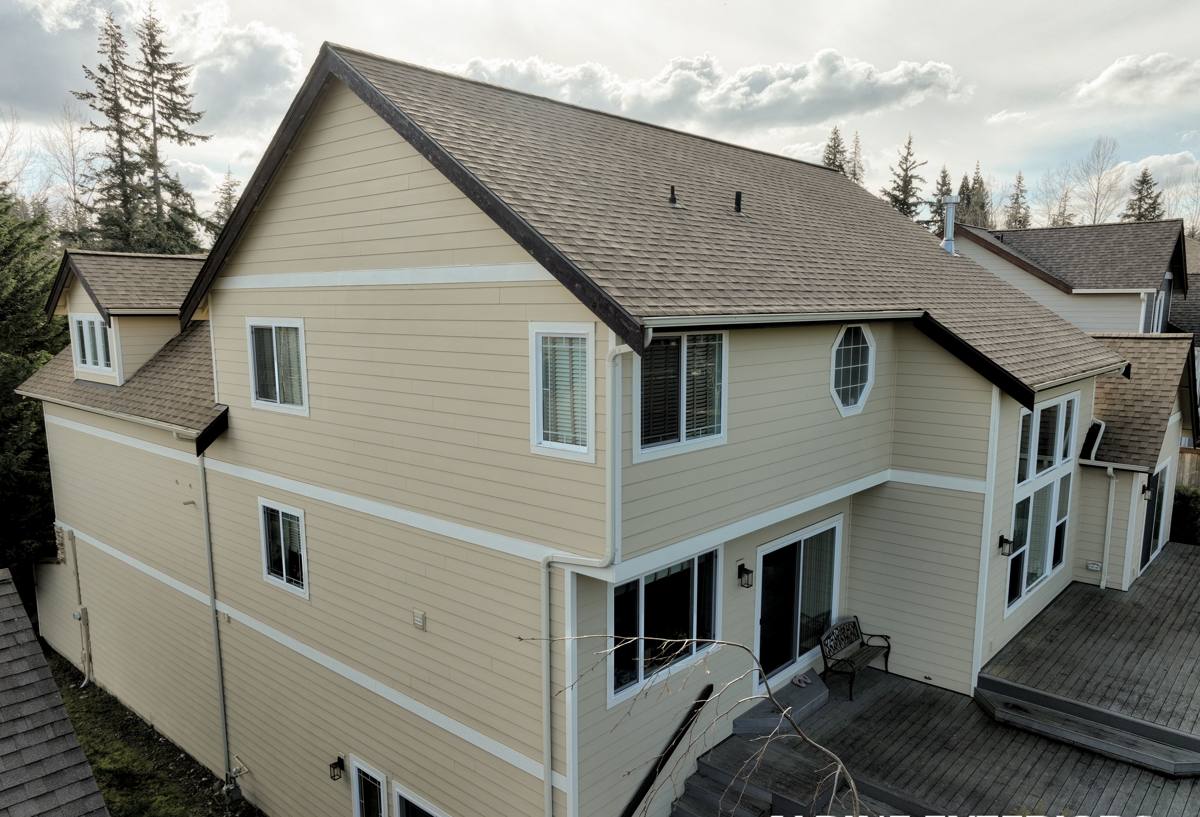
Why Happy Valley's Conditions Matter for Decking
Salt Air and Metal Fasteners
Proximity to the bay means airborne salt settles on every exterior surface, including deck hardware. Standard fasteners and connectors corrode faster here than they would further inland. Corroded fasteners don't just look bad — they lose holding strength, and a deck's structural integrity depends on every ledger bolt, joist hanger, and screw doing its job for the life of the deck.
Rain Volume and Duration
Bellingham gets a lot of rain, but it's the duration of Whatcom County's wet season — not just total rainfall — that does the damage. Decking boards, ledger connections, and hidden framing can stay damp for days at a time between storms. Any weak point in the water management of a deck compounds over years of that exposure.
Moss and Shade
Many Happy Valley lots have significant tree canopy, which is part of the neighborhood's character but also means decks get less direct sun to dry out. Shaded, damp surfaces are exactly where moss and algae take hold. On wood decking that means regular scrubbing and refinishing. On composite decking it's mostly a surface issue — but board selection and airflow underneath the deck still matter for keeping growth to a minimum.
What a Correct Composite Deck Build Involves
Composite decking is often marketed as "install and forget," but the material only performs as promised when the structure underneath it is built right. The board is one piece of the system — the framing, fasteners, and drainage are what actually determine whether the deck holds up in this climate.
Substructure and Framing
We frame to the load and spacing the composite manufacturer specifies, not a generic joist layout. Composite boards flex differently than wood and often require tighter joist spacing, especially on diagonal patterns or stair treads. We also use corrosion-resistant fasteners and connectors rated for coastal exposure — cutting corners here is the single most common cause of premature deck failure we see when we're called to inspect or repair someone else's work.
Ledger Attachment and Flashing
Where the deck attaches to the house is the single highest-risk water intrusion point on the entire structure. We flash the ledger board properly so water is directed away from the house framing, not into it. This is not an optional step, and it's one of the most commonly skipped details on lower-bid deck jobs.
Drainage and Airflow Underneath
A deck that traps water and stagnant air underneath it will grow moss and mildew faster, and it accelerates corrosion of the framing hardware. We grade the ground beneath the deck where possible and leave enough clearance for airflow, which matters more on shaded Happy Valley lots than it would on an open, sunny site.
Board Selection
Not all composite decking performs the same in wet, shaded conditions. We steer customers toward capped composite boards — meaning the core is fully wrapped in a protective polymer shell — over uncapped or lower-grade composite, because the cap is what actually resists moisture absorption, staining, and mold growth over time. It costs more up front and it's worth it in this climate.
Composite vs. Wood vs. PVC: An Honest Comparison
| Factor | Wood | Capped Composite | PVC |
|---|---|---|---|
| Moisture resistance | Low — absorbs water, prone to rot | High — capped shell resists absorption | Very high — fully synthetic |
| Moss/algae resistance | Poor in shade, needs regular cleaning | Good, easier to clean than wood | Good |
| Maintenance | Annual sanding/staining/sealing | Occasional wash, no refinishing | Occasional wash, no refinishing |
| Upfront cost | Lowest | Mid to upper | Highest |
| Feel underfoot | Natural, varies with species | Close to wood, some flex | Stiffer, more plastic feel |
| Warranty structure | Manufacturer warranty on lumber grade only | Typically 25–50 year limited, covers fading/staining | Typically 25–50 year limited |
We don't push one product on every homeowner. Some Happy Valley clients want the classic wood look and are willing to keep up with annual maintenance; others want to install it once and stop thinking about it. Our job is to lay out the real trade-offs — moisture behavior, upkeep, and long-term cost — so you can make that call with accurate information, not a sales pitch.
Our Process for a Happy Valley Deck Project
- Site walk and assessment. We look at sun exposure, tree cover, existing drainage, and the condition of any structure the new deck will attach to.
- Material and layout discussion. We talk through composite board options, color, and layout based on how the space will actually be used.
- Permitting. Deck projects in Bellingham and unincorporated Whatcom County often require a building permit depending on size and height — we handle that paperwork as part of the job.
- Demolition or prep. If we're replacing an existing deck, we remove it and inspect the ledger and any framing that will be reused.
- Framing and flashing. Structure goes in first, built to the composite manufacturer's spec, with proper ledger flashing and corrosion-resistant hardware.
- Decking installation. Boards are installed with the fastening system specified for that product line — hidden fastener clips, color-matched screws, or both depending on the board.
- Final walkthrough. We go over care instructions specific to the product installed and answer questions before we consider the job done.
What to Check Before You Hire a Deck Contractor
- Are they licensed and insured to do structural work in Washington State?
- Do they pull permits, or do they suggest skipping that step?
- Will they show you their framing plan and fastener spec before the build starts?
- Do they flash the ledger board, or just bolt it to the siding?
- Are they familiar with the specific composite product's installation requirements, including joist spacing and expansion gaps?
- Can they explain why they'd choose one composite line over another for your site's sun and shade conditions?
- Do they offer a written warranty on their labor, separate from the manufacturer's product warranty?
A deck is a structural project with real safety implications — it's not just a surface finish. A contractor who can't answer these questions clearly is a contractor who hasn't thought through the framing, and framing is what fails first in this climate.
Maintenance: What Composite Actually Requires
Composite decking is lower-maintenance than wood, not maintenance-free. In Happy Valley's shaded, damp conditions, we recommend:
- Sweeping debris off the deck regularly, especially fallen leaves and needles that trap moisture against the board surface.
- Washing the deck once or twice a year with a soft-bristle brush and mild soap and water — pressure washing on low settings only, and never aimed directly at board seams.
- Checking underneath the deck periodically for standing water, blocked drainage, or vegetation growing up against the framing.
- Inspecting fastener heads and any exposed hardware annually, since coastal air accelerates corrosion even on treated hardware.
None of this is heavy work, but skipping it entirely — treating composite as truly zero-maintenance — is how moss and grime build up on boards left in constant shade.
Why Local Experience in Happy Valley Matters
A deck built to a generic spec sheet doesn't account for what a specific lot actually deals with — how much direct sun it gets, how close it sits to the bay, how the surrounding trees affect drying time after a rain. We work Bellingham and greater Whatcom County regularly, which means we've seen how composite decks age in exactly these conditions over multiple wet seasons, not just how they look on installation day. That experience shapes real decisions: which board lines hold up best in shade, how tight to run joist spacing on this site, and where extra flashing attention pays off years down the road.
If you're planning a new deck or replacing an aging one in Happy Valley, we're happy to walk the site, look at your sun and drainage conditions, and give you a straight assessment of what will hold up — along with a free, no-pressure estimate using the form below.