 Bellingham Exterior
 Building Decks That Actually Hold Up in Happy Valley
Happy Valley sits close enough to Bellingham Bay and the surrounding hills that homes here deal with a specific combination of weather: salt-tinged air moving in off the water, long stretches of driving rain through fall and winter, and a moss season that can run half the year on anything shaded or north-facing. A deck built with generic, one-size-fits-all methods will show it within a few seasons — soft spots at the ledger board, green film on the boards, rust bleeding from fasteners, or a railing post that's gone spongy at the base. A deck built for this specific neighborhood and this specific climate doesn't have those problems, or at least not for a long, long time.
We build and repair decks throughout Bellingham and Whatcom County, and Happy Valley is one of the areas we're in regularly. That matters more than it sounds like it should: knowing the typical lot grading, the tree cover, and how moisture behaves on this side of town changes real decisions we make on your project, from footing depth to board spacing.
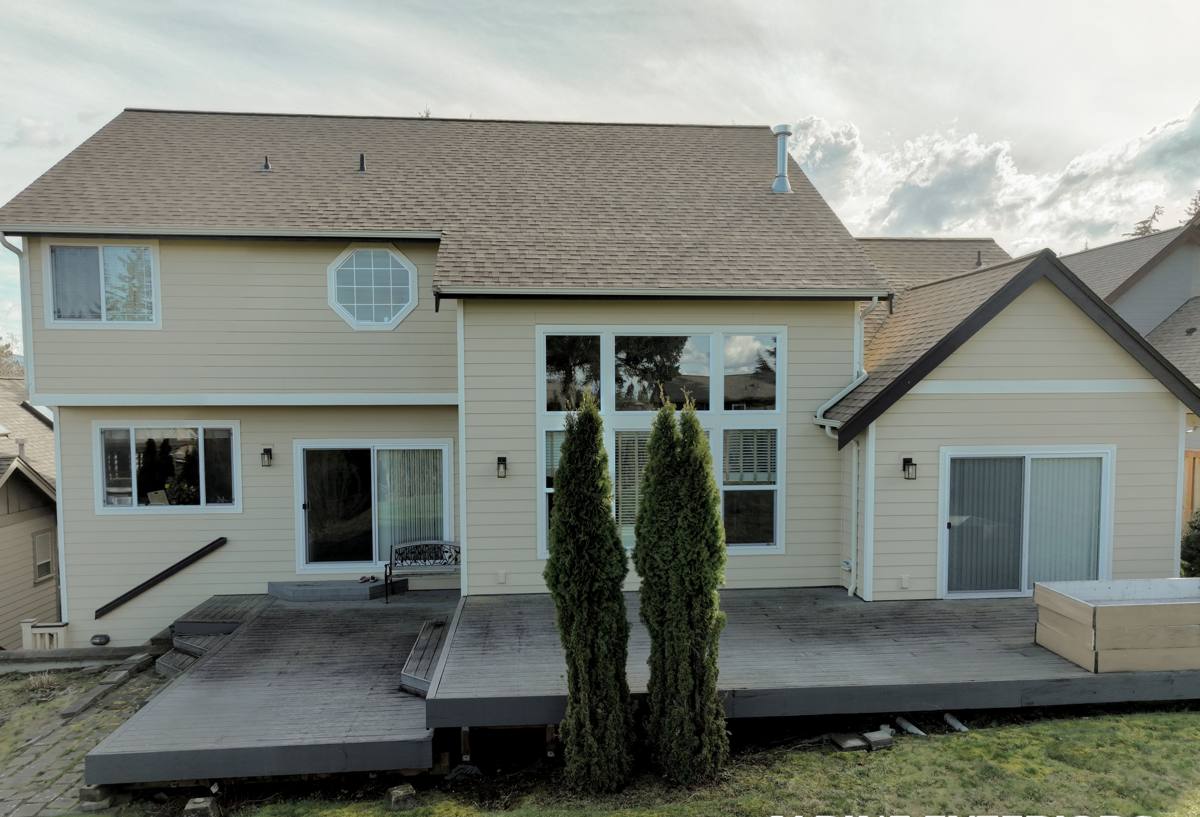
What Happy Valley Homes Need From a Deck
Every deck in Whatcom County has to deal with rain. But a few things about Happy Valley's setting push certain design choices to the front of the list:
- Shade and moisture retention — mature trees and hillside lots mean many decks here don't get full sun exposure, so wood and even some composite surfaces stay damp longer after a storm.
- Salt-influenced air — proximity to the bay means metal hardware, fasteners, and connectors are exposed to more corrosive air than a deck built further inland.
- Slope and drainage — a lot of Happy Valley properties have some grade to them, which affects footing depth, how water sheds under the deck, and whether a lower-level patio or walkway needs its own drainage plan.
- Moss and algae growth — long damp, shaded stretches are exactly what moss needs to establish, and once it's growing on a deck surface it holds moisture against the boards and becomes a slip hazard.
None of this means Happy Valley decks are harder to build well. It means the details that get skipped on a rushed job — flashing, fastener grade, gap spacing, drainage slope — are the details that actually determine whether your deck looks and performs the same in year ten as it did in year one.
Choosing the Right Decking Material
There's no single "best" decking material — there's a best material for your budget, your maintenance appetite, and your site conditions. Here's how the common options actually compare for a damp, shaded, salt-air environment like Happy Valley:
| Material | Moisture & Moss Behavior | Salt Air / Hardware Corrosion | Maintenance |
|---|---|---|---|
| Pressure-treated lumber | Absorbs and releases moisture; needs airflow underneath to avoid cupping and rot | Requires stainless or coated fasteners near the bay | Annual cleaning and periodic sealing/staining |
| Cedar | Naturally rot-resistant but still needs finish to resist moss staining | Same fastener requirements as treated lumber | Refinishing every few years to keep color and protection |
| Composite decking | Won't rot, but can still grow surface moss/algae in constant shade | Hidden-fastener systems reduce exposed metal | Occasional washing; no staining or sealing |
| PVC / capped polymer | Fully moisture-resistant surface; least hospitable to moss growth | Lowest exposed-hardware corrosion risk when installed correctly | Lowest maintenance of the group |
We install all of these. Our job is to walk your specific lot — sun exposure, tree cover, how sheltered or exposed the deck location is — and give you a straight recommendation rather than pushing whatever's easiest to install. A shaded, tree-covered Happy Valley lot is a different conversation than an open, sunny one, even a few streets over.
A Note on Fasteners and Hardware
This is the detail that gets skipped most often and causes the most trouble later. Standard galvanized fasteners can corrode faster than expected in air with any salt content, leading to staining, weakened connections, and premature hardware failure. We use stainless steel or high-corrosion-rated coated fasteners and structural connectors on decks in bay-adjacent neighborhoods like Happy Valley as our standard practice — not an upgrade — because replacing rusted-out fasteners later means tearing into finished decking.
Framing and Substructure: Where Decks Actually Fail
The decking boards are the part everyone looks at, but the framing underneath is what determines whether the deck is safe and long-lasting. Most deck failures we get called out to inspect trace back to the substructure, not the surface boards.
Ledger Attachment and Flashing
The ledger board — where the deck attaches to the house — is the single most common failure point in this climate. Without proper flashing, water works its way behind the ledger and into the house's rim joist, rotting it from the inside where you can't see it. Correct flashing detail, installed before the decking goes down, is non-negotiable on every deck we build.
Footings and Post Bases
Footing depth needs to go below the frost line and land on stable soil, which can vary across a sloped Happy Valley lot even within the same project. Post bases should hold the post above the concrete and above standing water, not buried or sitting flush against wet ground, since that's exactly where rot and moss establish first.
Joist Spacing and Airflow
Tight joist spacing and a low deck height can trap moisture underneath with no airflow to dry it out — a real problem in a climate with as much sustained damp weather as ours. We plan joist layout and deck height with drying time in mind, not just span tables.
Designing for a Wet, Mossy Climate
A deck built for Whatcom County weather has to manage water on purpose, not by accident. That comes down to a handful of design decisions:
- Board gap spacing sized to shed water quickly rather than trap it between boards.
- Slight slope away from the house so water runs off the deck surface instead of pooling.
- Under-deck drainage where the space below is used as a patio or storage area, so water doesn't just fall through onto whatever's underneath.
- Railing post bases detailed to shed water rather than hold it against end grain, which is where rot starts on most railing systems.
These aren't upgrades — they're what a correctly built deck looks like in a region with this much rainfall and shade. Skipping them is how you end up with a deck that needs board replacement in five years instead of fifteen or twenty.
Our Deck Building Process
- On-site evaluation — we look at your lot's slope, sun exposure, tree cover, and how the deck ties into the house before recommending anything.
- Material and layout discussion — honest tradeoffs on wood versus composite versus PVC, sized to your budget and how much upkeep you actually want to do.
- Permitting — we handle the permit application and inspections required for your project.
- Framing and flashing — footings, ledger flashing, and structural framing built to hold up in wet, shaded conditions.
- Decking and railing installation — surface materials and railings installed with corrosion-resistant hardware throughout.
- Final walkthrough — we go over the finished deck with you, including how to care for whichever material you chose.
Permits and Local Requirements
Most deck projects in and around Bellingham require a building permit, and the requirements typically cover footing depth, railing height and spacing, and structural attachment to the house. Requirements can vary depending on the deck's height, size, and location relative to property lines, and inspections are generally required at specific stages of construction. We handle the permit process as part of the job, but it's worth knowing upfront that "no permit needed" is rarely the right answer for a ground-up deck build — and skipping it can create real problems later when you go to sell the house.
Maintenance Checklist for Happy Valley Deck Owners
Whatever material you choose, a little regular attention goes a long way in this climate. A few things worth doing at least once or twice a year:
- Sweep off leaves and debris regularly, especially in fall — trapped organic matter is where moss and mildew get started.
- Rinse or gently wash the surface periodically to remove the early film of algae or moss before it takes hold.
- Check railing posts and stair stringers for soft spots, especially where they meet the ground or a footing.
- Inspect the ledger flashing area where the deck meets the house for any signs of staining or moisture.
- Re-seal or re-stain wood decking on the schedule recommended for the product — don't wait until it's visibly gray and weathered.
- Keep planters and pots elevated slightly or moved periodically so they don't trap moisture against the decking underneath.
Why a Crew That Already Works Happy Valley Makes a Difference
A deck contractor who works across a wide territory can still build you a fine deck. But a crew that already works Happy Valley regularly has a head start: we've seen how the slope on this side of town affects footing plans, how much shade certain lots hold onto through the afternoon, and which fastener and flashing details actually matter this close to the bay. That's not a sales pitch — it's the difference between a deck designed on paper and a deck designed for the lot it's actually going on.
If you're planning a new deck, or replacing one that's showing its age, we're happy to come take a look and give you a straightforward, no-pressure estimate. There's a form below — reach out and we'll set up a time to walk the site with you.