 Bellingham Exterior
 Siding Replacement Is a Different Job Than Siding Repair
A lot of calls we get from Lynden homeowners start as a repair question — a soft spot near a downspout, a cracked panel after a windstorm, a corner that's started to pull away from the wall. Sometimes that really is a repair. But often, once we're up close on a ladder, the damage in one spot is a symptom of something happening across the whole wall system, and patching the visible problem just delays the real one. Siding replacement means removing the existing cladding down to the sheathing, addressing whatever that tear-off reveals, and installing a new water-management and siding system from scratch. It's a bigger job, a bigger cost, and — done correctly — a decades-long fix instead of a few more seasons of patching.
This page is specifically about full siding replacement for homes in Lynden, not a general overview of every service we offer. Lynden sits inland from Bellingham Bay, out in Whatcom County's agricultural belt near the Canadian border, and while that inland position changes the exposure a little compared to a shoreline lot, it doesn't remove the core problem: this is a wet, marine-influenced climate, and old or failing siding here tends to fail in specific, predictable ways.
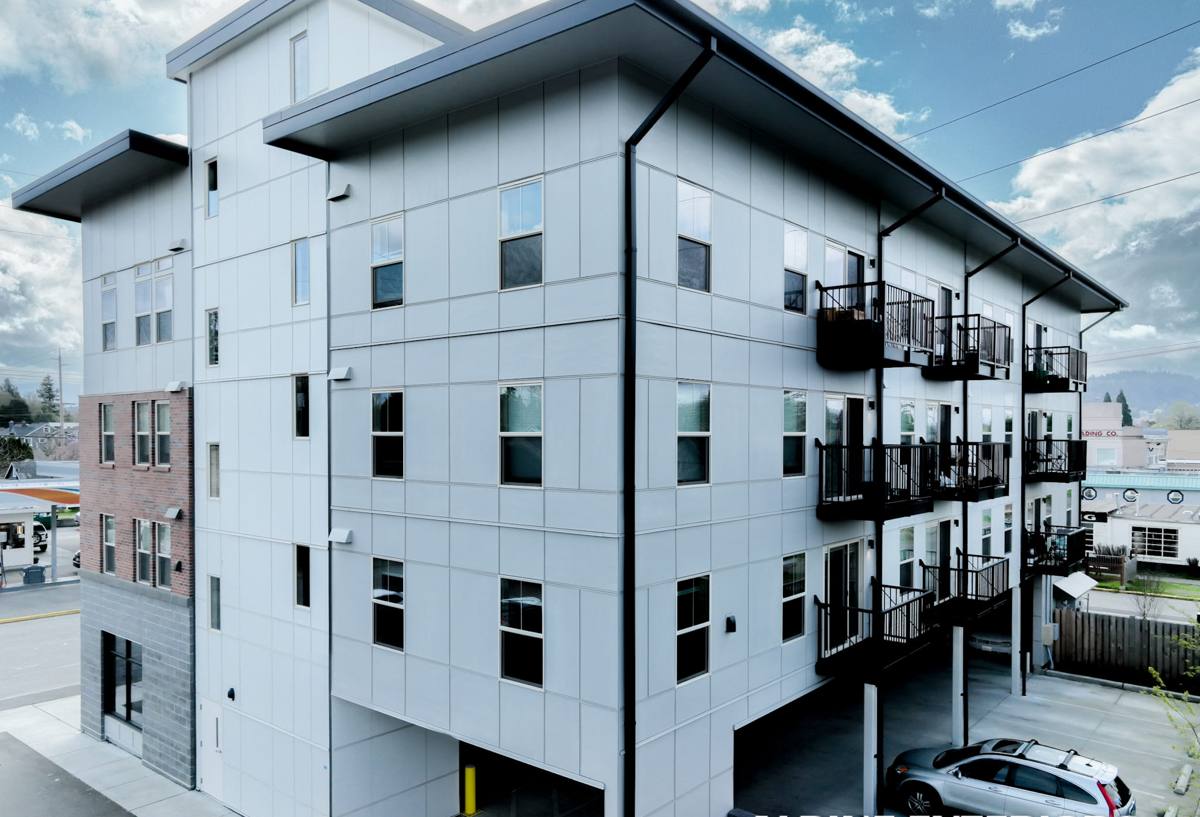
What Lynden's Climate Does to Siding Over the Years
Salt Air, Even This Far Inland
Lynden isn't right on the water, and homeowners sometimes assume that means salt exposure isn't a factor. Marine air moves across this whole part of Whatcom County, though, and over enough years it works on fasteners, flashing, and lower-grade trim hardware — more slowly than it would a few miles closer to the shoreline, but it adds up over the 20 or 30 years most siding is expected to last.
Driving, Wind-Pushed Rain
Rain through fall and winter rarely falls straight down here. Wind pushes it sideways into lap joints, under trim, and into any gap in a wall's water-management layer. That sideways load is what actually determines whether siding holds up for decades or starts letting water in behind the cladding after a few wet seasons — and it's a bigger factor in long-term performance than the raw material rating on a spec sheet.
A Long Moss Season
Mild temperatures, consistent moisture, and a mix of open farmland and tree-sheltered residential lots add up to a moss and mildew season that can run close to year-round on shaded walls. Lynden's layout means this varies a lot house to house — a wall facing open field dries out fast after a storm, while a shaded wall against a tree line or a north-facing gable often stays damp for days. Old siding with any porosity becomes a growth surface in those conditions, and the moss holds even more moisture against the wall behind it.
None of these three factors act alone. A house with failing caulk joints, a little bit of moss holding moisture in place, and 25 years of salt-laden wind cycling through the same gaps is exactly the kind of house where a "small repair" call turns into a full replacement conversation once we're actually looking at the wall.
Signs Your Siding Has Crossed the Line From Repair to Replacement
- Soft, spongy, or crumbling material when you press on it near the bottom courses, around window trim, or below downspouts
- Visible warping, cupping, or bowing across multiple panels rather than one isolated spot
- Paint or finish that keeps failing within a couple of years of repainting, no matter how well the prep work was done
- Persistent moss or dark staining that comes back within months of cleaning, especially on shaded walls
- Gaps, cracks, or separation at butt joints and corners that keep reopening after caulking
- Interior signs — musty smell, discoloration on interior drywall, or a spike in heating bills — that trace back to exterior wall moisture
- Siding that's simply reached the end of its rated service life, even if it looks intact from the ground
Any one of these on its own might still be a repair. Several of them together, especially combined with a house that's overdue for its first or second re-side, is usually a sign the whole system needs to come off.
What Tear-Off Actually Reveals
The most important part of a siding replacement often isn't the new material — it's what we find once the old siding comes off. This is where replacement earns its cost advantage over repair, because it's the only point in the process where the sheathing, framing, and water-resistive barrier underneath are fully visible and accessible.
What We're Checking For
- Soft or delaminated sheathing, particularly around window and door openings and at the base of walls
- Rot or moisture staining on framing members where it's tracked in from a failed flashing detail
- A water-resistive barrier that's torn, improperly lapped, or missing entirely in spots
- Insect activity in framing that's stayed damp for an extended period
- Improperly flashed windows, doors, or deck ledger connections that have been quietly feeding water into the wall for years
On a Lynden home that's had one or two siding systems on it already, it's common to find at least one of these issues somewhere on the house, even when the siding itself looked fine from the driveway. Addressing it now — while the wall is already open — is far cheaper and less disruptive than discovering it later through a different repair.
Our Siding Replacement Process
| Stage | What Happens |
|---|---|
| Inspection and estimate | Full walk-around of the house, noting exposure differences by wall, visible damage, and likely problem areas before any siding comes off |
| Tear-off | Existing siding removed down to the sheathing so the wall assembly can actually be evaluated, not guessed at |
| Sheathing and framing repair | Any soft, rotted, or damaged sheathing and framing replaced before anything new goes back on the wall |
| Water-resistive barrier and flashing | New house wrap installed and properly lapped, with flashing corrected at every window, door, and penetration |
| James Hardie fiber cement installation | Panels and trim installed to manufacturer spec — correct fastener pattern, clearances from grade and roofline, and joint treatment |
| Final detailing and walkthrough | Caulking, touch-up, cleanup, and a walkthrough so you know exactly what was done and what the maintenance schedule looks like going forward |
Every one of those stages matters. Skipping the sheathing check to save a day, or reusing an old, torn water-resistive barrier to save material cost, is exactly the kind of shortcut that turns a 30-year siding job into a 10-year one.
Why We Replace Siding With James Hardie Fiber Cement — Nothing Else
We install James Hardie fiber cement exclusively on replacement jobs. We don't install vinyl, LP SmartSide, Cemplank, Allura, primed spruce, or cedar. That's a professional standard, not a sales pitch, and it's worth explaining plainly rather than just asserting it.
- Non-combustible core: fiber cement doesn't feed a fire the way wood-based products can, which matters for both safety and insurance underwriting.
- Dimensional stability: it doesn't swell, cup, or warp the way engineered wood or solid wood siding can after repeated wetting cycles across a wet Whatcom County winter.
- Factory-applied ColorPlus finish: baked on in a controlled process rather than field-painted, so it holds color and adhesion far longer under sustained moisture and UV exposure.
- Climate-engineered HZ product lines: Hardie's HZ5 formulation is built for regions with significant moisture exposure and freeze-thaw cycling — a closer match to this county than a general-purpose product.
- A strong, typically transferable warranty: backed by the manufacturer when the installation follows Hardie's published specifications, which is exactly what our install process is built around.
Vinyl, engineered wood, and untreated solid wood all have a place in the broader market, and plenty of homeowners are satisfied with them elsewhere. Our call is specific to this climate: given how much sustained moisture and wind-driven rain this region deals with, we'd rather stand fully behind one system we trust than offer a cheaper alternative that quietly shifts maintenance risk onto the homeowner five or ten years down the road.
What Correct Installation Actually Involves
Fiber cement performs close to its rated lifespan only when it's installed to spec — the material itself doesn't make up for a rushed install. On every Lynden replacement job, that means holding to a specific set of details:
- Minimum clearance from grade, roofline, and any horizontal surface like a deck or patio, so splash-back and standing water don't sit against the bottom edge
- Correct fastener type, spacing, and placement — Hardie is specific about this, and it directly affects both wind resistance and warranty coverage
- Proper joint treatment at every butt seam and corner, since these are the highest-risk points for water intrusion on any siding system
- Flashing integrated correctly at windows, doors, and any wall penetration, tied into the water-resistive barrier in the right shingle-lap order
- Adequate rainscreen or drainage detailing where the wall assembly calls for it, so any moisture that does get behind the siding has a path out
None of this is visible once the job is finished and the house looks good from the street. It's exactly the kind of work that separates a siding replacement that's still performing in year 25 from one that's showing problems again in year eight.
Cost Factors on a Lynden Siding Replacement
| Factor | Why It Moves the Price |
|---|---|
| Amount of sheathing or framing repair found at tear-off | Hidden damage isn't known until the old siding is off; more damage means more replacement material and labor |
| House size and wall complexity | More corners, dormers, and trim details mean more cutting, fitting, and labor hours per square foot |
| Number of stories and access difficulty | Multi-story walls and tight access points require more scaffolding and slower, more careful work |
| Trim and detail package chosen | Corner boards, window trim profiles, and accent details all add material and installation time |
| Color and finish selection | Factory ColorPlus finishes vary in cost by line and color depth compared to primed-for-paint options |
| Site conditions | Landscaping, fencing, and general property access can affect setup time and material staging |
We won't quote a number without seeing the house, because the tear-off findings alone can shift a project significantly. What we can tell you upfront is what drives the estimate, so a bid makes sense when you get it instead of feeling like a black box.
Why Hiring a Crew That Already Works in Lynden Matters
Siding replacement is detail-sensitive work, and the details that matter most are the ones tied to local exposure — how much clearance to leave near grade given typical rainfall patterns, how aggressively to detail flashing given how sideways the rain comes in during a fall storm, which walls on a typical Lynden lot are most likely to hold moisture and grow moss based on tree cover and orientation. A crew that works this area regularly has already seen how a given detail holds up five and ten years later on a house down the road, not just on a spec sheet. That's the kind of knowledge that doesn't show up in a bid line item but shows up in how the siding performs a decade in.
It also matters for accountability. A local crew is still around, still working in the same towns, still reachable if something needs a look years after installation. That's worth factoring in alongside price when you're comparing bids for a project this significant.
Questions to Ask Before You Sign a Siding Replacement Contract
- Does the bid include a full tear-off and sheathing inspection, or is it assuming the wall underneath is fine?
- What water-resistive barrier and flashing details are included, and are they spelled out or just implied?
- What fiber cement product line and finish are being quoted, and does it match what's rated for this climate?
- What does the warranty actually cover, and what installation requirements does it depend on?
- Is the crew doing the physical installation the same crew that's licensed and insured, or is the job being subcontracted out?
- What happens if hidden damage is found once the old siding comes off — is there a clear process for pricing that change?
If your Lynden home's siding is showing the kind of wear that goes beyond a simple patch, we're glad to take a real look and give you a straight answer about whether you're looking at repair or replacement. There's no pressure and no cost to get an estimate — just a clear picture of what your walls actually need.