 Bellingham Exterior
 Why Roofs Age Faster in Silver Beach
Every roof in Whatcom County deals with rain. What makes a Silver Beach roof different is the combination it has to survive year-round: near-constant moisture, salt-tinged marine air blowing in off the Salish Sea and Bellingham Bay, heavy tree cover in many yards, and long stretches where a shingle roof simply never gets a chance to fully dry out between storms. That combination is what shortens the useful life of a poorly built or poorly maintained shingle roof faster than the manufacturer's warranty sheet would suggest.
None of this means asphalt shingles are the wrong choice for this neighborhood. They remain one of the most practical, cost-effective, and proven roofing materials available, and the vast majority of homes here already use them. The issue isn't the material — it's whether the roof underneath the shingles was built to handle this specific climate, and whether it gets the attention it needs afterward.
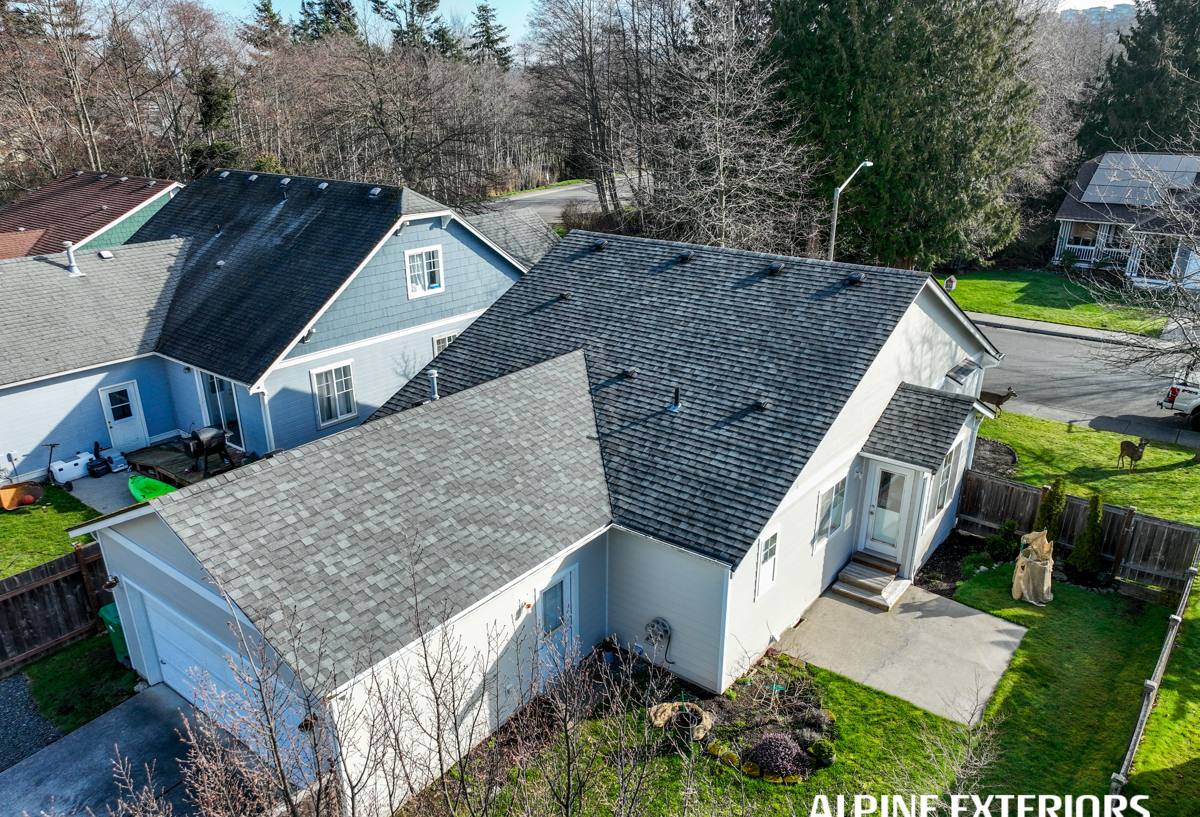
What Moss Season Actually Does to a Shingle Roof
Moss doesn't just sit on top of a shingle roof looking bad. It changes how the roof behaves. In Bellingham's damp, shaded conditions, moss and algae take hold fastest on north-facing slopes, under overhanging branches, and anywhere shade keeps a roof from drying out between rain events.
How Moss Actually Damages Shingles
Moss roots work their way under shingle edges and tabs, gradually lifting them. Once a shingle edge is lifted even slightly, wind-driven rain — common during Whatcom County storms — gets pushed underneath it instead of running off the surface. Over time, that trapped moisture breaks down the granules that protect the shingle from UV and weather, and it keeps the decking underneath damp far longer than it should ever stay wet.
Why Scraping Moss Off Isn't a Fix
A lot of homeowners try to handle moss themselves with a broom, a pressure washer, or a store-bought spray. Pressure washing in particular can strip the protective granules right off the shingle, which does more long-term damage than the moss itself. Chemical treatments can help slow regrowth, but they don't repair shingles that have already lifted or granules that have already washed away. If a roof already has significant moss coverage, it needs an inspection to find out whether the shingles underneath are still sound — not just a cleaning.
Choosing the Right Shingle for This Climate
Not every asphalt shingle is built the same, and the difference matters more here than in a drier climate. We look at wind rating, algae resistance, and how the shingle is designed to shed water on lower-slope sections, which are common on ranch-style and mid-century homes throughout the Bellingham area.
| Shingle Type | Typical Lifespan | Best Fit For |
|---|---|---|
| 3-Tab (Standard) | 15–20 years | Budget-conscious re-roofs on simple rooflines with good sun exposure |
| Architectural / Dimensional | 25–30 years | Most Silver Beach homes — better wind rating, thicker profile, stronger algae resistance |
| Premium / Designer | 30+ years | Steeper, more visible rooflines where appearance and maximum durability both matter |
For most homes in this area, we recommend architectural shingles with a algae-resistant (AR) rating as the practical baseline. The upgrade cost over standard 3-tab shingles is modest relative to the added years of service and the better resistance to the moss and algae growth this climate encourages.
What a Correct Asphalt Shingle Job Actually Includes
A shingle roof is only as good as everything installed underneath it. In a climate this wet, the underlayment, flashing, and ventilation matter as much as the shingle brand printed on the wrapper.
- Full tear-off and inspection of the decking — not a layover on top of old shingles
- Replacement of any damp, soft, or delaminated decking found underneath
- Ice-and-water shield membrane at eaves, valleys, and around penetrations, not just building paper
- Properly lapped synthetic underlayment across the full roof, not just the visible field
- New flashing at every chimney, skylight, and wall intersection — reused flashing is a common source of hidden leaks
- Balanced intake and exhaust ventilation so the attic can actually dry out between storms
- Manufacturer-specified nailing pattern and fastener count, matched to the local wind exposure
- Drip edge at eaves and rakes to direct water away from the fascia and siding
Skipping any one of these doesn't always show up right away. It shows up two, five, or eight years later as a leak, a soft spot in the decking, or shingles that fail well ahead of their rated lifespan — and by then the fix is more expensive than it would have been to do correctly the first time.
Our Process, Start to Finish
- On-site inspection. We get on the roof, not just the ladder, and check decking condition, ventilation, flashing, and moss/moisture damage before quoting anything.
- Honest scope and estimate. You get a clear breakdown of what's needed versus what's optional, in plain language, with no pressure to upgrade beyond what the roof actually needs.
- Scheduling around the weather. We plan tear-off days around forecasted dry windows whenever possible, since an open roof deck and Whatcom County rain don't mix.
- Tear-off and deck inspection. Old material comes off down to bare decking, which gets inspected and repaired before anything new goes down.
- Underlayment, flashing, and ventilation installed. This is the stage that determines how the roof performs in year ten, not just how it looks on day one.
- Shingle installation to manufacturer spec. Correct nailing pattern, exposure, and fastener count for the wind exposure at your specific lot.
- Cleanup and magnetic sweep. Debris, old material, and stray nails are cleared from the yard, driveway, and gutters before we consider the job finished.
- Final walkthrough. We go over the finished roof with you and answer any questions before closing out the job.
The Details Nobody Sees — But Everybody Eventually Notices
Ice-and-Water Shield Isn't Optional Here
Some parts of the country can get away with minimal eave protection. Whatcom County's driving rain, occasional wind-driven storms, and long wet stretches make self-adhering ice-and-water membrane at eaves and valleys a baseline requirement on any roof we build, not an upsell.
Ventilation Balance
An attic that can't breathe traps moisture, and trapped moisture rots decking and rusts fasteners from the inside out — problems you won't see until they're already serious. We check soffit intake and ridge or roof-vent exhaust together, since one without the other does very little good.
Flashing Around Penetrations
Chimneys, plumbing vents, and skylights are the most common leak points on any shingle roof, and reusing old flashing to save time is one of the most common shortcuts in the trade. We replace flashing as part of every re-roof rather than working around it.
Repair or Full Replacement? How We Help You Decide
Not every roof problem in Silver Beach needs a full tear-off. But a roof with widespread moss damage, multiple past patch jobs, or decking that's been wet for years is often past the point where a repair makes financial sense. We walk through the honest factors with you rather than defaulting to the most expensive option.
| Factor | Leans Toward Repair | Leans Toward Replacement |
|---|---|---|
| Roof age | Under 12–15 years | Approaching or past rated lifespan |
| Damage extent | Isolated area or single leak | Widespread moss, multiple leak points |
| Decking condition | Solid, no soft spots | Soft, delaminated, or previously wet |
| Shingle granule loss | Minor, localized | Widespread, bare patches visible |
| Past repair history | First repair needed | Third or fourth patch on the same roof |
Maintenance That Actually Extends a Roof's Life Here
Between installations, a few habits make a real difference in this climate:
- Keep overhanging branches trimmed back to reduce shade and debris buildup on the roof
- Clean gutters at least twice a year so water isn't backing up under the lowest shingle course
- Have moss treated or removed at the first sign of growth rather than waiting for full coverage
- Schedule a professional inspection after any significant windstorm, even if nothing looks obviously wrong from the ground
- Avoid pressure washing shingles yourself — leave moss and algae removal to methods that don't strip granules
Why It Matters to Hire a Crew That Already Works This Neighborhood
A roofing crew that regularly works Silver Beach and the surrounding Bellingham area already knows which slopes tend to hold moss, which rooflines see the worst wind-driven rain, and what decking condition to expect on homes of a given age in this part of Whatcom County. That familiarity shows up in fewer surprises during tear-off, more accurate estimates, and a finished roof that's actually built for the conditions it has to survive rather than a generic specification pulled from a manual written for a drier climate.
It also matters for something more basic: accountability. A local crew is easy to reach if a question comes up after the job, and has a reputation in the community worth protecting. That's a different relationship than a crew that drives in from out of the area for one job and doesn't come back.
Get a Straight Answer About Your Roof
If you're dealing with moss buildup, granule loss, a nagging leak, or a roof that's simply getting old, the first step is a straightforward, no-pressure look at what's actually going on. Use the form below to request a free estimate, and we'll give you an honest read on whether your roof needs a repair, a replacement, or just a bit of maintenance to get through the next few wet seasons.