 Bellingham Exterior
 Custom Windows Built for the Way Sudden Valley Actually Weathers
Sudden Valley sits in a pocket of Whatcom County that gets its own microclimate: wooded, hillside lots around Lake Whatcom, heavy tree cover, and a lot of shade that keeps siding and window frames damp long after the rest of Bellingham has dried out. Add in the driving rain that rolls through on winter storm systems and the salt-influenced marine air that moves inland off Bellingham Bay, and you've got a combination that's harder on exterior windows than most manufacturers' warranty language assumes. We've replaced and repaired windows on enough homes in this neighborhood to know which failure points show up here again and again, and we build our approach around them rather than treating Sudden Valley like any other job in town.
This page is about one job, done right, in one place: custom window replacement for Sudden Valley homes. Not a general product pitch — an honest look at what your windows are actually up against, what a correct installation involves, and what to expect if you call us.
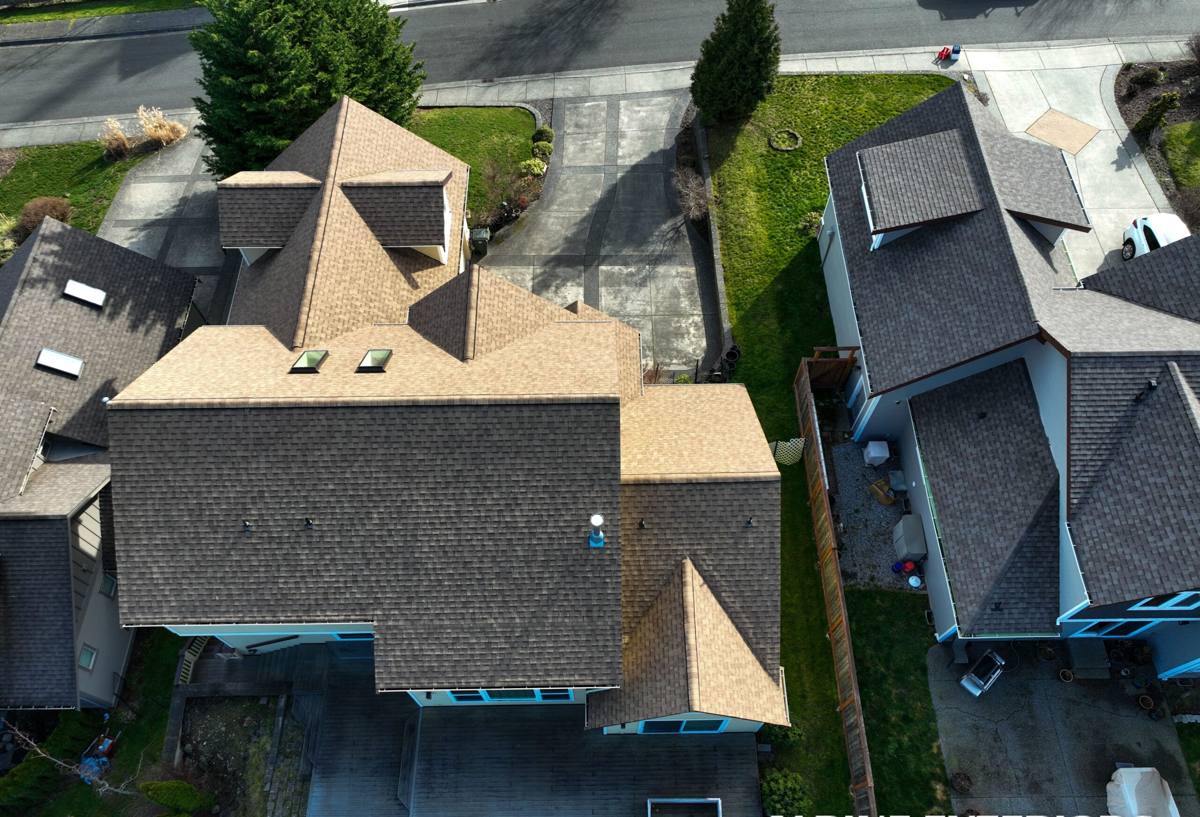
What This Climate Does to Windows Over Time
"Custom windows" doesn't just mean windows cut to fit an unusual opening. In a setting like Sudden Valley, it also means selecting materials and details that hold up to conditions a stock big-box window wasn't designed around.
Moss and Organic Growth
Deep tree cover means less direct sun and slower drying after every rain. Moss and algae find a foothold on horizontal window sills, trim, and anywhere water sits instead of running off. Left alone, that constant moisture works into seams, fastener holes, and old caulk lines, which is where rot and seal failure usually start — not from one bad storm, but from months of low-grade dampness that never fully dries.
Driving Rain and Wind-Driven Water
Storms coming off the water don't just fall straight down here; wind pushes rain sideways into wall assemblies and window openings. A window that's watertight in calm conditions can still leak under wind-driven rain if the flashing and sealant details around it weren't done correctly. This is one of the most common reasons we get called out to a house with a window that's "only a few years old" and already showing water staining below the sill.
Shade, Humidity, and Condensation
Wooded lots trap humidity near the house. Combined with temperature swings between a cold Whatcom County morning and a heated interior, that humidity shows up as condensation on glass and, over time, inside the sash or between panes if the seal has started to fail. Persistent condensation is usually the first visible sign that a window's insulated glass unit is breaking down.
What "Custom" Should Mean on a Job Like This
On hillside and lake-view lots, window openings are rarely a simple, uniform size. We regularly deal with:
- Tall or oversized units built to capture a lake or forest view
- Upper-story windows with limited or difficult exterior access
- Openings that have settled slightly out of square on sloped or older foundations
- A mix of window styles and eras on additions or remodeled sections of the same house
- Homes where community design guidelines call for a particular look or finish
Custom, in practice, means every opening gets measured and treated on its own, the flashing and water management details get built for this climate specifically, and the finished window matches the character of the home instead of looking like a generic replacement dropped into an old opening.
Choosing the Right Window for a Wooded, Wet Site
Frame Material
Frame material matters more here than in a drier, sunnier part of the state, because the frame spends more of its life damp. There's no single "right" answer for every home — it depends on your budget, your home's style, and how much upkeep you want to take on.
| Frame Material | Moisture Performance | Maintenance | Typical Cost Position |
|---|---|---|---|
| Vinyl | Won't rot; handles constant damp well | Low — occasional cleaning | Most affordable |
| Fiberglass | Very stable in wet, shaded conditions; minimal expansion/contraction | Low | Mid to upper-mid |
| Wood-clad | Good if the exterior cladding and seals stay intact; interior wood needs protection from any leaks | Higher — exterior cladding and joints need periodic inspection | Higher |
| Aluminum | Durable but prone to condensation without a thermal break | Low | Varies |
We don't push one material as universally best. We'll tell you honestly where each one is more or less forgiving in a shaded, damp setting like Sudden Valley, including the maintenance commitment that comes with it.
Glass Package
For a lake-adjacent, tree-covered lot, we generally steer homeowners toward insulated dual-pane glass with a low-E coating and an argon or krypton gas fill, which helps control both heat loss and interior condensation. Triple-pane is worth discussing for north-facing or particularly exposed openings, but it isn't automatically the right call for every window — sightlines, weight on the frame, and budget all factor in, and we'll walk through the real trade-offs rather than defaulting to the most expensive option.
How We Approach a Sudden Valley Window Job
- On-site assessment. We look at every opening individually — sun exposure, tree cover, current water staining, and how the existing flashing was done.
- Precise measurement. Custom means custom; we measure each opening rather than assuming uniformity across the house.
- Careful removal. We check the framing and sheathing behind the old window for hidden rot or moisture damage before anything new goes in — a step that's easy to skip and expensive to skip on a home that's had years of damp exposure.
- Correct flashing and water management. This is the single most important step for this climate. Proper sill pan flashing, house wrap integration, and drip caps matter more here than in a drier region, because the margin for error under driving rain is smaller.
- Installation and sealing. The window goes in level, plumb, and square, with sealant details built for wind-driven rain, not just a bead of caulk around the trim.
- Cleanup and walkthrough. We show you what was done and why, including anything we found behind the old window that's worth knowing about.
A correct installation should check every one of these boxes:
- Sheathing and framing inspected for hidden moisture damage before the new window is set
- Sill pan flashing installed, not just caulk relied on as the primary water barrier
- House wrap or building paper properly integrated with the window flange, shingle-style, so water sheds outward
- Window shimmed and fastened so it's level, plumb, and square — not just wedged to fit
- Interior and exterior sealed with materials rated for sustained damp exposure
- Drainage path confirmed at the sill so any incidental moisture has somewhere to go
What Affects the Cost
Every Sudden Valley job is different, but the same handful of factors drive most of the price difference between one house and the next.
| Factor | Why It Matters Here |
|---|---|
| Number and size of openings | Larger view windows and multiple openings add material and labor |
| Access and terrain | Steep or wooded lots can require ladders, staging, or extra care getting equipment to the house |
| Condition behind the old window | Hidden rot or moisture damage found during removal adds repair scope before the new window goes in |
| Frame material chosen | Vinyl, fiberglass, and wood-clad carry different material costs and finish work |
| Trim and finish matching | Matching existing trim profiles or community design standards can add carpentry time |
We'll walk your home with you and give you real numbers for your specific windows rather than a generic per-window estimate that doesn't account for what's actually going on with your house.
Maintaining Custom Windows in a Moss-Prone, Rain-Heavy Setting
Even a well-installed window benefits from a little seasonal attention in this environment:
- Clear debris, needles, and moss off sills and tracks a couple of times a year, especially on shaded sides of the house
- Check exterior caulk lines annually for cracking or separation, particularly after a hard winter
- Keep gutters and downspouts clear so water isn't sheeting down the wall near window openings
- Watch for interior condensation that lingers rather than clearing — it can signal a ventilation issue or an early seal problem worth checking
- Trim back vegetation that keeps a window in constant shade and moisture if it's practical to do so
Why Local Experience in Sudden Valley Matters
A window installer who mostly works dry, sunny, in-town lots doesn't necessarily think about sill pan flashing or wind-driven rain the same way a crew that works this neighborhood regularly does. We know which sides of a Sudden Valley home tend to take the worst weather, how tree cover changes the maintenance conversation, and how to work around hillside access without cutting corners on the installation itself. Some homes here also fall under community design expectations, and we're used to working within those rather than treating it as an afterthought.
If you're dealing with drafty, foggy, or water-stained windows — or you're planning ahead before a small problem becomes a bigger one — we're happy to take a look and talk through what your home actually needs. There's a free, no-pressure estimate form below whenever you're ready.