 Bellingham Exterior
 Roofing in Sudden Valley Comes With Its Own Set of Problems
Sudden Valley sits along Lake Whatcom, tucked into heavy tree cover southeast of Bellingham, and that setting shapes what a roof has to survive. The forest canopy that makes the neighborhood shaded and quiet also holds moisture against roof surfaces long after a storm has passed. The lake adds its own humidity to the mix. And even though the community sits back from open water, the damp, salt-tinged marine air that moves through all of Whatcom County still reaches inland, working on exposed metal and fasteners year after year.
None of this means a Sudden Valley roof is doomed — it means the replacement has to be planned for these specific conditions rather than treated like a generic reroof. A roof built the same way you'd build one in a dry, open, sun-exposed part of the county will wear out faster here, and usually in predictable ways: moss first, then granule loss, then moisture finding its way into the deck.
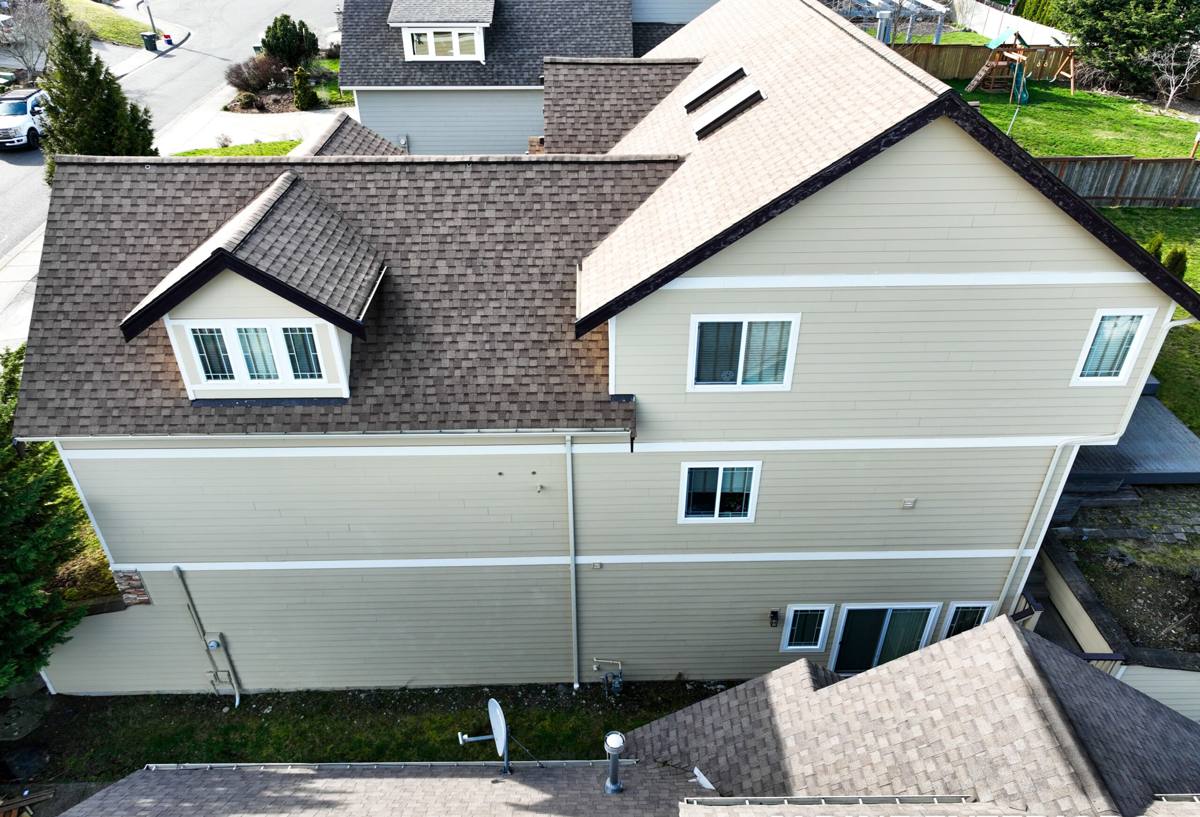
What the Local Climate Does to a Roof Over Time
Moss and Organic Growth
Shade is the single biggest factor working against roofs in Sudden Valley. Where sunlight can't reach a roof plane, moisture lingers, and moss, algae, and lichen get a foothold. Once established, moss holds water directly against the shingle surface, works into the granule layer, and over time lifts shingle edges enough for wind and rain to get underneath. In a fully exposed neighborhood this might be a once-a-decade nuisance. Under Sudden Valley's tree canopy, it's a recurring maintenance item for the life of the roof.
Driving Rain and Wind-Driven Moisture
Bellingham and the rest of Whatcom County see long stretches of steady, wind-driven rain through fall and winter. That kind of weather doesn't just fall straight down — it pushes sideways under shingle tabs, into valleys, and around any flashing that isn't properly lapped. A roof that's fine in a light shower can still leak in a sustained wind-driven system if the underlayment, flashing, and shingle overlaps weren't installed with that specific weather pattern in mind.
Salt Air and Metal Fatigue
Whatcom County's proximity to Bellingham Bay and the broader Salish Sea means the regional air carries more salt than most homeowners assume, even well inland. Over years, that salt content accelerates corrosion on exposed nails, flashing, gutters, and any metal roofing components. It's a slow process, but it's part of why we spec corrosion-resistant fasteners and flashing as standard on local jobs rather than treating it as an upgrade.
Signs Your Sudden Valley Roof Has Reached the End of Its Life
Because moss and shade-driven moisture do their damage gradually, many homeowners don't realize how far along the deterioration is until they're dealing with an active leak. Here's what we look for during an inspection:
- Moss or algae covering more than a small patch of the roof, especially on north-facing or shaded slopes
- Shingles that look cupped, curled, or have lost noticeable granule coverage
- Soft spots or noticeable give when walking the roof deck
- Daylight visible through the attic or staining on attic sheathing and insulation
- Rust streaking or corrosion around flashing, vent boots, or metal valleys
- Granules collecting in gutters after ordinary rain, not just after a storm
- A roof that's 20+ years old and hasn't had a full tear-off, only patch repairs
Any one of these on its own might just mean a repair. Several together, especially on a roof that's already past its expected service life, usually mean replacement is the more honest recommendation.
What a Correct Roof Replacement Actually Involves
Tear-Off and Deck Inspection
We remove the existing roofing down to the deck rather than layering over it. That's the only way to actually see what's underneath — soft or rotted sheathing doesn't show up from the surface, and covering it up just hides a problem that will resurface as a sag or a leak later. Any damaged decking gets replaced before anything new goes down.
Underlayment and Moisture Protection
Given how much moisture this area deals with, we don't treat underlayment as an afterthought. Self-adhered ice-and-water membrane goes in eaves, valleys, and around penetrations — the spots most likely to see standing water or wind-driven rain — with synthetic underlayment across the rest of the deck for a durable, water-resistant base layer.
Ventilation
A roof that can't breathe traps moisture in the attic, which feeds rot from the inside and speeds up shingle failure from underneath. We check intake and exhaust ventilation as part of every replacement, since a lot of older Sudden Valley homes were built before current ventilation standards were common practice.
Flashing and Valleys
Flashing failure is one of the most common causes of leaks we find in this area, usually because it was reused from the old roof or installed with too little overlap. We install new flashing at every roof-to-wall intersection, chimney, skylight, and valley, sized and lapped for the sideways rain this area gets.
Material Installation
Shingles or panels go down to manufacturer specification for nailing pattern, exposure, and fastener count — not a faster, looser version of it. On a shaded lot, correct installation matters even more, since a sloppy install gives moss and moisture more places to gain a foothold early.
Choosing Roofing Materials for a Shaded, Damp Lot
There's no single "right" material for every Sudden Valley roof — it depends on how much shade the lot gets, the roof's pitch, and what the homeowner wants to spend on upkeep versus upfront cost. Here's how the common options compare under this area's specific conditions:
| Material | Moss Resistance | Typical Lifespan Here | Maintenance Burden | Relative Cost |
|---|---|---|---|---|
| Standard asphalt composition shingle | Low without treatment | 18-25 years | Periodic moss treatment and gutter clearing | Lowest |
| Algae-resistant (AR) shingle | Moderate | 20-28 years | Less frequent moss treatment | Low-Moderate |
| Metal roofing (standing seam or panel) | High | 40-50+ years | Occasional fastener and sealant checks | Highest upfront |
| Synthetic/composite shingle | Moderate-High | 30-40 years | Low, but installation quality matters more | Moderate-High |
Under heavy shade, we usually steer homeowners toward algae-resistant shingles at minimum, and often discuss metal or composite for roof planes that almost never see direct sun, since those areas are where standard shingles struggle most. The right call also depends on the home's structure, HOA considerations, and budget, which is exactly what an on-site look is for.
How Our Process Works
We keep the process straightforward and communicate at each stage rather than disappearing between the estimate and the install date:
- Inspection and estimate — we walk the roof and attic, document what we find, and give a written estimate with the reasoning behind our material recommendation, not just a number.
- Material selection — we go over the trade-offs in the table above based on your roof's actual shade and pitch conditions, not a generic pitch.
- Scheduling — we schedule around Whatcom County's weather windows rather than forcing a tear-off into a forecasted storm system.
- Tear-off day — full removal to the deck, deck repair as needed, and same-day dry-in so the home isn't left exposed overnight.
- Installation — underlayment, flashing, ventilation, and roofing material installed to spec, with daily cleanup so the property stays livable through the job.
- Final walkthrough — we go over the completed roof with you before calling the job done, and register any manufacturer warranty that applies.
Why Local Experience in Sudden Valley Matters
Sudden Valley isn't a typical open-neighborhood job site. Narrower private roads, tree-lined driveways, and HOA architectural guidelines are all things a crew needs to plan around before a truck ever shows up with materials. A contractor who already works in the community knows how to stage a job without blocking a narrow road, understands that overhanging branches may need to be addressed before tear-off can safely happen, and isn't guessing at what an HOA review process might require for material or color approval.
There's also a practical knowledge factor that only comes from repeat work in a specific area: which roof orientations in this community hold moisture the longest, which lots need extra attention to ventilation because of surrounding tree density, and how the lake's microclimate affects drying time between rain systems. That's the kind of detail that doesn't show up in a generic estimate but does show up in how long the roof actually lasts.
After the Replacement: Keeping a New Roof Sound in This Climate
A correctly installed roof still needs some ongoing attention in a climate like this one. A little regular upkeep goes a long way toward getting the full lifespan out of the materials:
- Clean gutters at least twice a year, more often if the lot has heavy tree cover
- Have moss growth treated before it spreads, rather than waiting for a visible problem
- Trim back overhanging branches to reduce shade and debris buildup on the roof
- Check attic ventilation isn't blocked by insulation or debris after any attic work
- Schedule a roof check after any major windstorm to catch lifted shingles or flashing early
- Keep an eye on valleys and low-slope sections, where standing water and debris collect first
None of this replaces a properly built roof, but it's the difference between getting the full rated lifespan out of a roof and cutting it short because moss or trapped moisture went unaddressed.
If you're noticing moss, granule loss, or an aging roof on your Sudden Valley home, we're happy to come take a look and give you a straight assessment — no pressure, no upsell, just what we actually see and what it would take to fix it right. Use the form below to request a free estimate.